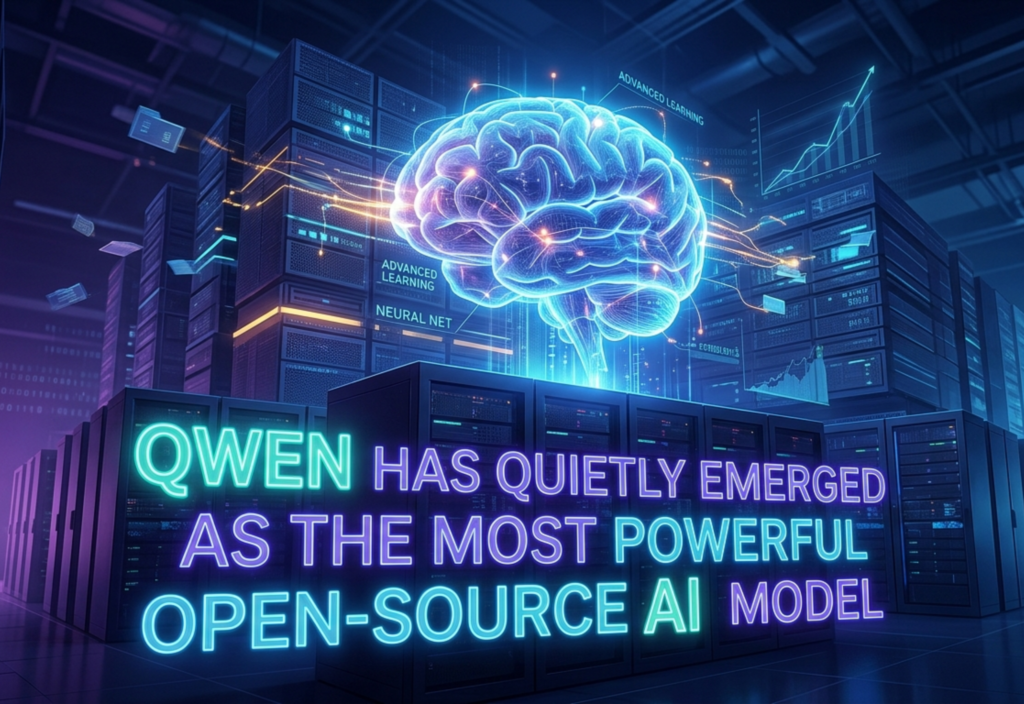
The Qwen AI model is rapidly emerging as one of the most powerful open-source artificial intelligence systems in 2026, gaining widespread attention due to its strong performance, advanced capabilities, and growing adoption among developers, researchers, and businesses worldwide.
Developed by Alibaba, Qwen has not relied on hype or aggressive marketing to gain recognition. Instead, its growth has been driven by real-world performance, developer adoption, and a rapidly expanding ecosystem. For many, it represents the next stage in the evolution of open AI—where power, accessibility, and flexibility meet.
Understanding Qwen: More Than Just a Language Model
Qwen, also known as Tongyi Qianwen, is not a single model but a family of AI systems designed to handle a wide range of tasks. These include:
- Natural language processing (NLP)
- Code generation and debugging
- Logical reasoning and problem-solving
- Multimodal understanding (text + images)
This versatility makes Qwen suitable for everything from simple chat applications to complex enterprise-level automation systems.
What sets Qwen apart is its open-weight approach. Unlike fully closed systems, developers can access model weights, run them locally, and fine-tune them according to their specific needs. This level of control is becoming increasingly valuable in a world where data privacy and customization are critical.
The Rise of Open-Source AI
To understand Qwen’s importance, it’s essential to look at the broader trend it represents. Open-source AI has gained momentum as developers seek alternatives to proprietary systems like GPT-4 and Claude.
While these closed models are powerful, they come with limitations:
- Restricted access to inner workings
- Dependence on external APIs
- Limited customization
- Ongoing usage costs
Qwen challenges this model by offering a more transparent and flexible alternative, allowing developers to innovate without constraints.
Performance That Rivals the Best
One of the key reasons behind Qwen’s rapid adoption is its impressive performance. Across benchmarks and practical use cases, Qwen consistently demonstrates:
- Strong reasoning capabilities
- High-quality text generation
- Accurate code outputs
- Robust multilingual understanding
In many scenarios, Qwen performs at a level comparable to top-tier proprietary models. This is a significant achievement for an open-source system and signals a shift in the balance of power within the AI industry.
Multimodal Capabilities: A Major Leap Forward
Modern AI is no longer limited to text, and Qwen reflects this shift. Its multimodal capabilities allow it to:
- Analyze and interpret images
- Combine visual and textual information
- Perform context-aware reasoning across different data types
This opens the door to advanced applications such as:
- Document analysis and extraction
- Visual assistants
- Smart surveillance systems
- Interactive educational tools
By integrating multiple forms of data, Qwen moves closer to human-like understanding, making it more useful in real-world scenarios.
A Developer-First Ecosystem
Another reason for Qwen’s success is its strong appeal to developers. The model is designed with usability in mind, offering:
- Compatibility with popular AI frameworks
- Easy integration into existing workflows
- Support for APIs and local deployment
- Active community contributions
This developer-friendly approach has helped Qwen build a loyal user base. Whether you are an individual programmer or part of a large engineering team, Qwen provides the tools needed to experiment, build, and scale.
Comparing Qwen with Other Open Models
Qwen is often compared with other open-source AI models such as LLaMA and Mistral.
While all three are powerful, Qwen stands out in several areas:
- Multimodal Strength: More advanced image and text integration
- Ease of Use: Simpler deployment and customization
- Balanced Performance: Strong across multiple domains rather than excelling in just one
This balance makes Qwen a versatile choice for a wide range of applications.
Real-World Applications
Qwen is not just a research model—it is actively being used across industries.
1. Business Automation
Organizations are using Qwen to automate repetitive tasks such as customer support, data processing, and internal communication. This reduces operational costs and increases efficiency.
2. Software Development
Developers rely on Qwen for:
- Writing and optimizing code
- Debugging errors
- Generating documentation
This accelerates development cycles and improves productivity.
3. Content Creation
Writers and marketers use Qwen to:
- Generate blog posts and articles
- Optimize content for SEO
- Create social media campaigns
Its ability to produce coherent and engaging text makes it a valuable creative tool.
4. Education and Research
Students and researchers benefit from Qwen’s ability to:
- Explain complex concepts
- Assist with research tasks
- Provide structured learning support
This enhances both teaching and learning experiences.
Challenges and Limitations
Despite its strengths, Qwen is not without challenges.
- Hardware Requirements: Larger models require powerful GPUs or cloud infrastructure
- Maintenance Effort: Self-hosting demands technical expertise
- Potential Misuse: Like all open AI systems, there is a risk of unethical applications
However, these challenges are not unique to Qwen—they are part of the broader open-source AI landscape.
The Future of Qwen
Qwen’s trajectory suggests that it will continue to play a major role in shaping the future of AI. As the ecosystem evolves, we can expect:
- More advanced model versions
- Improved reasoning and autonomy
- Better efficiency and lower resource requirements
- Wider enterprise adoption
The growing demand for transparent, customizable AI solutions positions Qwen as a key player in the years ahead.
Final Thoughts
Qwen’s rise is a clear signal that open-source AI is no longer a secondary option—it is becoming a primary force in the industry. By combining high performance with flexibility and accessibility, Qwen empowers developers and organizations to build powerful AI systems on their own terms.
In a world increasingly shaped by artificial intelligence, tools like Qwen are not just innovations—they are enablers of a more open, collaborative, and inclusive technological future.