Claude AI software engineering is transforming how developers build, test, and optimize modern applications. The rise of advanced AI systems like Claude is changing traditional development workflows and introducing new ways of writing and understanding code.
This shift is not just technical—it’s philosophical. It challenges long-held assumptions about coding, problem-solving, and the role of a software engineer. What once felt like a deterministic, human-dominated process is rapidly becoming a collaborative ecosystem between humans and intelligent machines.
Rethinking What “Writing Code” Means
For decades, software engineering has been defined by writing code line by line. Developers translate business requirements into logical instructions that machines can execute.
However, the emergence of advanced AI systems changes this definition significantly. Instead of strictly writing code, developers increasingly:
- Describe problems in natural language
- Rely on AI to generate initial implementations
- Refine and validate outputs
- Iterate through conversational feedback loops
This transforms coding from a manual process into a guided, iterative interaction.
The “code” itself becomes less of a final product written entirely by humans and more of a result of collaboration between human intent and machine intelligence.
The Rise of Intent-Driven Development
One of the most profound insights from AI systems like Claude is the shift toward intent-driven development.
Instead of focusing on syntax and low-level implementation details, developers focus on:
- What the system should achieve
- Constraints and requirements
- Expected behavior
- Edge cases and performance considerations
The AI then translates that intent into working code.
This approach reduces friction between idea and implementation. Developers no longer need to manually handle every detail; instead, they guide the system toward a solution.
This doesn’t eliminate the need for technical knowledge—it repositions it. Understanding architecture, trade-offs, and correctness becomes even more important than memorizing syntax.
Abstraction Layers Are Becoming Smarter
Software engineering has always relied on abstraction layers—from machine code to high-level languages, frameworks, and APIs. AI introduces yet another abstraction layer that sits on top of all of these.
In traditional systems:
- Developers interact with frameworks directly
- They manage dependencies manually
- They write repetitive boilerplate code
In AI-assisted systems:
- AI handles repetitive patterns
- It suggests architecture and structure
- It generates scaffolding automatically
- It can even refactor or optimize existing code
This means developers are now operating at a higher level of abstraction, focusing more on system-level thinking rather than implementation details.
From Static Instructions to Dynamic Reasoning
Traditional programs follow static instructions written by developers. AI systems like Claude, however, exhibit a form of dynamic reasoning.
Instead of executing fixed logic, these systems:
- Interpret context
- Adapt responses based on input
- Generate solutions on the fly
- Handle ambiguity more gracefully
This fundamentally changes how software behaves. It becomes less about rigid flows and more about flexible reasoning.
For developers, this means designing systems that:
- Incorporate AI components
- Handle probabilistic outputs
- Account for non-deterministic behavior
- Include validation layers to ensure reliability
The Developer’s Role Is Evolving
Perhaps the most important realization is that the role of a software engineer is not disappearing—it is evolving.
Modern developers are becoming:
1. System Designers
They focus on architecture, scalability, and integration rather than just writing functions.
2. AI Collaborators
They interact with AI tools as partners, guiding them to produce useful outputs.
3. Quality Controllers
They validate, test, and ensure that AI-generated code meets requirements and standards.
4. Problem Framers
They define problems clearly so that AI systems can interpret and solve them effectively.
This shift requires a different mindset—one that emphasizes clarity, abstraction, and critical thinking over manual implementation.
Productivity vs Understanding
AI dramatically increases productivity, but it also introduces an important trade-off: reliance versus understanding.
On one hand:
- Developers can build faster
- Prototypes can be created quickly
- Complex systems can be assembled with less effort
On the other hand:
- There is a risk of shallow understanding
- Debugging AI-generated code can be challenging
- Developers may depend too heavily on AI suggestions
To navigate this, developers must maintain a balance:
- Use AI as an accelerator, not a replacement for thinking
- Understand the underlying principles behind generated code
- Continuously learn fundamentals alongside AI tools
Debugging in an AI-Assisted World
Debugging AI-generated code introduces new complexities.
Instead of tracing human-written logic step by step, developers may need to:
- Analyze AI reasoning patterns
- Identify inconsistencies in generated outputs
- Validate assumptions made by the AI
- Re-prompt or refine instructions to correct behavior
Debugging becomes less about finding syntax errors and more about understanding intent mismatches between the developer and the AI.
This requires strong analytical skills and the ability to interpret both code and context.
Prompting as a Core Engineering Skill
In an AI-driven workflow, prompting becomes a critical skill. Writing effective prompts is similar to writing good specifications.
A well-crafted prompt should:
- Clearly define the problem
- Include constraints and expectations
- Provide context and examples when needed
- Guide the AI toward a desired structure
Poor prompts lead to vague or incorrect outputs, while precise prompts produce high-quality results.
This is why many developers now treat prompting as part of software design rather than just interaction.
System Design Becomes More Important Than Ever
As AI handles more of the implementation details, system design becomes the core differentiator.
Engineers must think about:
- How components interact
- Where AI fits into the architecture
- How data flows through the system
- How to ensure reliability and scalability
- How to handle failures gracefully
AI can generate pieces of the system, but humans are still responsible for ensuring the system works as a cohesive whole.
Risks and Limitations of AI-Generated Code
Despite its advantages, AI-assisted development has limitations:
- Hallucinations: AI may generate incorrect or non-functional code
- Inconsistency: Outputs may vary across prompts
- Security concerns: Generated code may introduce vulnerabilities
- Lack of domain specificity: AI may not fully understand niche requirements
- Maintenance challenges: Long-term maintainability still requires human oversight
These risks highlight the importance of human review and testing in any AI-assisted workflow.
The Future of Software Engineering
Looking ahead, software engineering is likely to evolve into a hybrid discipline where:
- Humans define goals, constraints, and architecture
- AI systems handle implementation, optimization, and iteration
- Development becomes more conversational and interactive
- Teams rely on AI to accelerate every stage of the lifecycle
Instead of writing every line of code, engineers will focus on directing intelligent systems to produce reliable, scalable, and efficient solutions.
Final Reflection
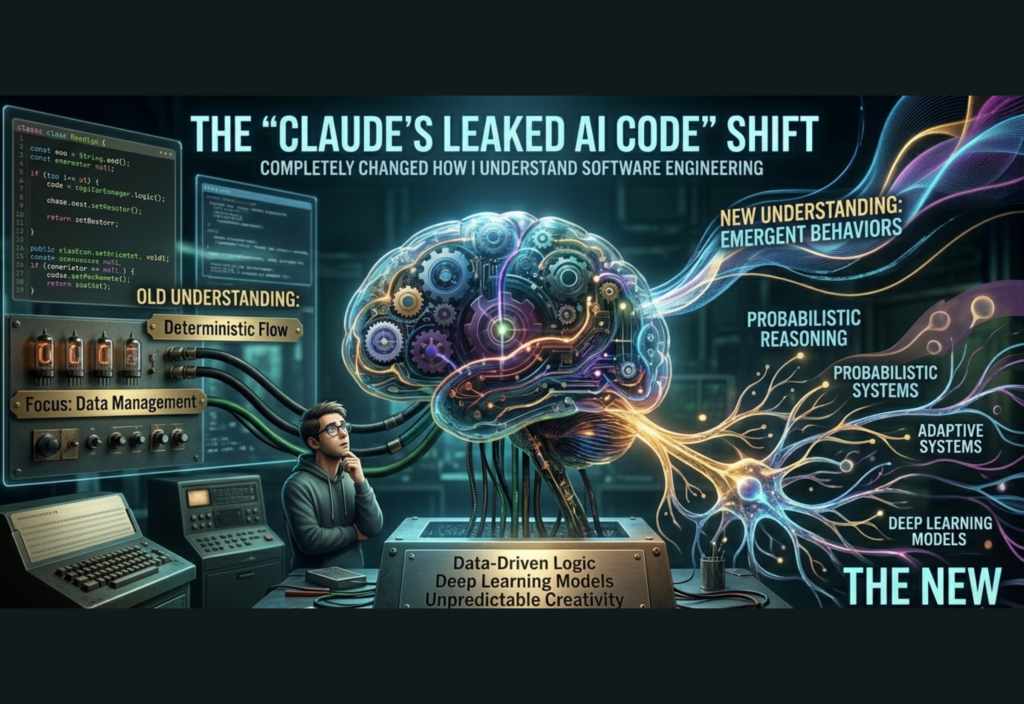
The idea behind Claude’s leaked AI code—whether factual or symbolic—serves as a powerful reminder of how quickly software engineering is evolving. It highlights a transition from manual coding to collaborative intelligence, from deterministic logic to adaptive reasoning, and from implementation-heavy work to intent-driven design.
For developers, the key takeaway is not fear of replacement, but adaptation. Those who embrace AI as a tool, learn how to guide it effectively, and strengthen their foundational understanding will find themselves far more capable than before.
Software engineering is no longer just about writing code—it’s about shaping intelligent systems that can think, assist, and evolve alongside us.