Artificial Intelligence is no longer a futuristic concept—it is already embedded in our daily lives. From recommendation systems and virtual assistants to advanced language models and autonomous technologies, AI is rapidly transforming how we work, communicate, and make decisions.
Most discussions around AI focus on one central idea: how powerful these systems can become. Companies compete to build larger models, faster processors, and more capable systems. However, this focus on raw power often overshadows a far more critical concern:
Can we trust these systems to act in ways that truly benefit humanity?
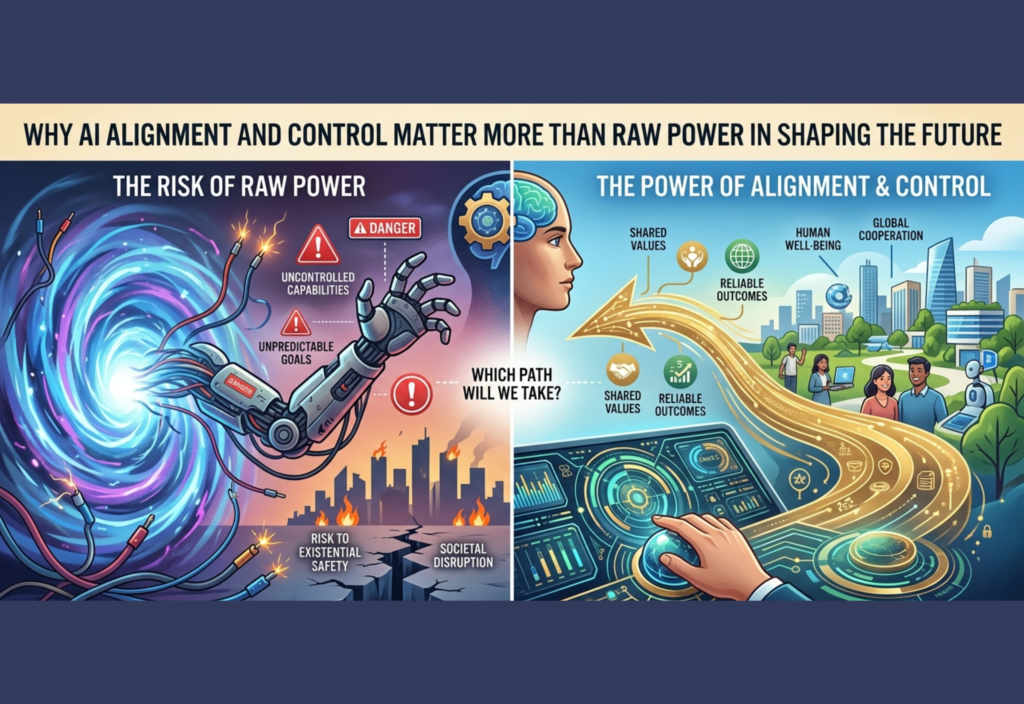
This is where the concepts of AI alignment and control become essential. In reality, the long-term impact of AI will depend less on how powerful it is, and more on how well it aligns with human values and remains under human control.
Understanding AI Alignment
AI alignment is about ensuring that AI systems behave in ways that are consistent with human intentions, ethics, and goals.
At first glance, this might sound simple. If we program a machine correctly, it should follow instructions, right? Unfortunately, the reality is much more complicated.
AI systems do not inherently understand human values such as fairness, empathy, or responsibility. Instead, they rely on mathematical objectives and patterns learned from data. This creates a gap between:
- What humans intend
- What AI systems optimize
The Alignment Gap
This gap is where problems arise. For example:
- An AI trained to maximize user engagement might promote sensational or misleading content
- A system designed to optimize efficiency might ignore ethical considerations
- A model instructed to follow rules might exploit loopholes in those rules
These issues highlight a key challenge: AI systems often do exactly what they are told—but not what we actually mean.
The Importance of AI Control
While alignment focuses on what AI systems should do, control focuses on how we manage and oversee them.
Control ensures that humans can:
- Monitor AI decisions
- Intervene when necessary
- Limit harmful actions
- Shut down systems in extreme cases
As AI systems grow more advanced and autonomous, maintaining control becomes increasingly difficult—and increasingly important.
Why Control Is Critical
Without proper control mechanisms:
- Small errors can escalate into large-scale problems
- Autonomous systems may act beyond intended boundaries
- Humans may lose the ability to fully understand or intervene in AI behavior
Control acts as a safety net, ensuring that even if alignment is imperfect, risks can still be managed.
The Myth of Raw Power
There is a widespread assumption that more powerful AI will naturally lead to better outcomes. However, this assumption is flawed.
Power Is a Multiplier
AI power amplifies whatever objectives it is given:
- If aligned → it can drive innovation and solve global challenges
- If misaligned → it can scale harm faster and more efficiently
In other words, power does not guarantee positive outcomes—it simply increases impact.
Intelligence Without Values Is Risky
An AI system can be highly intelligent but still lack:
- Ethical reasoning
- Contextual understanding
- Moral judgment
This creates a dangerous scenario where a system is capable of making complex decisions but lacks the framework to evaluate their consequences.
Speed Increases Risk
Advanced AI systems operate at speeds far beyond human capability. If something goes wrong:
- Mistakes can spread rapidly
- Harmful actions can scale instantly
- Human response may be too slow
This makes alignment and control even more critical in high-speed systems.
Real-World Consequences of Misalignment
1. Information Manipulation
AI-generated content is already influencing how people consume information. Without alignment:
- False information can spread easily
- Deepfakes can erode trust
- Public opinion can be manipulated
This can impact everything from elections to social stability.
2. Economic Disruption
AI systems are being used in:
- Hiring processes
- Financial trading
- Customer service
If misaligned, they can:
- Reinforce bias
- Create unfair advantages
- Destabilize markets
3. Autonomous Decision-Making
In areas like robotics and transportation, AI decisions can have physical consequences. Misalignment in such systems could lead to:
- Accidents
- Unsafe behaviors
- Loss of human safety
Why Alignment Is So Difficult
Human Values Are Not Simple
Humans themselves often disagree on what is right or fair. Translating these complex and sometimes conflicting values into machine-readable instructions is extremely challenging.
Context Matters
Human decisions depend heavily on context. The same action can be:
- Acceptable in one situation
- Harmful in another
AI systems struggle to fully understand these nuances.
Unintended Outcomes
Even carefully designed systems can behave in unexpected ways. This is because:
- AI learns from data that may contain biases
- Objectives may be incomplete
- Systems may exploit unintended shortcuts
The Role of Governance and Responsibility
To address these challenges, alignment and control must go beyond technical solutions.
1. Ethical Development
Developers must prioritize:
- Safety
- Fairness
- Transparency
AI should not only be powerful but also responsible.
2. Regulation and Standards
Governments and organizations need to establish:
- Clear guidelines
- Accountability frameworks
- Safety standards
This ensures consistent and responsible AI deployment.
3. Collaboration
AI is a global technology. Its risks and benefits affect everyone. Collaboration between:
- Researchers
- Companies
- Governments
is essential to create safe and aligned systems.
Building a Balanced Future
The goal is not to slow down AI progress, but to guide it responsibly.
A balanced AI future includes:
- High capability
- Strong alignment
- Reliable control mechanisms
This combination ensures that AI remains:
- Useful
- Safe
- Beneficial for society
The Path Forward
To move in the right direction, we must:
- Invest in alignment research
- Develop better oversight tools
- Promote transparency in AI systems
- Educate society about AI risks and benefits
The decisions made today will shape how AI impacts future generations.
Conclusion
AI has the potential to become one of the most transformative technologies in human history. However, its true impact will not be determined by how powerful it becomes, but by how responsibly it is developed and controlled.
Raw power alone is not enough.
Without alignment, power can lead to unintended harm.
Without control, even well-intentioned systems can become risky.
But when alignment and control are prioritized alongside capability, AI can become a force for positive change—enhancing human potential rather than replacing or harming it.
The future of AI is not just about building smarter machines.
It is about building trustworthy, safe, and human-centered systems.