
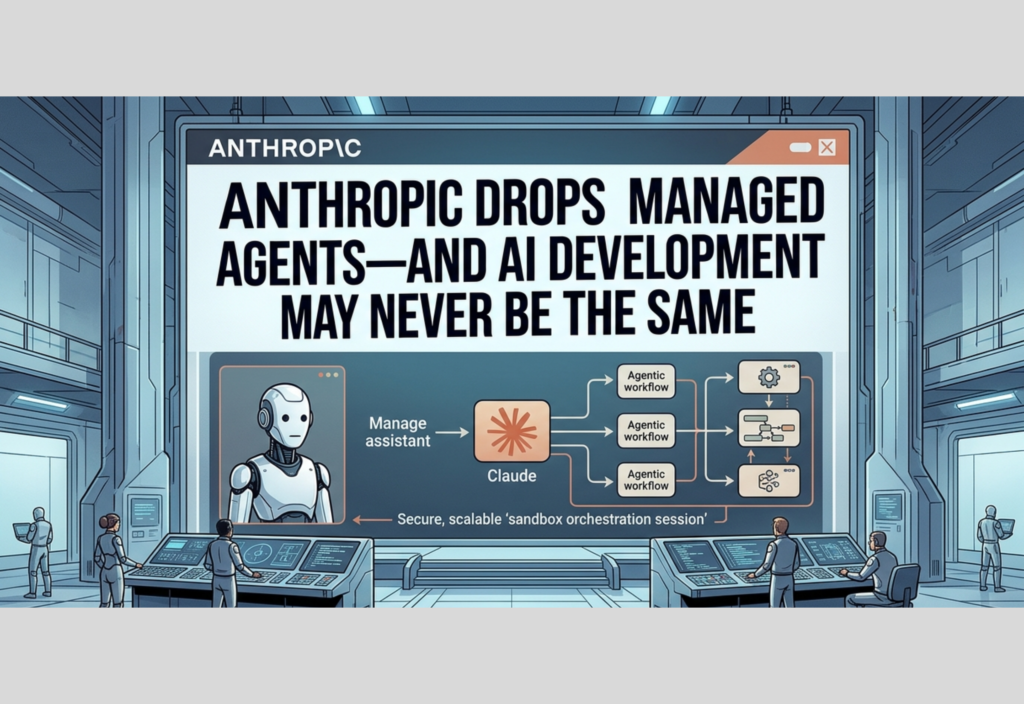
Artificial intelligence is no longer just about generating text, images, or code. The industry is moving toward something far more powerful: systems that can think, plan, and act independently. With the introduction of Managed Agents, Anthropic has taken a major step in that direction—one that could fundamentally reshape how AI applications are built and deployed.
This is not just another product update. It represents a shift from AI as a tool to AI as a self-operating system capable of handling complex workflows with minimal human involvement.
The Evolution of AI: From Tools to Agents
To understand why Managed Agents matter, it’s important to look at how AI development has evolved.
In the early days, AI models were primarily used for simple tasks—text completion, classification, or answering questions. Developers interacted with models through prompts, often crafting detailed instructions to get the desired output.
As use cases expanded, developers began building AI pipelines, combining multiple prompts, APIs, and tools into structured workflows. This led to the rise of agent-like systems—but these were often fragile, hard to maintain, and required constant tuning.
Managed Agents represent the next stage in this evolution:
fully integrated systems that handle planning, execution, and optimization internally.
What Are Managed Agents?
Managed Agents are AI systems that can:
- Break down complex tasks into smaller steps
- Decide which tools or actions are needed
- Execute tasks in sequence
- Adjust their approach based on results
- Maintain context across operations
Instead of developers manually orchestrating every step, the agent handles the logic.
Think of it like hiring a highly skilled assistant. You don’t tell them every tiny detail—you give them a goal, and they figure out how to achieve it.
Why Traditional AI Development Was a Bottleneck
Before Managed Agents, building intelligent AI systems required significant effort. Developers had to manually manage:
1. Prompt Engineering
Crafting and refining prompts to guide the model’s behavior was time-consuming and often inconsistent.
2. Workflow Orchestration
Complex tasks required chaining multiple steps together, which increased the risk of errors.
3. Tool Integration
Connecting AI systems to external tools like APIs, databases, or search engines added another layer of complexity.
4. Memory Management
Maintaining context across multiple interactions was difficult and often unreliable.
5. Error Handling
If something failed mid-process, developers had to build fallback mechanisms manually.
All of these challenges slowed down development and made scaling difficult.
How Managed Agents Solve These Problems
Managed Agents simplify AI development by abstracting away much of the complexity.
Built-in Planning and Reasoning
Instead of relying on static instructions, agents dynamically decide how to approach a task. They can adapt based on new information and changing conditions.
Seamless Tool Usage
Agents can automatically interact with tools—whether it’s retrieving data, running computations, or interacting with external services.
Persistent Memory
Managed Agents can maintain context over time, allowing for more consistent and intelligent behavior.
Reliability and Self-Correction
If a task fails, the agent can retry, adjust its strategy, or choose a different approach—without human intervention.
A Massive Productivity Boost for Developers
One of the biggest impacts of Managed Agents is the speed at which developers can build applications.
Faster Development Cycles
What once required days or weeks of engineering effort can now be achieved in hours. Developers can focus on defining goals rather than building infrastructure.
Lower Technical Barriers
Even developers with limited experience in AI can build powerful applications using Managed Agents.
Reduced Maintenance
Because the system handles much of the complexity, there is less code to maintain and fewer edge cases to manage.
Real-World Applications
The potential use cases for Managed Agents are vast and growing rapidly.
Intelligent Customer Support
Agents can handle customer queries from start to finish—understanding the problem, retrieving relevant information, and providing solutions.
Automated Research
AI agents can gather information from multiple sources, analyze it, and present structured insights.
Content Production Systems
From ideation to writing and editing, agents can manage entire content workflows.
Business Process Automation
Tasks like report generation, data analysis, and workflow management can be fully automated.
Personal Productivity Assistants
Individuals can use agents to manage schedules, summarize information, and complete daily tasks more efficiently.
The Shift Toward Autonomous AI Systems
Managed Agents are part of a broader trend: the move toward autonomous AI.
Instead of humans controlling every step, AI systems are increasingly capable of:
- Making decisions
- Executing tasks
- Learning from outcomes
- Improving over time
This does not eliminate the need for humans—it changes the role of humans from operators to supervisors and strategists.
Challenges and Risks
As powerful as Managed Agents are, they also introduce new challenges.
Control and Transparency
When systems operate autonomously, it becomes harder to understand how decisions are made.
Safety and Ethics
Ensuring that AI behaves responsibly and does not cause harm is critical.
Over-Reliance on Automation
Businesses must be careful not to depend entirely on AI without human oversight.
Security Concerns
Agents interacting with external systems must be properly secured to prevent misuse or data leaks.
What This Means for the Future
The introduction of Managed Agents signals a major shift in AI development.
In the coming years, we can expect:
- AI systems that require minimal coding
- Greater integration with real-world tools and platforms
- More reliable and efficient automation
- Increased adoption across industries
Eventually, building AI applications may feel less like programming and more like collaborating with intelligent systems.
A New Development Paradigm
Managed Agents redefine the role of developers.
Instead of writing detailed instructions, developers will:
- Define objectives
- Set constraints
- Monitor outcomes
- Optimize performance
This is a shift from coding logic to designing intelligent behavior.
Conclusion
Anthropic’s Managed Agents are more than just a new feature—they represent a turning point in the evolution of artificial intelligence.
By simplifying development, enabling autonomy, and improving efficiency, they are setting the stage for a new era of AI-powered applications.
The question is no longer whether AI can assist with tasks—it’s whether AI can take ownership of entire workflows.
And with Managed Agents, the answer is becoming increasingly clear.
AI development may never be the same again.