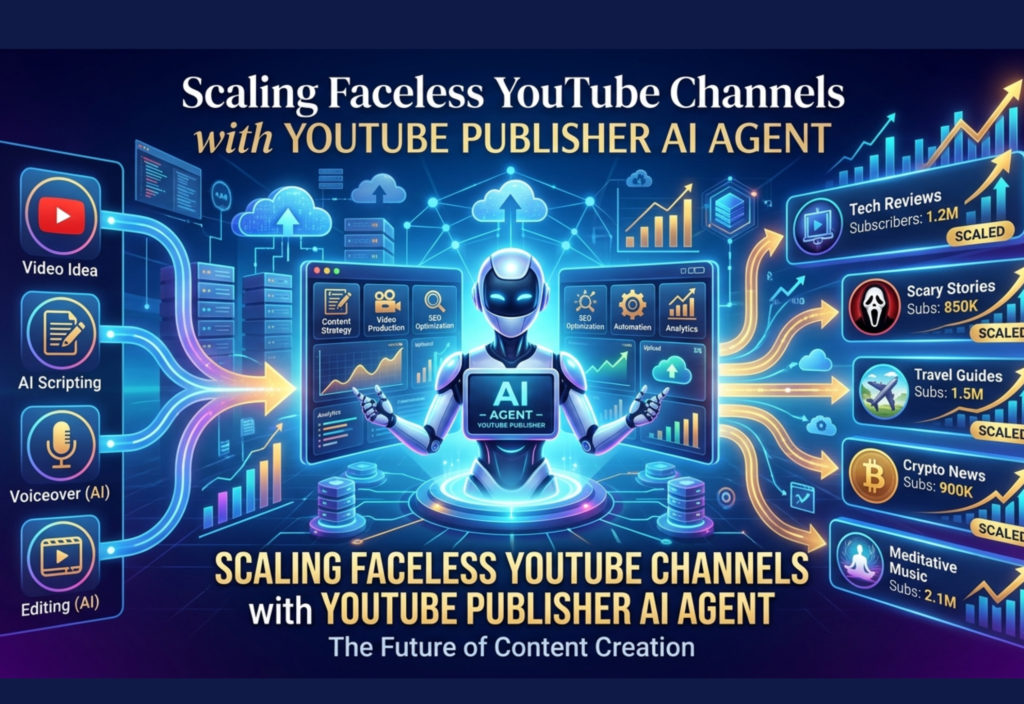
Faceless YouTube AI is transforming how creators build and scale faceless YouTube channels by enabling automation, intelligent content generation, and AI-powered workflows that streamline scripting, voiceovers, video production, and publishing while reducing manual effort and increasing efficiency.
This article provides an in-depth exploration of how faceless channels work, how AI agents are transforming content production, and how you can build a scalable, efficient, and future-ready YouTube system.
The Evolution of Faceless YouTube Channels
In the early days of YouTube, personal branding and on-camera presence were considered essential. However, the platform has matured, and content quality now outweighs personality in many niches.
Faceless channels emerged as a result of this shift. Instead of relying on a single individual’s identity, these channels focus on delivering value through:
- Information-rich scripts
- Engaging narration
- Visual storytelling
- Data-driven topics
Over time, creators discovered that faceless channels offer several advantages:
- Lower production barriers
- Reduced time commitment per video
- Ability to outsource or automate tasks
- Easier scaling across multiple channels
Today, many successful channels operate entirely without revealing the creator’s identity.
Why Faceless Channels Are Ideal for Automation
Faceless content is naturally suited for automation because it separates the creator from the output. This separation allows systems—not individuals—to handle production.
Key reasons automation works well:
1. Standardized Content Structure
Most faceless videos follow a predictable format:
- Hook
- Introduction
- Main points
- Conclusion
This structure can be replicated easily using AI.
2. Repeatable Workflows
Tasks like script writing, voiceover generation, and video editing follow consistent patterns that can be automated.
3. Minimal Dependency on Personal Presence
No need for filming setups, lighting, or physical appearance.
4. Scalable Production Model
Once a workflow is built, it can be reused to produce multiple videos across different topics or channels.
Understanding the YouTube Publisher AI Agent
A YouTube Publisher AI Agent is an intelligent system designed to manage the entire lifecycle of YouTube content creation with minimal human intervention.
It integrates multiple AI capabilities into a unified pipeline, including:
- Natural language processing for script writing
- Machine learning for topic selection
- Text-to-speech for voiceovers
- Automation tools for publishing
- Data analysis for performance tracking
Instead of manually handling each step, creators can rely on the AI agent to coordinate and execute tasks efficiently.
Core Components of an AI-Powered Content System
A fully functional AI-driven YouTube system typically includes several interconnected components.
1. Idea Generation Engine
This module identifies trending topics, keywords, and content gaps by analyzing:
- Search trends
- Audience behavior
- Competitor videos
- Seasonal demand
The goal is to consistently generate high-potential video ideas.
2. Script Generation Module
Once a topic is selected, the AI generates a structured script that includes:
- A strong opening hook to capture attention
- Clear explanations of key points
- Logical transitions between sections
- A compelling conclusion
Advanced systems can adapt tone, style, and complexity based on the target audience.
3. Voice Synthesis System
Text-to-speech technology converts scripts into voiceovers.
Modern AI voice systems can:
- Mimic human tone and emotion
- Adjust pacing and emphasis
- Offer multiple voice styles and accents
- Produce natural-sounding narration
This eliminates the need for manual recording.
4. Visual Content Engine
Visuals are crucial for engagement. AI can assist by:
- Matching stock footage with script segments
- Generating animations or overlays
- Synchronizing visuals with narration
- Adding background music and effects
In advanced setups, video creation can be partially automated from script to final output.
5. SEO Optimization Layer
To maximize reach, AI generates:
- Optimized titles with high click-through potential
- Keyword-rich descriptions
- Relevant tags
- Video chapters for navigation
- Thumbnail concepts
SEO plays a critical role in discoverability on YouTube.
6. Publishing Automation
The final stage involves uploading and scheduling videos.
An AI agent can:
- Upload videos automatically
- Schedule posts at optimal times
- Update metadata if needed
- Maintain consistent publishing frequency
Consistency is one of the most important factors for channel growth.
Step-by-Step Strategy to Scale a Faceless Channel
Scaling requires more than just automation—it requires a systemized approach.
Step 1: Choose a Profitable Niche
Focus on niches that have:
- High demand
- Evergreen content potential
- Monetization opportunities
Examples include:
- Finance
- Technology
- Education
- Motivation
- AI tools
Step 2: Build a Content Pipeline
Create a structured workflow such as:
Idea → Script → Voiceover → Visuals → Editing → SEO → Upload
This pipeline ensures consistency and efficiency.
Step 3: Batch Content Creation
Instead of producing videos one by one:
- Generate multiple scripts at once
- Create voiceovers in bulk
- Edit videos in batches
Batching significantly improves productivity and reduces context switching.
Step 4: Maintain Consistency
Consistency is more important than perfection. Regular uploads help:
- Build audience trust
- Improve algorithm visibility
- Increase watch time over time
AI agents help maintain this consistency without burnout.
Step 5: Optimize for Retention
YouTube prioritizes watch time and engagement. To improve retention:
- Start with strong hooks
- Keep pacing dynamic
- Avoid unnecessary filler
- Use storytelling techniques
Benefits of Using AI Agents for YouTube Growth
AI agents provide several advantages that make scaling easier:
- Speed: Faster content production cycles
- Efficiency: Reduced manual workload
- Scalability: Ability to manage multiple channels
- Cost Reduction: Less reliance on large teams
- Consistency: Reliable publishing schedules
- Automation: Minimal repetitive manual tasks
These benefits allow creators to focus on strategy rather than execution.
Challenges in AI-Driven Content Creation
Despite its advantages, AI-based content creation comes with challenges:
1. Quality Control
AI-generated content may require editing to ensure clarity, accuracy, and engagement.
2. Lack of Originality
Overuse of AI without human input can result in generic or repetitive content.
3. Platform Guidelines
YouTube has policies against low-effort or reused content. Channels must ensure originality and value.
4. Competition
As more creators adopt AI tools, standing out becomes more difficult.
Best Practices for Long-Term Success
To succeed with faceless channels and AI agents:
- Add human creativity to AI-generated outputs
- Focus on storytelling rather than just information
- Continuously analyze analytics (CTR, retention, watch time)
- Experiment with different formats and styles
- Improve thumbnails and titles regularly
- Build a recognizable content style or theme
The combination of automation and creativity is the key to sustainable growth.
Building Multiple Channels with AI
One of the biggest advantages of AI agents is the ability to manage multiple channels simultaneously.
Creators can:
- Repurpose content across niches
- Test different audiences
- Diversify income streams
- Reduce dependency on a single channel
With proper systems in place, one person can effectively run a network of channels.
The Future of Faceless Content Creation
The future of YouTube content is closely tied to AI advancements. We are moving toward a landscape where:
- Content creation becomes highly automated
- AI agents handle end-to-end workflows
- Personalized content is generated for viewers
- Real-time optimization improves performance
- Human creators act more as strategists than operators
In this environment, those who understand how to leverage AI systems will have a significant competitive advantage.
Conclusion
Faceless YouTube channels combined with YouTube Publisher AI Agents represent a major shift in how digital content is created, distributed, and scaled. This model removes traditional barriers such as time, technical skills, and production complexity.
By building an AI-powered workflow, creators can automate research, scripting, voiceovers, editing, and publishing—allowing them to focus on strategy, creativity, and growth.
As AI technology continues to evolve, the opportunities for scaling content will expand even further. Creators who adopt these systems early and integrate them effectively will be well-positioned to succeed in the future of content creation.