Artificial intelligence is evolving at an unprecedented pace, and AI Trends 2026 indicate a future where AI is not just reactive but proactive, autonomous, and deeply integrated into everyday life. From businesses automating complex workflows to smart devices understanding human behavior, AI is becoming a central part of our digital and physical ecosystems.
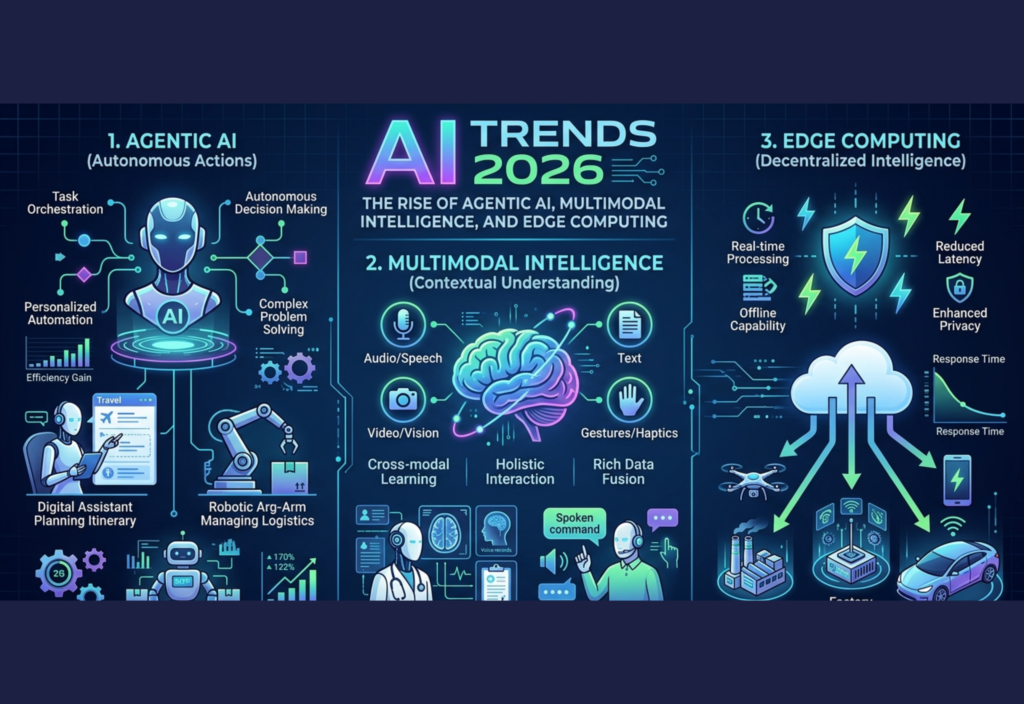
In 2026, AI is shifting from simple automation to agentic AI, systems capable of independent decision-making, multimodal intelligence, where machines process text, audio, images, and video together, and edge computing, bringing computation closer to the source of data. These trends are transforming industries, redefining how we work, live, and interact with technology.
AI Trends 2026: Understanding Agentic AI
Agentic AI is one of the most significant trends defining AI in 2026. Unlike traditional AI, which responds only to user commands, agentic AI can operate autonomously, set goals, and execute tasks without continuous human supervision.
Features of Agentic AI
- Autonomous Decision-Making: AI can choose the best course of action based on available data.
- Task Completion: Capable of completing entire workflows independently.
- Self-Learning: Continuously adapts to new information and feedback.
- Tool Integration: Can interact with software, APIs, and even physical devices.
Applications Across Industries
- Business Operations: Automating repetitive tasks in marketing, finance, and HR.
- Customer Support: AI handles customer queries from start to finish.
- Supply Chain Management: Real-time optimization and logistics planning.
- Creative Industries: AI generates content, designs, and marketing strategies autonomously.
Example: A company can instruct an agentic AI to “increase social media engagement this month,” and it will draft posts, schedule campaigns, analyze performance, and adjust strategies in real-time.
AI Trends 2026: Multimodal Intelligence
Another defining trend in AI Trends 2026 is multimodal AI, which allows machines to process multiple types of data simultaneously. Humans perceive the world through sight, sound, and language, and multimodal AI enables machines to mimic this capability.
Why Multimodal AI Matters
- Better Understanding: AI can understand context across different media formats.
- Richer Interaction: Systems can interpret text, images, audio, and video together.
- Enhanced Creativity: Generating content that combines multiple media formats.
Key Use Cases
- Healthcare: Diagnosing diseases using medical images combined with patient history and lab reports.
- Education: AI tutors provide lessons using visuals, text explanations, and voice guidance simultaneously.
- Content Creation: Generating videos, graphics, and written content in one workflow.
- Customer Support: Interpreting screenshots, voice messages, and text queries together.
Example Scenario: A student uploads a diagram, asks a question via voice, and the AI generates a step-by-step solution using images, annotations, and text—all in one response.
AI Trends 2026: Edge Computing
Edge computing is redefining AI in 2026 by moving computation closer to the data source. Instead of sending data to centralized cloud servers, AI can process it locally on devices like smartphones, IoT devices, or local servers.
Benefits of Edge AI
- Low Latency: Instant responses without cloud delays.
- Enhanced Privacy: Sensitive data stays on local devices.
- Bandwidth Efficiency: Reduces dependency on internet connectivity.
- Reliability: Systems continue functioning even with intermittent network access.
Applications
- Smart Homes: Devices react instantly without needing cloud servers.
- Autonomous Vehicles: AI makes real-time decisions critical for safety.
- Retail: Personalized customer experiences in-store.
- Healthcare: Wearables analyze health data and provide immediate insights.
Edge computing, combined with agentic AI and multimodal intelligence, creates systems that are faster, smarter, and more reliable than ever before.
AI Trends 2026: Convergence of Technologies
The true power of AI Trends 2026 lies in the integration of agentic AI, multimodal intelligence, and edge computing.
Imagine a smart device that:
- Understands spoken commands, images, and text simultaneously (multimodal intelligence)
- Executes complex tasks autonomously (agentic AI)
- Processes data locally for instant results (edge computing)
This convergence enables:
- Real-time problem-solving
- Fully automated workflows
- Highly personalized experiences
- Minimal human intervention without sacrificing control
Example: A smart city system that monitors traffic, predicts congestion, and automatically redirects vehicles while informing citizens in real-time.
Industry-Specific Impact of AI Trends 2026
1. Technology
Companies are building smarter software that can anticipate user needs and automate processes across multiple platforms.
2. Healthcare
AI-powered diagnostics, personalized treatment plans, and predictive health analytics are becoming standard.
3. Finance
Automated trading, fraud detection, and AI-driven customer service are transforming the banking landscape.
4. Education
Personalized learning powered by multimodal AI provides customized lesson plans, instant feedback, and adaptive tutoring.
5. E-commerce
Hyper-personalized shopping experiences based on AI insights improve engagement and sales.
Ethical Considerations and Challenges
As AI becomes more autonomous and intelligent, ethical considerations become increasingly important in AI Trends 2026:
- Privacy and Security: Especially with edge computing and multimodal AI.
- Bias Mitigation: Ensuring fair, inclusive, and unbiased AI decisions.
- Transparency: Users need to understand AI decision-making.
- Human Oversight: Autonomous systems must remain accountable.
Organizations are investing in responsible AI frameworks to balance innovation with ethics.
Future Outlook Beyond 2026
Looking forward, AI Trends 2026 are just the beginning. The next wave will bring:
- Fully autonomous AI ecosystems
- Human-like interactions with machines
- AI deeply integrated into everyday life
- Strong regulatory and ethical frameworks
The focus will remain on enhancing human potential, not replacing humans, creating systems that are both powerful and safe.
Conclusion
AI Trends 2026 are no longer theoretical—they are real, transformative, and actionable. With agentic AI, multimodal intelligence, and edge computing, industries and individuals are entering a new era of autonomous, intelligent, and context-aware systems.
Understanding these trends now is critical to staying competitive, innovative, and prepared for a future where AI is an active collaborator in every aspect of life.