
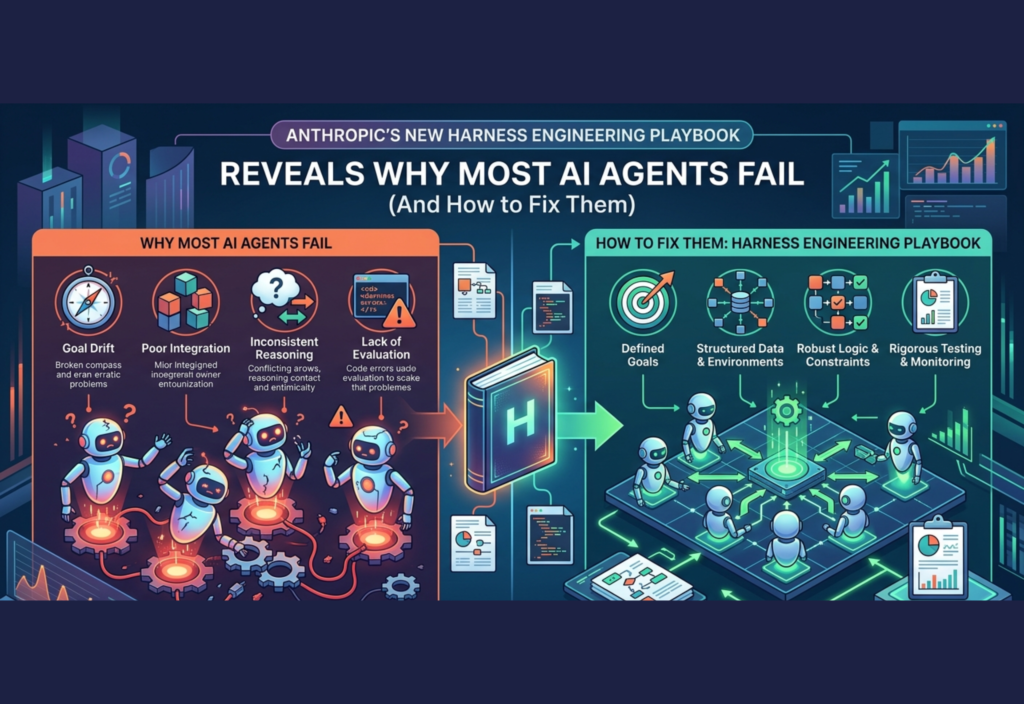
Anthropic Harness Engineering Playbook explains why most AI agents fail and how better system design can significantly improve their reliability, stability, and real-world performance. As AI systems evolve from simple chat interfaces into autonomous agents capable of planning and executing tasks, the gap between model capability and system design becomes more apparent. Many failures are not caused by the underlying model itself, but by how the model is orchestrated within a larger system.
In real-world applications, AI agents must interact with tools, maintain context, follow structured workflows, and handle unexpected situations. Without proper engineering around these components, even the most advanced models can produce inconsistent, irrelevant, or incorrect outputs. This is why a structured “harness” approach is essential—it provides the control layer that guides the model’s behavior and ensures predictable execution.
Why AI Agents Fail
One of the primary reasons AI agents fail is the lack of clearly defined objectives. When a task is too broad or ambiguous, the agent struggles to determine the correct path forward. Instead of focusing on meaningful steps, it may generate generic responses or drift away from the intended goal. Clear task definition and constraint setting are essential to guide the agent effectively.
Another key issue is poor task decomposition. Complex problems require breaking down into smaller, manageable steps. Many agents attempt to solve everything in a single pass, which leads to shallow reasoning and incomplete solutions. Without intermediate reasoning stages, the agent cannot properly evaluate progress or correct mistakes along the way.
Tool Integration Challenges
Modern AI agents rely heavily on external tools such as APIs, databases, search engines, and internal services. However, tool integration is often a weak point. If tool interfaces are not well-defined, the agent may misuse them or fail to interpret their outputs correctly.
For example, inconsistent input formats, unclear documentation, or unpredictable responses can confuse the agent. To avoid this, tools should be designed with strict schemas, standardized inputs and outputs, and reliable error-handling mechanisms. When tools behave predictably, the agent can interact with them more effectively and produce accurate results.
Planning and Reasoning Limitations
Planning is a critical component of any AI agent. Without proper planning, agents may jump directly to conclusions without considering intermediate steps. This results in incomplete reasoning and incorrect outputs.
Effective agents use iterative reasoning processes where they:
- Analyze the task
- Break it into sub-tasks
- Execute steps sequentially
- Evaluate intermediate results
This structured approach allows the agent to maintain coherence across multiple steps and adapt when errors occur. It also improves transparency, making it easier to debug and refine agent behavior.
Memory and Context Handling
Memory plays a vital role in multi-step tasks. AI agents often need to remember previous actions, decisions, and intermediate outputs to maintain continuity. However, many systems lack proper memory management, leading to context loss.
Without structured memory:
- Agents may repeat actions unnecessarily
- They may forget earlier constraints
- They may fail to connect related steps
To address this, developers can implement structured memory systems that store relevant information across steps. This can include short-term working memory for immediate context and long-term storage for persistent knowledge. Proper memory handling ensures that the agent builds upon prior knowledge rather than starting from scratch each time.
Autonomy and Control Trade-offs
Autonomy is a defining feature of AI agents, but excessive autonomy without constraints can lead to unpredictable behavior. Agents may enter loops, explore irrelevant paths, or make inefficient decisions if not properly guided.
The key is to balance autonomy with control. This can be achieved by:
- Limiting the number of execution steps
- Defining stopping conditions
- Adding validation checks
- Restricting actions within safe boundaries
These guardrails ensure that the agent operates efficiently while avoiding unnecessary or harmful behavior.
Harness Engineering Approach
The core idea behind the Anthropic Harness Engineering Playbook is that AI agents should not rely solely on model intelligence. Instead, they should be embedded within a structured system that guides their behavior.
This “harness” includes:
- Clear workflows
- Explicit tool interfaces
- Controlled execution loops
- State and memory management
- Validation and monitoring layers
By designing these components carefully, developers can transform a raw language model into a reliable and predictable agent capable of handling complex tasks.
Iterative Execution Loops
One of the most effective patterns in agent design is the iterative execution loop. Instead of producing a final answer in one step, the agent continuously cycles through:
- Observing the environment
- Reasoning about the next step
- Taking an action
- Evaluating the result
- Repeating the process
This loop allows the agent to refine its outputs over time, correct mistakes, and adapt to new information. It also makes the system more resilient to errors and unexpected scenarios.
Observability and Monitoring
To build reliable AI agents, observability is essential. Developers need visibility into how the agent makes decisions, which tools it uses, and where it fails.
Key practices include:
- Logging each action taken by the agent
- Tracking tool calls and responses
- Monitoring performance over time
- Analyzing failure cases for improvement
This data helps identify patterns, optimize workflows, and continuously improve system behavior.
Practical Strategies for Improvement
Improving AI agents involves applying several practical engineering strategies:
- Break complex tasks into smaller, modular components
- Use structured prompts with clear instructions
- Define strict tool interfaces with predictable behavior
- Implement iterative reasoning and execution loops
- Add validation layers to verify outputs
- Maintain structured memory for context retention
- Limit autonomy with guardrails and constraints
These strategies collectively enhance the reliability, accuracy, and scalability of AI agents.
Conclusion
The Anthropic Harness Engineering Playbook highlights a critical shift in how AI agents should be designed. Rather than focusing solely on improving model performance, greater emphasis must be placed on system architecture, orchestration, and control mechanisms.
AI agents fail not because they lack intelligence, but because they lack structure. By implementing a well-designed harness—complete with clear workflows, controlled execution, reliable tools, and proper memory management—developers can build agents that are consistent, scalable, and capable of performing complex real-world tasks effectively.