
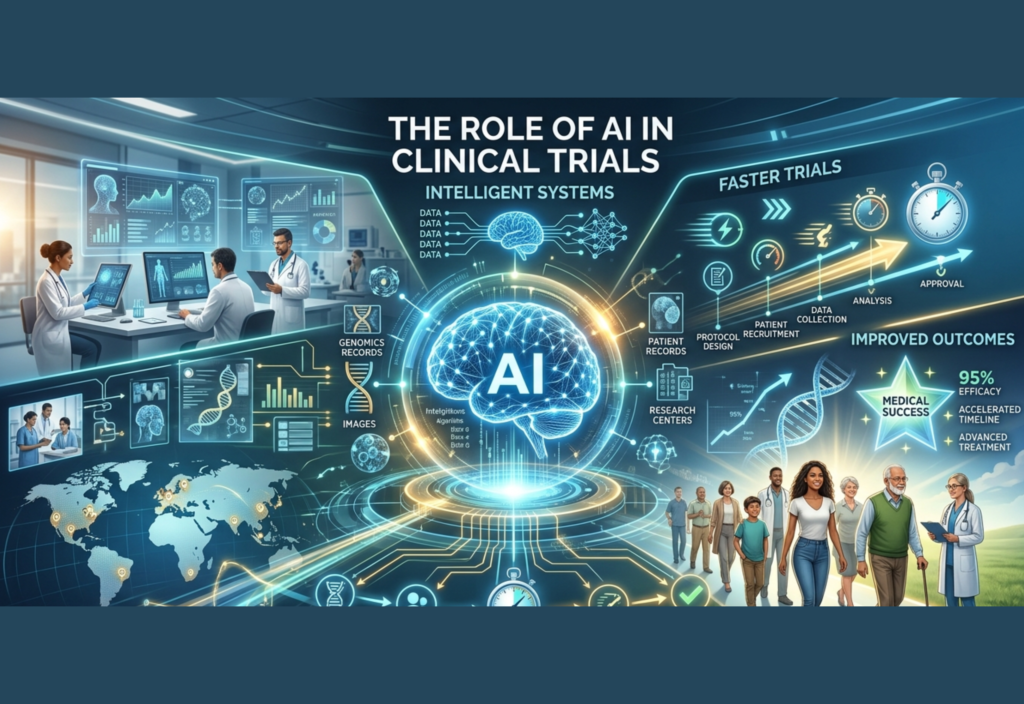
Artificial Intelligence (AI) is rapidly reshaping the healthcare industry, and one of its most impactful applications is in clinical trials. Clinical trials are essential for developing new medicines, therapies, and medical devices, but they have traditionally been slow, costly, and resource-intensive. The integration of AI is transforming these processes by introducing automation, advanced analytics, and intelligent decision-making systems. As a result, clinical trials are becoming faster, more efficient, and more patient-centered, ultimately accelerating the delivery of life-saving treatments.
This article explores how AI is revolutionizing clinical trials across multiple stages, from planning and patient recruitment to data analysis, monitoring, and regulatory compliance.
Introduction to Clinical Trials and Their Importance
Clinical trials are structured research studies conducted on human participants to evaluate the safety and effectiveness of medical interventions such as drugs, therapies, and procedures. These trials typically follow multiple phases and involve strict protocols to ensure accuracy and patient safety.
However, traditional clinical trials face several challenges, including long timelines, high operational costs, difficulty in patient recruitment, and complex data management. These challenges often delay the availability of new treatments to patients who need them most. AI offers powerful solutions to these problems by improving efficiency and enabling smarter, data-driven processes.
Key Challenges in Traditional Clinical Trials
Before understanding the role of AI, it is important to recognize the limitations of conventional methods:
- Slow recruitment processes: Identifying suitable participants based on strict eligibility criteria is time-consuming.
- High operational costs: Trials require significant financial and human resources.
- Complex data handling: Clinical trials generate large volumes of structured and unstructured data.
- Manual processes: Many steps rely on human intervention, increasing the chances of errors.
- Participant dropout: Maintaining engagement over long trial durations is difficult.
These issues highlight the need for more advanced, automated, and intelligent systems—where AI plays a crucial role.
AI in Patient Recruitment and Matching
One of the most critical stages of a clinical trial is recruiting the right participants. AI significantly improves this process through:
- Electronic health record (EHR) analysis: AI scans medical records to identify eligible candidates quickly.
- Machine learning algorithms: These models predict patient eligibility and likelihood of participation.
- Natural language processing (NLP): AI extracts meaningful insights from unstructured clinical notes, reports, and documents.
- Automated screening: AI reduces manual effort by filtering large datasets efficiently.
By improving accuracy and speed, AI helps researchers enroll the right participants faster, reducing delays in trial initiation.
Optimizing Clinical Trial Design with AI
Designing a clinical trial requires careful planning to ensure reliability and validity. AI enhances this stage by:
- Analyzing historical trial data to identify patterns and best practices
- Simulating trial outcomes to test different scenarios before implementation
- Enabling adaptive trial designs that allow modifications during the trial based on real-time data
- Identifying potential risks early in the process
These capabilities help researchers create more efficient and flexible trial designs, reducing the chances of failure and improving success rates.
AI in Data Collection and Real-Time Monitoring
Modern clinical trials generate massive amounts of data from various sources such as hospitals, wearable devices, mobile apps, and remote monitoring tools. AI improves data management through:
- Real-time data monitoring: Continuous tracking of patient health metrics
- Anomaly detection: Identifying unusual patterns that may indicate adverse events
- Remote monitoring systems: Allowing patients to participate from home
- Automated data validation: Ensuring consistency and accuracy in datasets
This approach not only improves data quality but also enhances patient safety and reduces the need for frequent in-person visits.
Advanced Data Analysis Using AI
Data analysis is one of the most important aspects of clinical trials. AI helps researchers process and interpret complex datasets more efficiently:
- Pattern recognition: AI identifies trends and correlations in large datasets
- Predictive analytics: Models forecast treatment outcomes and patient responses
- Subgroup analysis: AI evaluates how different populations respond to treatments
- Faster insights: Reduces the time required for statistical analysis
These capabilities enable researchers to make informed decisions quickly and with greater confidence.
Accelerating Drug Development Pipelines
AI is not limited to clinical trials alone—it also plays a major role in drug discovery and development:
- Target identification: AI analyzes biological data to identify potential drug targets
- Drug repurposing: Existing drugs are evaluated for new uses
- Molecular modeling: AI assists in designing new compounds with desired characteristics
- Predictive toxicity analysis: Helps assess potential side effects early
By streamlining these processes, AI significantly reduces the time and cost required to bring new drugs to market.
Enhancing Patient Experience and Engagement
Patient participation is a key factor in the success of clinical trials. AI improves the patient experience in several ways:
- Personalized communication: AI-powered systems provide tailored reminders and updates
- Chatbots and virtual assistants: Offer 24/7 support and guidance
- Remote participation: Patients can join trials without frequent hospital visits
- User-friendly platforms: Simplify data entry and feedback collection
Improved engagement leads to higher retention rates and more reliable trial results.
AI in Regulatory Compliance and Safety Monitoring
Clinical trials must adhere to strict regulatory guidelines to ensure patient safety and data integrity. AI assists in maintaining compliance through:
- Automated documentation and reporting
- Audit trail generation for transparency
- Adverse event detection and reporting
- Continuous compliance monitoring
These features help organizations meet regulatory standards while reducing administrative burden.
Ethical Considerations and Challenges
Despite its advantages, the adoption of AI in clinical trials comes with certain challenges:
- Data privacy and security: Protecting sensitive patient information is critical
- Algorithmic bias: AI systems may reflect biases present in training data
- Lack of standardization: Regulatory frameworks for AI are still evolving
- Integration issues: Implementing AI into existing systems can be complex
Addressing these challenges requires collaboration between researchers, healthcare providers, regulators, and technology developers.
The Future of AI in Clinical Trials
The future of clinical trials is expected to become increasingly digital and AI-driven. Emerging trends include:
- Fully decentralized clinical trials
- Integration of AI with genomics and personalized medicine
- Continuous learning systems that improve over time
- Greater use of real-world data from wearable devices and digital health tools
These advancements will further enhance efficiency, reduce costs, and improve patient outcomes.
Conclusion
Artificial Intelligence is fundamentally transforming clinical trials by introducing intelligent systems that streamline processes, enhance data analysis, and improve patient engagement. From recruitment to regulatory compliance, AI is making clinical trials faster, more accurate, and more efficient. While challenges remain, the benefits of AI are undeniable. As the technology continues to evolve, it will play an increasingly vital role in shaping the future of healthcare innovation and accelerating the development of new, life-saving treatments.