
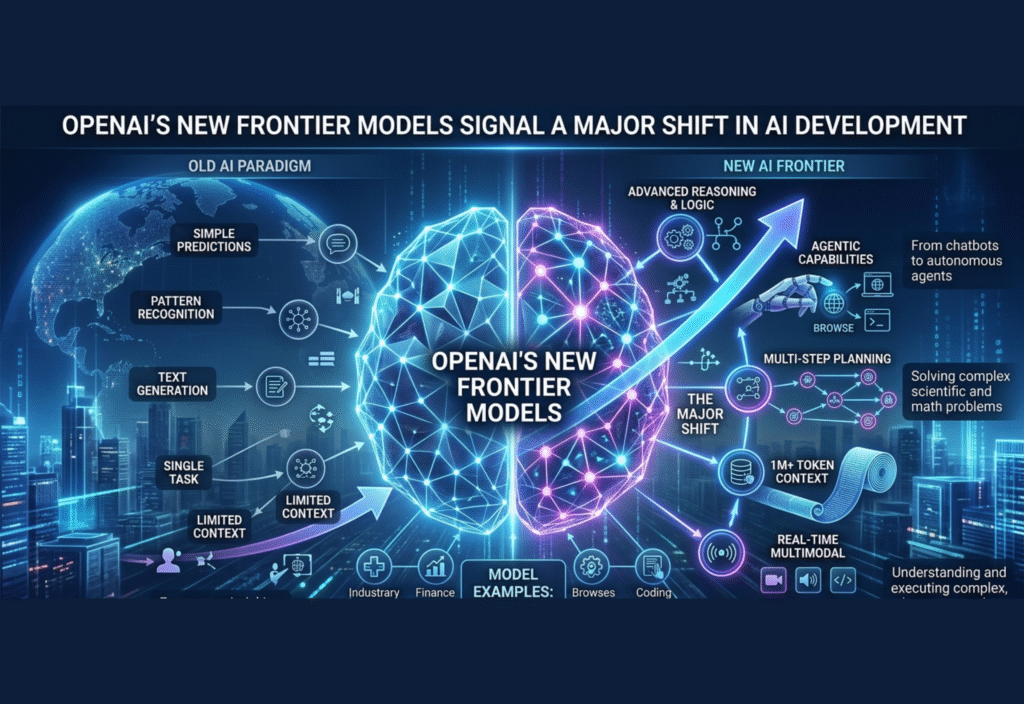
Artificial Intelligence is rapidly evolving, and OpenAI Frontier Models are leading this transformation by introducing advanced reasoning, multimodal capabilities, and more autonomous AI systems. These models are changing how AI is developed and applied across industries, marking a major shift from traditional reactive systems to intelligent, goal-driven technologies.
The Journey from Narrow AI to Frontier Models
To understand the significance of frontier models, it’s important to look at how AI has developed over time. Early AI systems were task-specific. They could perform a single function—like recognizing faces, translating text, or recommending products—but lacked flexibility.
The emergence of large language models (LLMs) marked a turning point. Models like GPT (Generative Pre-trained Transformer) demonstrated that a single system could handle multiple tasks by learning patterns from massive datasets. These models brought natural language understanding and generation to a level that felt almost human.
However, frontier models go several steps further. They are not limited to responding to queries. Instead, they can:
- Break down complex problems
- Perform multi-step reasoning
- Adapt to different contexts
- Interact with tools and environments
This transition reflects a move from static intelligence to dynamic, goal-oriented systems.
Core Features of Frontier Models
1. Deep Reasoning and Problem-Solving
One of the most defining characteristics of frontier models is their ability to think through problems. Instead of giving quick, surface-level answers, these systems can analyze situations step by step.
For example, in programming tasks, a frontier model can:
- Understand requirements
- Write code
- Debug errors
- Optimize performance
This level of reasoning makes AI far more useful in professional and technical environments.
2. Multimodal Intelligence
Frontier models are not limited to text. They can process and generate multiple types of data, including:
- Images
- Audio
- Video
- Structured data
This capability allows AI to interact with the world in a more human-like way. For instance, a user can upload an image and ask the AI to analyze it, describe it, or even modify it.
3. Agent-Like Capabilities
Perhaps the most transformative aspect is the rise of AI agents. Frontier models can act as agents that perform tasks on behalf of users.
These agents can:
- Plan actions
- Execute tasks
- Use external tools
- Adjust strategies based on feedback
This means AI is no longer just assisting—it is actively participating in workflows.
4. Extended Context and Memory
Traditional models struggled with long conversations or large documents. Frontier models, however, can handle significantly larger context windows. This enables them to:
- Maintain coherent long-form discussions
- Analyze entire documents or datasets
- Provide more accurate and relevant outputs
This improvement is especially valuable for research, education, and business applications.
Real-World Impact Across Industries
Software Development
AI is transforming how software is built. Developers now use AI to:
- Generate code
- Automate testing
- Debug complex systems
This reduces development time and allows engineers to focus on innovation rather than repetitive tasks.
Content Creation and Media
Writers, marketers, and designers are leveraging AI to produce high-quality content at scale. From blog posts to video scripts, AI tools are helping creators work faster while maintaining quality.
However, human creativity and oversight remain essential to ensure authenticity and originality.
Healthcare and Scientific Research
Frontier models are accelerating research by:
- Analyzing large datasets
- Identifying patterns
- Assisting in hypothesis generation
In healthcare, AI can support diagnostics and treatment planning, although it must always be used under professional supervision.
Business and Automation
Organizations are integrating AI into daily operations, including:
- Customer support (chatbots and virtual assistants)
- Data analysis and forecasting
- Workflow automation
This leads to improved efficiency, reduced costs, and better decision-making.
A New Paradigm: Human-AI Collaboration
Despite concerns about job displacement, the reality is more nuanced. Frontier models are best seen as collaborators rather than replacements.
Humans bring:
- Creativity
- Emotional intelligence
- Ethical judgment
AI contributes:
- Speed
- Data processing
- Pattern recognition
Together, this combination creates a powerful partnership that enhances productivity and innovation.
Challenges and Ethical Considerations
1. Bias and Fairness
AI systems learn from data, which can include biases. Ensuring fairness and inclusivity is a major challenge that developers must address.
2. Misinformation and Misuse
Powerful AI tools can be misused to generate misleading or harmful content. Safeguards and responsible usage policies are critical.
3. Privacy and Data Security
As AI systems process large amounts of data, protecting user privacy becomes increasingly important. Strong encryption and ethical data practices are essential.
4. Over-Reliance on AI
While AI can enhance productivity, excessive dependence may reduce human critical thinking skills. Balance is key.
The Future of AI Development
Frontier models are setting the stage for the next generation of AI systems. In the coming years, we can expect:
- More autonomous AI agents
- Deeper integration into everyday tools
- Improved personalization
- Stronger focus on safety and alignment
AI will likely become as fundamental as the internet—an invisible layer powering countless applications and services.
Conclusion
The emergence of frontier models from OpenAI marks a significant milestone in the evolution of artificial intelligence. These systems are not just smarter—they are more capable, adaptable, and impactful than ever before.
This shift represents a move toward AI that can truly assist, collaborate, and innovate alongside humans. While challenges remain, the potential benefits are enormous. By focusing on responsible development and ethical use, society can harness the power of frontier models to drive progress, solve complex problems, and unlock new opportunities for the future.