
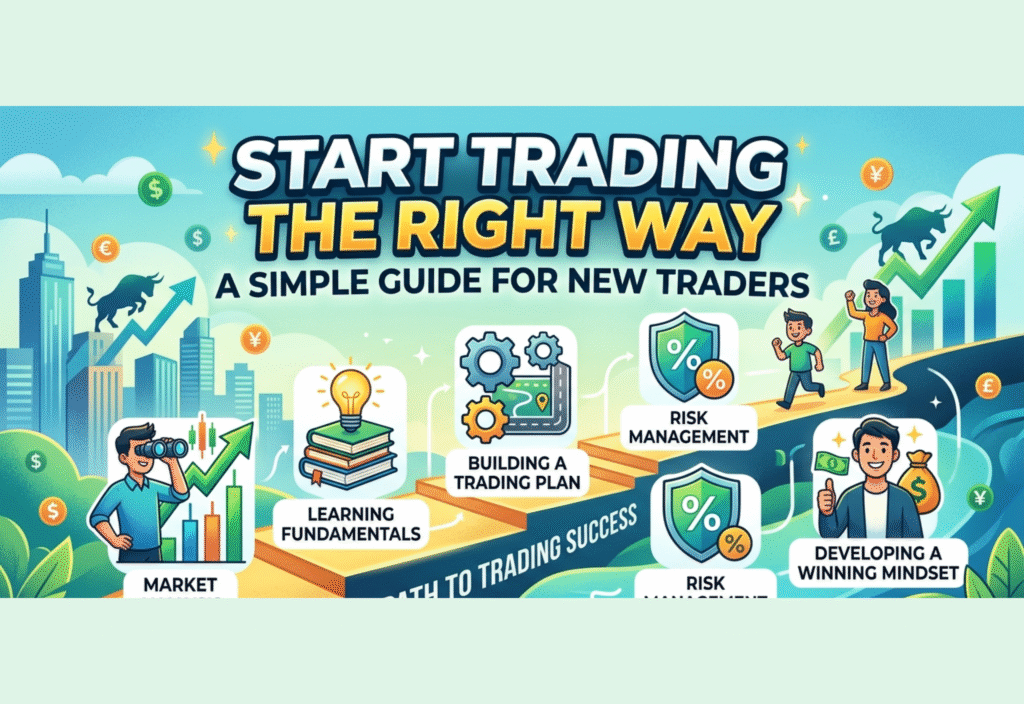
Start trading for beginners can feel overwhelming at first, but with the right guidance it becomes much easier to understand. This simple guide explains how to start trading for beginners, covering the basics, strategies, and risk management so you can begin your trading journey the right way.
This guide is designed to help new traders understand the basics and build a strong foundation for starting their trading journey the right way.
Understanding What Trading Really Is
Trading involves buying and selling financial instruments such as stocks, currencies, commodities, or cryptocurrencies with the goal of making a profit. Unlike long-term investing, trading focuses on shorter time frames and takes advantage of market price movements.
Before jumping in, it’s important to understand that trading is not a guaranteed income source. It requires learning, practice, emotional control, and risk management.
Step 1: Build the Right Mindset
One of the biggest differences between successful and unsuccessful traders is mindset. Beginners often expect quick profits, but trading is a skill that develops over time.
A proper trading mindset includes:
- Accepting losses as part of the process
- Avoiding emotional decisions
- Staying patient and consistent
- Focusing on long-term improvement rather than short-term gains
Treat trading like a profession, not a gamble.
Step 2: Learn the Basics of the Market
Before placing any trades, you need to understand how markets work. This includes:
- How prices move
- What affects market trends (news, economic data, supply and demand)
- Basic terminology like bid, ask, spread, and liquidity
- Types of markets such as forex, stocks, and crypto
Start with one market and focus on learning it deeply instead of trying to master everything at once.
Step 3: Choose a Trading Style
There are different trading styles depending on your time availability and personality:
- Scalping: Very short-term trades, quick profits
- Day Trading: Trades opened and closed within the same day
- Swing Trading: Trades held for several days or weeks
- Position Trading: Long-term trades based on trends
As a beginner, swing trading is often recommended because it allows more time for analysis and decision-making.
Step 4: Learn Technical and Fundamental Analysis
To make informed decisions, traders rely on two main types of analysis:
Technical Analysis
This involves studying charts, patterns, indicators, and price action to predict future movements.
Fundamental Analysis
This focuses on economic data, news events, company performance, and global factors that influence prices.
A balanced approach using both can improve decision-making.
Step 5: Use Risk Management
Risk management is the backbone of successful trading. Without it, even a good strategy can lead to losses.
Key principles include:
- Never risk more than a small percentage of your capital on a single trade
- Use stop-loss orders to limit losses
- Maintain a proper risk-to-reward ratio (e.g., 1:2 or better)
- Avoid overtrading
Protecting your capital is more important than making profits quickly.
Step 6: Start with a Demo Account
Before trading with real money, practice on a demo account. This allows you to:
- Understand how the platform works
- Test strategies without financial risk
- Build confidence
Treat demo trading seriously as if it were real money.
Step 7: Develop a Trading Plan
A trading plan is your roadmap. It should include:
- Entry and exit rules
- Risk management rules
- Trading schedule
- Strategy criteria
Without a plan, trading becomes random and emotional. A well-defined plan keeps you disciplined and consistent.
Step 8: Keep Learning and Improving
Markets are constantly changing, so continuous learning is essential. You can improve by:
- Reading trading books and guides
- Watching educational content
- Analyzing your past trades
- Learning from mistakes
Keeping a trading journal is highly recommended to track performance and identify patterns in your behavior.
Common Mistakes Beginners Should Avoid
- Trading without knowledge or preparation
- Ignoring risk management
- Overtrading due to excitement
- Following random tips without analysis
- Letting emotions control decisions
- Expecting quick profits
Avoiding these mistakes can significantly increase your chances of success.
Final Thoughts
Starting trading the right way requires patience, discipline, and a commitment to learning. There is no shortcut to becoming a successful trader. Instead, focus on building strong fundamentals, practicing consistently, and managing risk effectively.
Remember, trading is not about winning every trade—it’s about staying profitable over time. With the right approach and mindset, you can gradually develop the skills needed to navigate the markets confidently and responsibly.