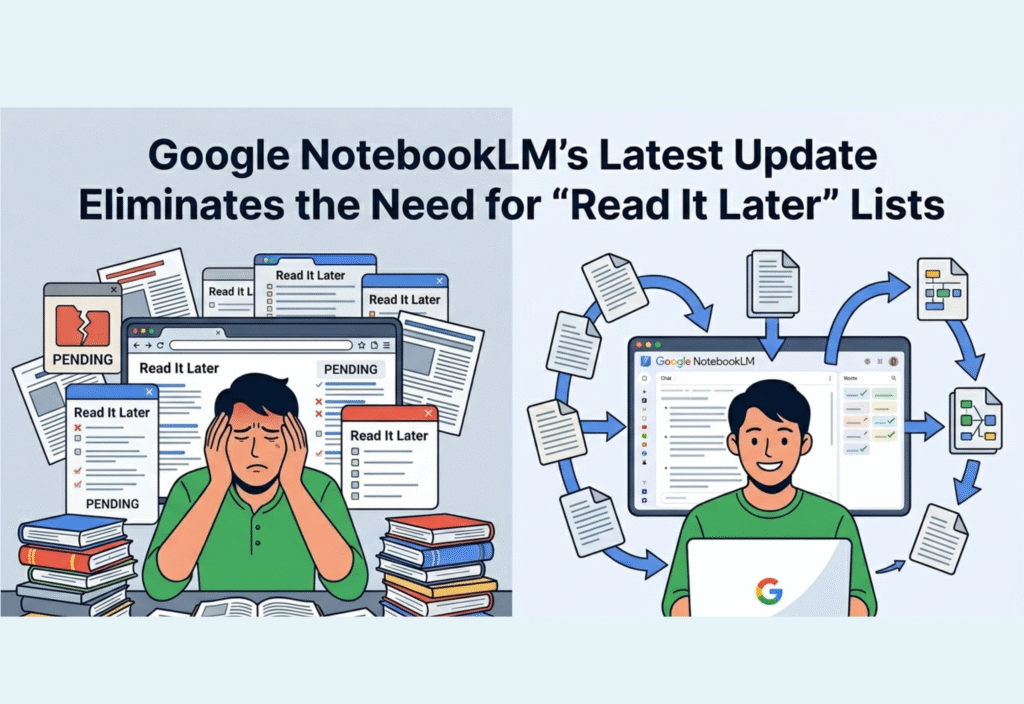
The Google NotebookLM update is changing how users manage and consume information by replacing traditional read-it-later lists with AI-powered summaries and smarter organization.
For years, users have relied on bookmarking apps, browser extensions, or dedicated services to save articles, blogs, videos, and research papers for later reading. While this approach helped in collecting useful content, it often resulted in cluttered lists, forgotten links, and information overload. NotebookLM is addressing these problems by changing not just how content is saved, but how it is processed and understood.
A Shift from Saving Links to Understanding Content
In the traditional workflow, a user would save a link with the intention of reading it later. However, most of these saved items were never revisited due to time constraints or lack of organization. The latest capabilities in NotebookLM transform this passive behavior into an active learning experience.
Instead of storing links in a list, users can now upload or import content directly into NotebookLM. Once the content is inside the system, it becomes part of an interactive workspace where AI can analyze, summarize, and answer questions based on that material. This removes the dependency on external “read it later” tools and consolidates everything into one intelligent environment.
Interactive Knowledge Instead of Static Storage
One of the key improvements is that NotebookLM does not treat saved content as static information. Instead, it builds a dynamic understanding of the material. Users can interact with their documents by asking natural language questions, requesting summaries, or exploring specific topics within the uploaded sources.
For example, instead of reopening a 20-page article, a user can simply ask NotebookLM to summarize the main points or extract key arguments. This saves time and improves comprehension, especially when dealing with large volumes of information.
Solving the Problem of Information Overload
A major issue with “read it later” lists is accumulation. Over time, users often end up saving far more content than they can realistically consume. This leads to digital clutter and reduces productivity, as important information gets buried under an ever-growing list.
NotebookLM addresses this challenge by converting saved materials into structured notebooks. Within these notebooks, users can organize sources, generate summaries, and search across all their content using AI. Instead of scrolling through dozens or hundreds of saved links, users can quickly locate relevant insights through intelligent queries.
This approach significantly reduces cognitive load and makes it easier to focus on understanding rather than managing information.
Smarter Summarization and Context Awareness
Another major advantage of NotebookLM is its ability to generate context-aware summaries. Unlike generic summarization tools, it understands the relationship between multiple documents within the same notebook.
Users can combine different sources—such as research papers, articles, and notes—and ask NotebookLM to compare them or identify common themes. This is especially useful for students, researchers, and professionals who need to synthesize information from multiple references.
The AI doesn’t just summarize individual documents; it can also provide cross-document insights, helping users build a deeper understanding of a topic without manually analyzing each source.
Practical Benefits for Different Users
The update is useful across a wide range of use cases:
Students:
They can upload textbooks, lecture notes, and research material into NotebookLM and use it as a study assistant. Instead of maintaining separate notes and bookmarks, everything can be centralized and queried when needed.
Researchers:
Those working with multiple academic sources can compare findings, extract citations, and identify patterns across documents more efficiently.
Content creators and writers:
Writers can store reference materials, articles, and ideas in one place, then use NotebookLM to generate outlines, summaries, or topic suggestions.
Professionals:
Business users can organize reports, meeting notes, and industry documents, making it easier to retrieve insights during decision-making processes.
Why “Read It Later” Lists Are Becoming Obsolete
The concept of saving links for later made sense in a time when content consumption was linear and manual. However, modern workflows demand faster access to insights rather than just access to content.
NotebookLM changes the equation by:
- Eliminating the need to revisit full-length articles manually
- Providing instant summaries and explanations
- Enabling search across multiple documents simultaneously
- Turning passive reading into interactive exploration
Instead of asking, “What should I read later?”, users can now ask, “What do I need to understand right now?” This fundamental shift is what makes traditional read-it-later tools less relevant.
A New Approach to Digital Learning and Productivity
The broader implication of this update is a transformation in how people manage knowledge. NotebookLM represents a move from storage-based systems to intelligence-driven systems. Rather than acting as a repository of links, it behaves like an active assistant that helps interpret, organize, and explain information.
This aligns with a growing trend in AI tools where the focus is not just on saving data, but on making that data useful immediately. Users no longer need to build long queues of unread content. Instead, they can maintain curated knowledge bases that evolve as they add new information.
Conclusion
The latest update to Google NotebookLM is more than just an incremental improvement—it represents a fundamental change in how people interact with information. By replacing static “read it later” lists with an interactive, AI-powered workspace, NotebookLM allows users to move from passive saving to active understanding.
As a result, the traditional habit of bookmarking articles for later reading is gradually being replaced by a more efficient and intelligent approach: organizing, analyzing, and learning from content in real time. This not only saves time but also enhances productivity, comprehension, and overall knowledge management in the digital age.