
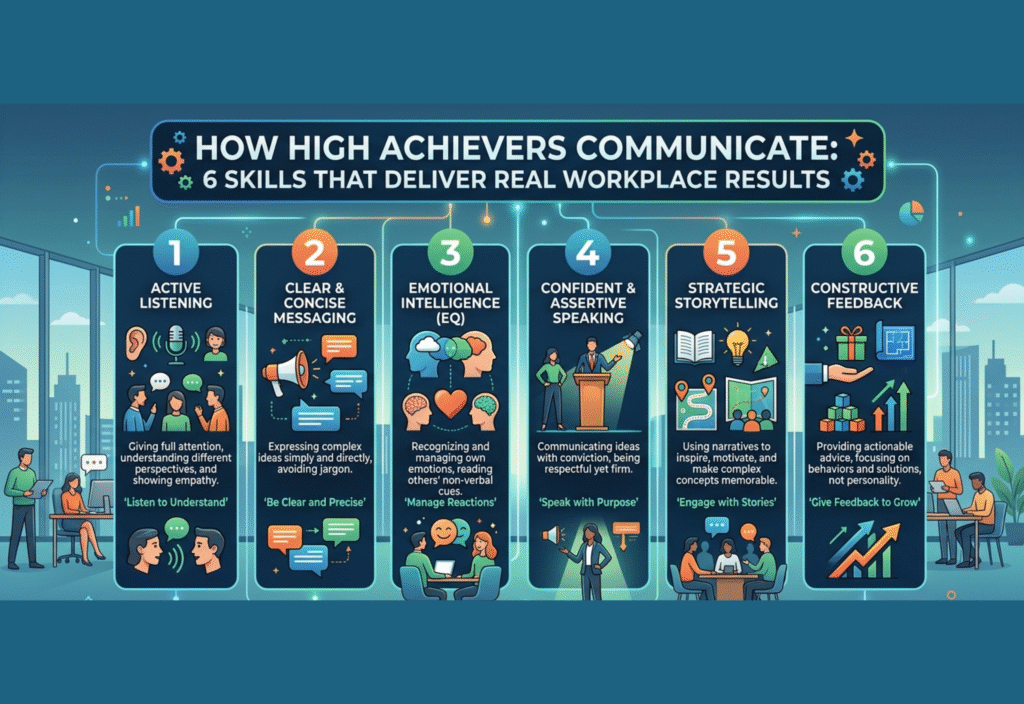
High achievers communication skills are essential for success in modern workplaces, as they help professionals express ideas clearly, listen actively, and build strong professional relationships.
High achievers don’t just communicate more—they communicate better. Their approach is intentional, structured, and outcome-driven. They understand that every message, whether spoken or written, contributes to alignment, trust, and execution.
Below is a deeper and more detailed look at six powerful communication skills that consistently help high performers deliver real workplace results.
1. Clarity Over Complexity
High achievers prioritize clarity because they understand that confusion slows down progress. In complex work environments, messages often become diluted with unnecessary detail, jargon, or assumptions. High performers avoid this by simplifying their communication without losing meaning.
Why clarity matters:
- Reduces misunderstandings
- Improves execution speed
- Minimizes back-and-forth communication
- Helps teams stay aligned on goals
They structure their thoughts before speaking or writing and ensure their message answers three key questions:
- What needs to be done?
- Why is it important?
- What is the expected outcome?
Example:
Instead of saying:
“We should revisit the current workflow optimization strategy to enhance operational efficiency.”
A high achiever would say:
“Let’s simplify the workflow by removing unnecessary steps so tasks are completed faster.”
The second version is clear, actionable, and easy to understand.
2. Active Listening
Listening is often underestimated, yet it is one of the most powerful communication tools. High achievers practice active listening, which means they fully concentrate on the speaker rather than thinking about their response while the other person is talking.
Key behaviors of active listeners:
- Maintaining eye contact and engagement
- Avoiding interruptions
- Asking relevant follow-up questions
- Summarizing or paraphrasing to confirm understanding
Active listening leads to:
- Better decision-making
- Stronger relationships
- Reduced conflict
- Increased trust among team members
High achievers recognize that listening is not passive—it is an active effort to understand perspectives, uncover hidden issues, and gather valuable insights.
3. Emotional Intelligence in Communication
Emotional intelligence (EQ) plays a significant role in how messages are delivered and interpreted. High achievers are aware of both their own emotions and those of others, allowing them to adjust their tone, language, and timing accordingly.
Components of emotionally intelligent communication:
- Self-awareness: Understanding one’s emotional triggers
- Self-regulation: Staying calm under pressure
- Empathy: Recognizing others’ feelings
- Social skills: Managing interactions effectively
Practical application:
- During conflict, they avoid reacting impulsively
- In stressful situations, they maintain composure
- When giving feedback, they remain respectful and constructive
This ability helps them navigate challenging conversations without damaging relationships or morale.
4. Conciseness and Respect for Time
Time is one of the most valuable resources in any workplace. High achievers respect their own time and that of others by keeping communication concise and focused.
Characteristics of concise communication:
- Straight to the point
- Free from unnecessary details
- Structured and organized
- Easy to scan and understand
Whether it’s an email, meeting, or presentation, they prioritize delivering key information efficiently.
Benefits:
- Saves time for all participants
- Improves meeting productivity
- Keeps discussions focused
- Enhances message retention
For example, instead of long explanations, they summarize key points, highlight action items, and avoid repetition. This makes their communication more impactful and easier to act upon.
5. Adaptability to Audience
High achievers understand that not all audiences are the same. The way they communicate with a senior executive is different from how they interact with a peer or a client. Adapting communication style based on the audience ensures that the message is relevant, understandable, and effective.
How they adapt:
- With leadership: Focus on outcomes, ROI, and strategic impact
- With team members: Provide detailed instructions and context
- With clients: Emphasize value, clarity, and reassurance
- With technical teams: Use precise and detailed terminology
Why it matters:
- Increases message effectiveness
- Prevents misinterpretation
- Builds credibility and professionalism
- Strengthens stakeholder relationships
By tailoring their communication, high achievers ensure that their message resonates with the listener’s expectations and level of understanding.
6. Feedback as a Tool for Continuous Improvement
High achievers view feedback not as criticism, but as an opportunity for growth. They actively seek feedback to improve their performance and also provide feedback in a constructive and respectful manner.
When giving feedback:
- They focus on specific behaviors rather than personal traits
- They use clear examples
- They offer actionable suggestions
- They maintain a supportive tone
When receiving feedback:
- They listen without defensiveness
- They ask clarifying questions
- They reflect before responding
- They apply insights to improve
Impact of feedback culture:
- Encourages continuous learning
- Enhances individual performance
- Improves team collaboration
- Builds a culture of trust and openness
High achievers understand that growth is an ongoing process, and feedback is one of the most effective tools to accelerate it.
Additional Insight: Consistency Builds Trust
Beyond these six skills, one underlying principle ties everything together: consistency. High achievers communicate consistently in tone, clarity, and behavior. Over time, this consistency builds trust, which is essential for leadership and collaboration.
People know what to expect from them, and this predictability strengthens professional relationships and team dynamics.
Conclusion
Communication is not just a soft skill—it is a core driver of workplace success. High achievers distinguish themselves by mastering clarity, active listening, emotional intelligence, conciseness, adaptability, and feedback.
These skills enable them to:
- Collaborate more effectively
- Lead with confidence
- Resolve conflicts efficiently
- Make better decisions
- Deliver consistent results
The good news is that these communication habits can be developed with practice and awareness. By intentionally improving how you communicate, you can significantly enhance your professional impact and move closer to high-performance outcomes in any workplace environment.
In the end, high achievers don’t rely on chance—they rely on communication that is clear, thoughtful, and purpose-driven.