An agentic AI chatbot for clinics is transforming the healthcare industry by enabling automated, intelligent, and efficient patient communication. Unlike traditional chatbots that rely on static responses, an agentic system can reason, plan, and execute tasks independently.
Additionally, it can handle complex workflows such as appointment scheduling, patient inquiries, and system integrations. As a result, clinics can significantly reduce manual workload while improving response speed and service quality.
In modern healthcare environments, adopting an agentic AI chatbot for clinics is becoming essential to meet growing patient expectations and operational demands.
What is an Agentic AI Chatbot for Clinics?
An agentic AI chatbot for clinics is an advanced AI system capable of autonomous decision-making and task execution. It understands user intent, maintains context, and determines the best course of action.
Moreover, it can interact with external systems like APIs, databases, and scheduling tools. For example, it can retrieve doctor availability or book an appointment without human intervention.
In contrast to rule-based chatbots, this system is dynamic and context-aware. It does not just respond—it acts.
Why Clinics Need an Agentic AI Chatbot
Healthcare clinics often face high volumes of repetitive queries. These include questions about appointments, timings, services, and availability.
Therefore, an agentic AI chatbot for clinics helps automate these interactions efficiently. It ensures that patients receive instant responses without waiting for staff assistance.
Furthermore, it allows clinic staff to focus on critical responsibilities instead of routine communication tasks.
Key Benefits
- 24/7 availability for patient support
- Reduced administrative workload
- Faster response times
- Improved patient satisfaction
- Scalable and efficient communication
Core Features of an Agentic AI Chatbot for Clinics
A well-designed agentic chatbot includes multiple intelligent features that enhance usability and automation.
Appointment Scheduling
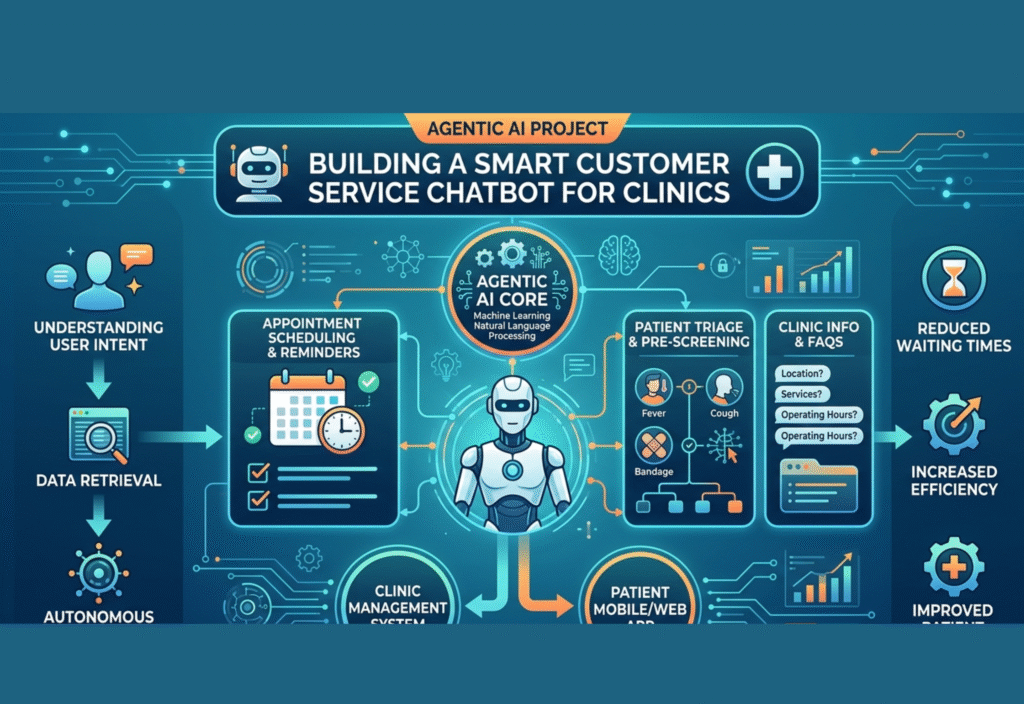
The chatbot can book, reschedule, or cancel appointments automatically. For example, a patient can request a time slot, and the chatbot will check availability and confirm the booking.
Patient Query Handling
It can respond to frequently asked questions regarding clinic services, fees, and timings. Additionally, it can guide users to the correct department or service.
Intelligent Decision Making
The system evaluates user input and decides whether to answer directly or use external tools. Moreover, it can escalate urgent queries to human agents when required.
Personalization
By storing user data and preferences, the chatbot provides personalized responses. As a result, patients receive more relevant and context-aware interactions.
Multi-Channel Support
The chatbot can operate across multiple platforms such as websites, mobile apps, and messaging services. In addition, this improves accessibility and user convenience.
Architecture of an Agentic AI Chatbot for Clinics
A robust chatbot system consists of several interconnected layers working together seamlessly.
User Interface Layer
This layer represents the frontend where users interact with the chatbot through web or mobile interfaces.
AI Agent Layer
This is the core intelligence of the system. It processes input, understands intent, and determines the next actions.
Tool Integration Layer
This layer connects the chatbot with external systems such as appointment APIs, patient databases, and notification services. For instance, it may call an API to fetch available time slots.
Memory Layer
Memory allows the chatbot to maintain context across conversations. Additionally, it stores user history and preferences for better personalization.
Backend Layer
The backend manages business logic, authentication, logging, and system operations. Therefore, it ensures the chatbot functions smoothly and securely.
Step-by-Step Development of an Agentic AI Chatbot for Clinics
Step 1: Define Use Cases
First, identify the primary functions of the chatbot. These may include appointment booking, answering FAQs, providing clinic information, and handling patient queries.
Step 2: Select Technology Stack
Next, choose the appropriate technologies. For example, you may use Python for backend development and an LLM API for natural language processing.
Step 3: Develop Agent Logic
The agent must interpret user input, reason about it, and decide which action to take. Moreover, it should handle multi-step workflows efficiently.
Step 4: Integrate External Systems
The chatbot should connect with clinic systems such as scheduling tools and electronic health records. As a result, it can perform real-world actions rather than just responding.
Step 5: Implement Memory Management
Short-term memory stores ongoing conversation context, while long-term memory stores user history. Additionally, this enhances personalization and continuity.
Step 6: Ensure Security and Compliance
Healthcare systems must prioritize data security. Therefore, encryption, authentication, and access control mechanisms are essential to protect sensitive information.
Step 7: Testing and Optimization
Finally, test the chatbot for performance, accuracy, and edge cases. Furthermore, continuous monitoring helps improve reliability and user experience.
Example Workflow of an Agentic AI Chatbot for Clinics
User request:
“I need a dentist appointment tomorrow.”
System execution:
- Detect intent (appointment booking)
- Extract key details (dentist, date)
- Check availability via API
- Present available slots
- Confirm user selection
- Book the appointment
- Send confirmation message
As a result, the entire process is completed automatically without human intervention.
Challenges in Building an Agentic AI Chatbot for Clinics
While the system offers many advantages, there are also challenges to consider:
- Handling sensitive healthcare data securely
- Ensuring accurate and reliable AI responses
- Integrating with legacy systems
- Managing long conversations effectively
- Maintaining system performance under load
However, these challenges can be addressed through proper architecture, validation, and monitoring strategies.
Best Practices
To build an effective system, follow these best practices:
- Use structured and well-designed prompts
- Validate outputs before executing actions
- Provide fallback to human agents when necessary
- Maintain detailed logs for monitoring
- Continuously update and improve the system
- Prioritize user privacy and data protection
Additionally, focus on creating a simple and user-friendly interface to improve usability.
Future Enhancements
The future of an agentic AI chatbot for clinics includes several advanced capabilities:
- Voice-based interactions for hands-free communication
- AI-driven symptom analysis and triage
- Integration with wearable health devices
- Predictive appointment scheduling
- Multilingual communication support
- Emotion-aware responses for better patient engagement
Moreover, these features will further enhance automation and patient experience.
Conclusion
An agentic AI chatbot for clinics represents a major advancement in healthcare technology. It enables automation, improves communication, and enhances operational efficiency.
Therefore, clinics adopting such systems can provide faster, smarter, and more reliable services. In summary, combining reasoning, tool integration, and memory management allows these chatbots to act as intelligent assistants capable of handling real-world tasks effectively.
As a result, both healthcare providers and patients benefit from improved service quality, reduced workload, and a more seamless experience overall.