
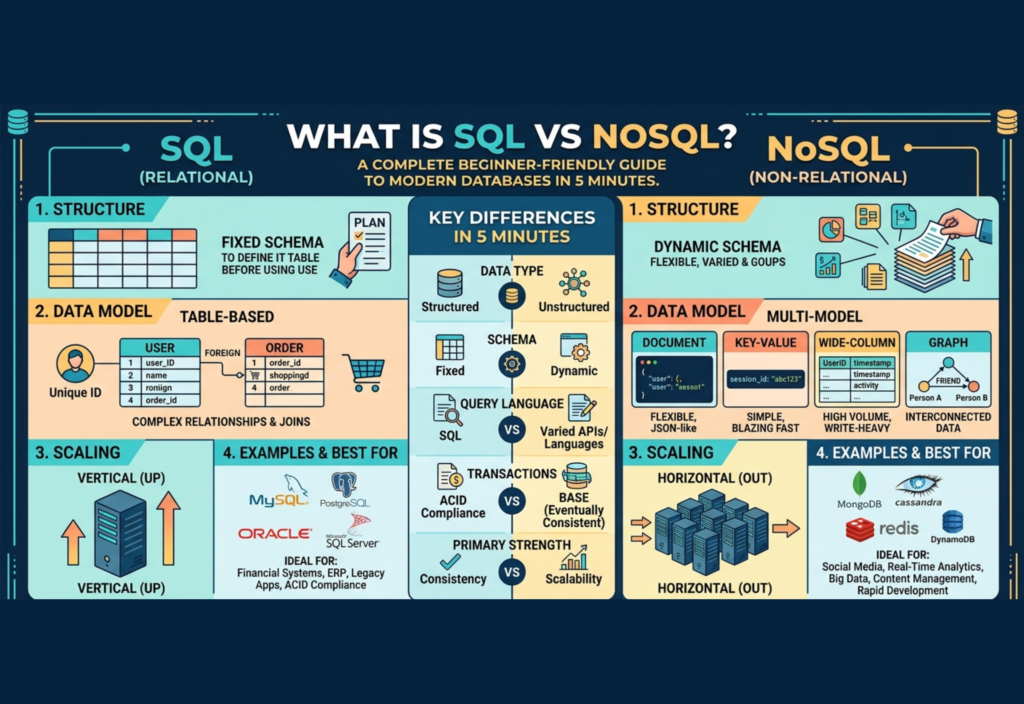
SQL vs NoSQL is one of the most important comparisons when learning about modern databases. In simple terms, both SQL and NoSQL are used to store and manage data, but they work in different ways. SQL databases use structured tables, while NoSQL databases offer flexible data storage formats.
In this guide, you will learn what SQL vs NoSQL means, how each one works, and when to use them in real-world applications. By the end, you will clearly understand the key differences between SQL vs NoSQL and how they impact modern development.
What is a Database?
A database is a system used to store, organize, and manage data efficiently. In simple terms, it acts like a digital storage system where information is kept in a structured way so it can be accessed quickly.
For example:
- A school database stores student records
- An e-commerce database stores product and order details
- A social media platform stores user profiles and posts
Because of databases, applications can handle large amounts of data smoothly and reliably.
What is SQL?
SQL stands for Structured Query Language. It is used to communicate with relational databases, which store data in tables.
In SQL databases:
- Data is organized into tables
- Each table contains rows and columns
- Relationships exist between tables using keys
For instance, a database may have one table for users and another for orders. These tables can be connected using a common field like a user ID.
Key Features of SQL Databases
First, SQL databases use a fixed structure called a schema. This means you must define the structure before inserting data.
Second, they follow ACID properties, which ensure:
- Data remains accurate
- Transactions are reliable
- No data loss occurs during operations
In addition, SQL allows you to perform complex queries. You can filter, join, and analyze data easily using SQL commands.
Because of these features, SQL databases are widely used in systems where accuracy and consistency are critical.
Examples of SQL Databases
Some popular SQL databases include:
- MySQL
- PostgreSQL
- Oracle Database
- Microsoft SQL Server
These are commonly used in enterprise applications and traditional systems.
What is NoSQL?
NoSQL stands for Not Only SQL. Unlike SQL databases, NoSQL databases do not follow a strict table-based structure. Instead, they allow more flexible ways of storing data.
NoSQL databases can store data in different formats such as:
- Documents (JSON-like structure)
- Key-value pairs
- Graphs
- Wide-column stores
Because of this flexibility, NoSQL databases are suitable for handling unstructured or rapidly changing data.
Key Features of NoSQL Databases
First, NoSQL databases offer a flexible schema. You can easily add or modify fields without affecting the entire database.
Second, they support horizontal scaling, which means you can handle more data by adding more servers.
Moreover, NoSQL databases are designed for high performance, especially when dealing with large datasets and real-time applications.
As a result, they are widely used in modern, data-intensive applications.
Examples of NoSQL Databases
Some popular NoSQL databases include:
- MongoDB
- Redis
- Cassandra
- Firebase
These databases are commonly used in modern web and mobile applications.
SQL vs NoSQL: Key Differences
Here is a simple comparison:
| Feature | SQL | NoSQL |
|---|---|---|
| Data Structure | Tables (rows & columns) | Documents, key-value, graphs |
| Schema | Fixed | Flexible |
| Scalability | Vertical | Horizontal |
| Data Type | Structured | Unstructured / semi-structured |
| Query Language | SQL | Varies by database |
When to Use SQL
You should use SQL databases when:
- Your data is structured and organized
- You need strong consistency
- You are working with financial or transactional systems
- You require complex queries and relationships
For example, banking systems and accounting software rely heavily on SQL.
When to Use NoSQL
You should use NoSQL databases when:
- Your data changes frequently
- You need high scalability
- You are building real-time applications
- You are handling large volumes of unstructured data
For example, social media platforms, chat apps, and analytics systems often use NoSQL.
Can SQL and NoSQL Work Together?
Yes, in many modern applications, developers use both SQL and NoSQL together. This approach is known as polyglot persistence.
For instance:
- SQL can manage transactions and structured data
- NoSQL can handle logs, user activity, or real-time data
By combining both, developers can take advantage of the strengths of each system.
Real-World Analogy
To understand better, think of SQL as a well-organized spreadsheet where everything follows strict rules. On the other hand, NoSQL is like a flexible folder where you can store different types of files without strict formatting.
This difference makes each system suitable for different types of applications.
Advantages and Disadvantages
SQL Advantages
- Ensures strong data consistency
- Supports complex queries
- Widely used and well-established
SQL Disadvantages
- Less flexible structure
- Scaling can be difficult
NoSQL Advantages
- Highly flexible
- Easy to scale
- Suitable for big data
NoSQL Disadvantages
- Less strict consistency in some cases
- Complex queries may be limited
Final Thoughts
In conclusion, both SQL and NoSQL databases are essential in modern application development. SQL focuses on structure, consistency, and reliability, while NoSQL focuses on flexibility, scalability, and performance.
If you are a beginner, it is a good idea to start with SQL to understand the fundamentals of data management. After that, learning NoSQL will help you build more advanced and scalable applications.
By understanding both technologies, you will be better prepared to work with real-world systems and become a more skilled developer