
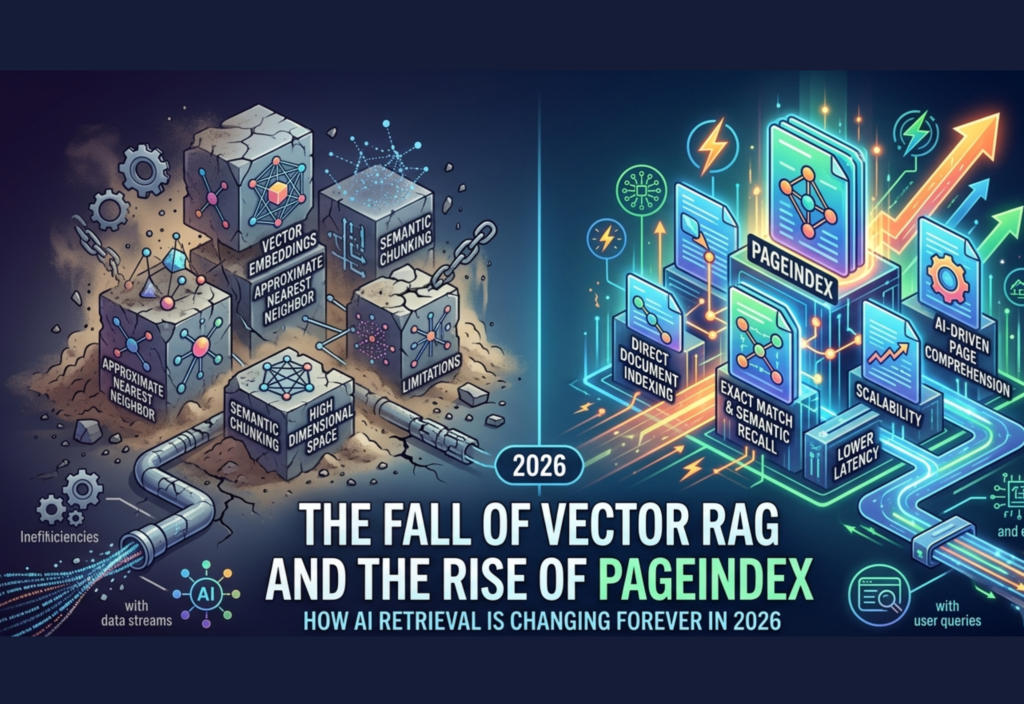
Vector RAG limitations 2026 are becoming increasingly visible as AI retrieval systems evolve, exposing weaknesses in traditional vector-based search and pushing the shift toward structured approaches like PageIndex.
This shift is not just incremental; it represents a fundamental change in how AI systems access, organize, and reason over information.
Understanding Vector RAG: The Foundation of Modern AI Retrieval
Vector RAG became popular as a way to enhance large language models by allowing them to retrieve relevant documents from external sources. The process generally works like this:
- Documents are split into chunks.
- Each chunk is converted into embeddings (vector representations).
- These vectors are stored in a vector database.
- When a user query is made, it is also converted into a vector.
- The system retrieves the most similar chunks using similarity search.
- The retrieved content is passed to the model for response generation.
This approach significantly improved the factual accuracy of AI systems and reduced hallucinations. It became the backbone of many AI-powered applications such as chatbots, enterprise search tools, and knowledge assistants.
Limitations of Vector RAG
Despite its success, vector RAG has several limitations that have become more evident as use cases scale:
1. Loss of Context Structure
Vector chunking often breaks documents into isolated pieces, losing the original structure such as headings, sections, and logical flow. This can reduce the quality of retrieved context.
2. Semantic Drift
Embeddings capture semantic meaning, but not always precise intent. This can lead to retrieval of loosely related chunks instead of the most relevant ones.
3. Chunk Size Trade-offs
Choosing the right chunk size is difficult. Small chunks improve precision but lose context, while large chunks preserve context but reduce retrieval accuracy.
4. Ranking Limitations
Similarity search does not always align with user intent. The top-k results may include irrelevant or partially relevant information.
5. Cost and Complexity
Maintaining vector databases, embedding pipelines, and retrieval tuning introduces operational overhead.
The Rise of PageIndex
PageIndex introduces a different philosophy: instead of breaking content into vector chunks, it treats entire pages or structured documents as primary units of retrieval.
Rather than focusing purely on semantic similarity at the chunk level, PageIndex emphasizes:
- Structural understanding of documents
- Hierarchical indexing (titles, headings, sections)
- Context-aware retrieval across full pages
- Improved alignment with how humans read and interpret content
How PageIndex Works
PageIndex shifts the retrieval process in several key ways:
1. Page-Level Representation
Instead of chunking documents into small fragments, PageIndex indexes entire pages or logically grouped sections.
2. Structure-Aware Indexing
It preserves:
- Headings (H1, H2, H3)
- Paragraph relationships
- Tables, lists, and metadata
This allows retrieval systems to understand not just what is said, but how it is organized.
3. Hybrid Retrieval Signals
PageIndex often combines:
- Semantic signals
- Structural relevance
- Keyword matching
- Positional importance
This hybrid approach improves precision.
4. Context Preservation
Because content is not heavily fragmented, the retrieved information retains its full context, leading to more accurate responses.
Why PageIndex Is Gaining Popularity
Several trends are driving the shift from vector RAG to PageIndex:
1. Better Alignment with Human Reading Patterns
Humans read documents as structured pages, not isolated chunks. PageIndex mirrors this behavior, improving interpretability.
2. Improved Answer Quality
With more complete context available, AI models generate more coherent and accurate responses.
3. Reduced Retrieval Noise
Page-level retrieval reduces the chance of pulling irrelevant or partially relevant fragments.
4. Simpler Pipelines
PageIndex reduces the need for aggressive chunking strategies and complex embedding tuning.
5. Scalability in Enterprise Systems
Large organizations dealing with structured documents (reports, manuals, policies) benefit from preserving document integrity.
Vector RAG vs PageIndex: Key Differences
| Feature | Vector RAG | PageIndex |
|---|---|---|
| Retrieval Unit | Chunks | Pages / Structured sections |
| Context Preservation | Low to Medium | High |
| Indexing Method | Embeddings | Structural + semantic |
| Complexity | Higher | Moderate |
| Precision | Dependent on chunking | More consistent |
| Best For | Unstructured text | Structured documents |
Use Cases Where PageIndex Excels
PageIndex is particularly effective in scenarios such as:
- Enterprise document search
- Legal and compliance systems
- Technical documentation
- Research papers
- Knowledge bases with hierarchical content
- Internal company wikis
In these environments, preserving structure is critical for accurate retrieval.
Is Vector RAG Dead?
Not exactly. Vector RAG is still useful and widely used. However, its role is evolving.
Instead of being the default solution, it is becoming:
- One component in hybrid systems
- A fallback retrieval mechanism
- A complement to structure-aware indexing methods
In many modern architectures, PageIndex and vector retrieval are combined to leverage the strengths of both approaches.
The Hybrid Future of AI Retrieval
The future is not purely PageIndex or vector RAG—it is a combination of multiple retrieval strategies:
- Vector similarity for semantic matching
- Page-level indexing for structural awareness
- Keyword search for exact matches
- Metadata filtering for precision
This hybrid retrieval approach enables AI systems to be more robust, accurate, and adaptable.
Challenges Ahead for PageIndex
Despite its advantages, PageIndex is not without challenges:
- Handling extremely large documents efficiently
- Balancing structural and semantic signals
- Adapting to unstructured or noisy data
- Integration with existing vector-based systems
As the ecosystem evolves, tooling and standards will likely emerge to address these challenges.
Conclusion
The transition from vector RAG to PageIndex represents a major evolution in AI retrieval systems. While vector-based methods revolutionized how machines understand and retrieve knowledge, they are now being complemented—and in some cases replaced—by more structure-aware approaches.
PageIndex brings retrieval closer to how humans naturally process information: by understanding documents as complete, structured entities rather than fragmented pieces. As AI applications continue to scale in 2026 and beyond, this shift is likely to play a crucial role in improving accuracy, efficiency, and user experience.
The future of AI retrieval is not just about similarity—it’s about structure, context, and understanding.