
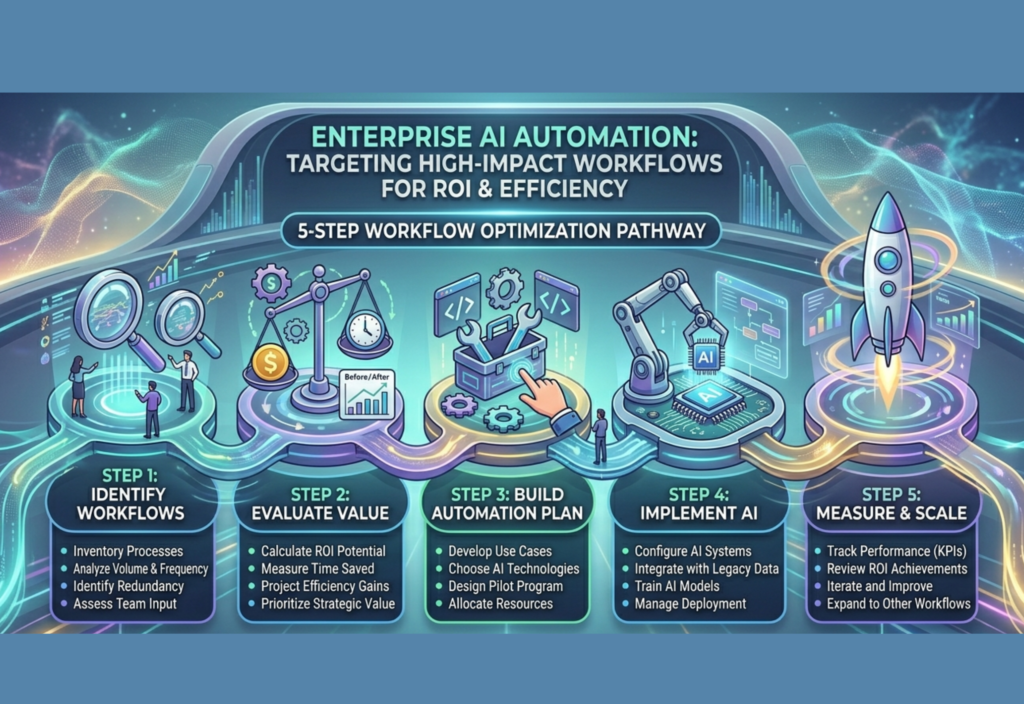
In the modern business landscape, enterprises are no longer competing solely on products or services—they are competing on speed, intelligence, and operational efficiency. Organizations that can process information faster, make smarter decisions, and reduce manual effort gain a clear advantage. This is where Enterprise AI Automation becomes a game-changer.
However, the real success of AI automation does not come from automating everything. Instead, it comes from identifying and targeting high-impact workflows—the processes that deliver the greatest business value when optimized.
This comprehensive guide will help you understand how to strategically implement AI automation, select the right workflows, and maximize return on investment (ROI) while maintaining efficiency and scalability.
Understanding Enterprise AI Automation in Depth
Enterprise AI Automation is the integration of artificial intelligence technologies into business operations to automate tasks, decisions, and workflows at scale. It goes beyond traditional rule-based automation by incorporating learning, adaptability, and predictive capabilities.
Key Components of AI Automation
- Machine Learning (ML): Enables systems to learn from historical data and improve over time
- Natural Language Processing (NLP): Allows machines to understand and respond to human language
- Computer Vision: Interprets visual data such as images and videos
- Robotic Process Automation (RPA): Automates repetitive tasks using software bots
- Decision Intelligence: Combines data analysis with AI to support decision-making
Together, these technologies create a powerful ecosystem capable of transforming enterprise workflows.
The Strategic Importance of High-Impact Workflows
Many organizations fail in their AI initiatives because they adopt a technology-first approach instead of a value-first approach. They invest heavily in AI tools without clearly defining where those tools will create meaningful impact.
Targeting high-impact workflows ensures that:
- Resources are used efficiently
- Results are measurable and significant
- Stakeholder confidence increases
- AI adoption scales smoothly across the organization
How to Identify High-Impact Workflows
Identifying the right workflows requires a structured and analytical approach.
1. Conduct Workflow Audits
Start by mapping all business processes across departments such as:
- Operations
- Finance
- Human Resources
- Customer Service
- Marketing
Document each step, identify bottlenecks, and evaluate performance gaps.
2. Analyze Cost vs. Value
Ask critical questions:
- How much time does this process consume?
- What is the cost of manual execution?
- What happens if this process fails?
- Can automation significantly improve outcomes?
Workflows with high cost and high impact should be prioritized.
3. Evaluate Automation Feasibility
Not every process is suitable for AI automation. Evaluate:
- Data availability and quality
- Process standardization
- Complexity level
- Integration requirements
4. Identify Pain Points
Look for areas where:
- Employees spend excessive time on repetitive tasks
- Errors frequently occur
- Customer complaints are high
- Delays impact business performance
These pain points often indicate high-impact automation opportunities.
Categories of High-Impact Enterprise Workflows
1. Front-Office Workflows (Customer-Facing)
These directly impact customer experience and revenue.
Customer Support
AI chatbots, voice assistants, and automated ticketing systems can:
- Resolve common queries instantly
- Reduce response time
- Improve customer satisfaction
Sales Automation
AI can:
- Score leads based on behavior
- Predict buying intent
- Automates follow-ups
2. Middle-Office Workflows (Decision Support)
These involve analysis and strategic operations.
Data Analytics
AI tools can process massive datasets and generate insights in real time.
Risk Management
AI models can detect anomalies and predict risks in finance, cybersecurity, and compliance.
3. Back-Office Workflows (Operational Efficiency)
These are internal processes critical to business operations.
Finance & Accounting
- Automated invoice processing
- Expense categorization
- Fraud detection
Human Resources
- Resume screening
- Employee onboarding
- Performance analysis
IT Operations
- Automated system monitoring
- Incident detection and resolution
- Predictive maintenance
Real-World Impact of AI Automation
Organizations that successfully implement AI automation often experience:
- 30–70% reduction in operational costs
- Significant improvement in process speed
- Higher accuracy and reduced errors
- Enhanced employee productivity
- Better decision-making through data insights
Step-by-Step Framework for Implementation
Step 1: Define Business Objectives
Clearly outline what you want to achieve:
- Cost reduction
- Revenue growth
- Improved customer experience
- Faster operations
Step 2: Build a Data Strategy
AI depends on data. Ensure:
- Data is clean and structured
- Systems are integrated
- Data governance policies are in place
Step 3: Choose the Right Technology Stack
Select tools that align with your needs:
- RPA platforms for task automation
- AI platforms for predictive analytics
- Cloud infrastructure for scalability
Step 4: Start with Pilot Projects
Avoid large-scale deployment initially. Instead:
- Choose one high-impact workflow
- Implement automation
- Measure results
Step 5: Train Employees
AI adoption requires human collaboration. Provide:
- Training programs
- Skill development
- Clear communication about benefits
Step 6: Monitor and Optimize
Continuously track performance metrics such as:
- ROI
- Efficiency gains
- Error reduction
- Customer satisfaction
Measuring ROI in Enterprise AI Automation
To calculate ROI effectively, consider:
Tangible Benefits
- Reduced labor costs
- Faster processing times
- Lower error rates
Intangible Benefits
- Improved customer experience
- Better employee satisfaction
- Enhanced brand reputation
Common Challenges and How to Overcome Them
1. Data Silos
Solution: Integrate systems and create centralized data platforms
2. Lack of Expertise
Solution: Hire AI specialists or partner with experts
3. Change Resistance
Solution: Educate employees and involve them in the process
4. Security Concerns
Solution: Implement strong cybersecurity measures and compliance protocols
Best Practices for Long-Term Success
- Focus on business value, not just technology
- Maintain transparency in AI decision-making
- Ensure ethical use of AI
- Regularly update models and systems
- Scale gradually and strategically
Future Trends in Enterprise AI Automation
The future of AI automation is moving toward hyperautomation, where multiple technologies work together seamlessly.
Key Trends to Watch:
- Autonomous AI agents handling entire workflows
- Real-time decision intelligence systems
- AI-powered digital twins for business processes
- Increased use of generative AI in enterprise operations
Conclusion
Enterprise AI Automation is transforming how businesses operate, compete, and grow. But success depends on targeting the right workflows—those that deliver maximum impact and measurable ROI.
By focusing on high-value processes, leveraging quality data, and implementing AI strategically, enterprises can unlock new levels of efficiency, innovation, and competitive advantage.
The organizations that act today will lead tomorrow.