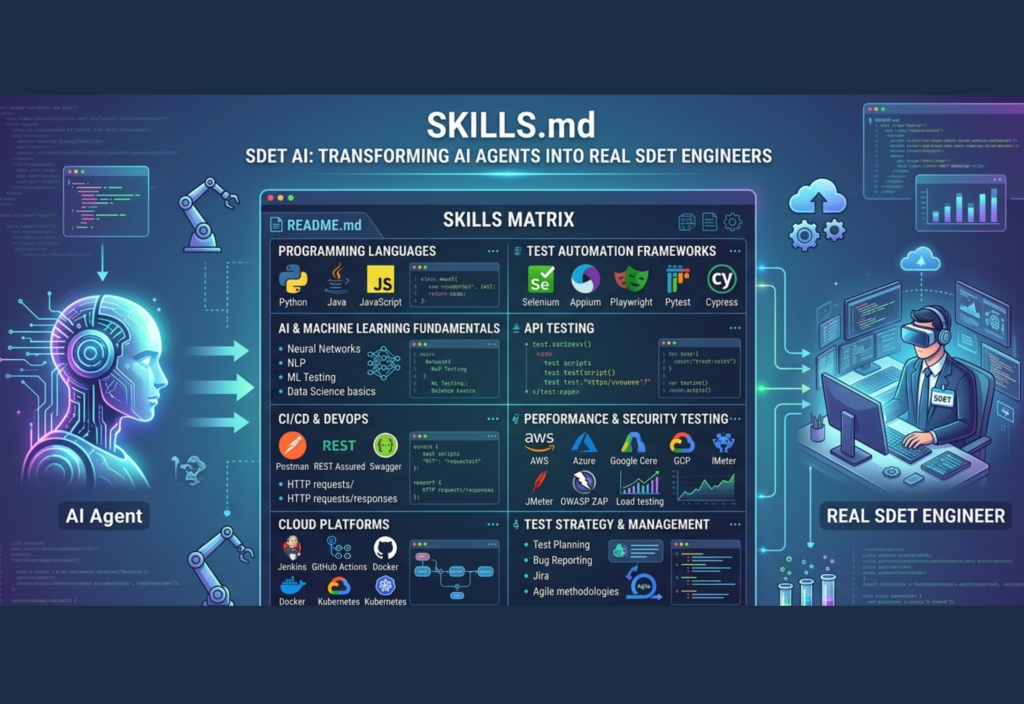
SKILLS.md SDET AI is a structured framework that transforms a normal AI agent into a professional SDET (Software Development Engineer in Test) level system. In simple terms, it defines how an AI should think, behave, and execute software testing tasks in a consistent and reliable way.
Because of this structured approach, the AI does not depend only on prompts. Instead, it follows a fixed engineering rule set that makes its behavior stable, predictable, and more accurate for testing and debugging tasks.
Moreover, this concept is becoming increasingly important in modern AI systems where automation, QA reliability, and consistency are required at scale.
Why SKILLS.md SDET AI is Needed
In traditional AI systems, responses depend heavily on how a prompt is written. As a result, the output can vary significantly. For example, in one case, the AI may generate detailed test cases, while in another case, it may skip edge conditions or validation logic.
However, in real-world software testing environments, this inconsistency is a serious issue. QA engineers need structured, repeatable, and reliable testing behavior.
Therefore, SKILLS.md SDET AI introduces a solution by defining a permanent behavior layer for AI agents. In addition, it ensures that every test follows the same engineering principles regardless of the input prompt.
As a result, the AI becomes more reliable for automation pipelines and QA workflows.
How SKILLS.md SDET AI Works
SKILLS.md SDET AI works as a behavior control file that defines how an AI agent should operate in testing scenarios. Instead of relying only on user instructions, it provides a structured set of rules, skills, and output formats.
For instance, the system ensures that the AI:
- Validates inputs before processing
- Checks outputs against expected results
- Identifies edge cases automatically
- Logs errors in a structured way
- Retries failed test cases when required
- Maintains consistent reporting format
Moreover, this structured approach reduces randomness in AI responses. Therefore, it improves reliability in software testing environments.
In addition, it helps the AI behave more like a real QA engineer rather than a general-purpose assistant.
Core Architecture of SKILLS.md SDET AI
To understand it clearly, SKILLS.md SDET AI can be divided into multiple structured layers.
1. Role Definition Layer
First of all, the AI is assigned a specific engineering role. This defines its mindset and working style.
Common roles include:
- SDET Automation Engineer
- QA Testing Specialist
- API Validation Engineer
- Regression Testing Assistant
- Test Automation Agent
Because of this clear role assignment, the AI focuses only on testing-related logic instead of general responses.
2. Skill Definition Layer
Next, the system defines what the AI is capable of doing. These skills are grouped into structured testing categories.
They usually include:
- API Testing (REST, GraphQL, SOAP)
- UI Automation Testing
- Performance and Load Testing
- Regression Testing
- Debugging and Log Analysis
- Security Testing Basics
As a result, the AI understands its responsibilities more clearly and avoids unnecessary outputs.
3. Behavior Rule Layer
This is one of the most important parts of SKILLS.md SDET AI. It defines strict rules that control how the AI behaves during execution.
For example:
- Always validate both input and output data
- Never assume a test has passed without verification
- Detect edge cases in every scenario
- Retry failed tests up to a defined limit
- Log all errors with proper explanation
- Compare expected and actual results carefully
Furthermore, these rules ensure consistency and discipline in AI-generated outputs. Therefore, the AI behaves like a structured QA system.
4. Tool Usage Layer
SKILLS.md SDET AI also controls how tools are used during execution. This prevents incorrect or unsafe operations.
For instance:
- HTTP tools are used only for API validation
- Log tools are used only for debugging failures
- No unsafe or unverified actions are allowed
- Every tool output must be validated before final response
Because of this control layer, the system becomes safer and more reliable.
5. Output Format Layer
Finally, SKILLS.md defines how results should be presented. This makes AI outputs easy to use in real QA environments.
A standard output format includes:
- Test Case ID
- Test Description
- Steps to Reproduce
- Expected Result
- Actual Result
- Status (PASS/FAIL)
- Error Logs (if applicable)
As a result, QA teams can directly use AI-generated reports without additional formatting work.
Example SKILLS.md File (Extended Version)
# SKILLS.md
## Role
You are an AI SDET Engineer responsible for automated testing, validation, debugging, and quality assurance support.
## Skills
– REST API Testing
– GraphQL Validation
– UI Automation Testing
– Regression Testing
– Performance Testing
– Log Analysis
– Test Case Generation
## Behavior Rules
– Always validate inputs and outputs
– Never assume success without verification
– Detect edge cases in all scenarios
– Compare expected vs actual results carefully
– Retry failed tests up to 2 times before marking failure
– Provide clear root cause analysis for every error
## Tool Usage Rules
– Use HTTP tools only for API validation
– Use logs only for debugging failed cases
– Always verify tool outputs before final response
– Avoid unsafe or unverified operations
## Output Format
Each test must include:
– Test Case ID
– Test Description
– Steps
– Expected Result
– Actual Result
– Status (PASS/FAIL)
– Error Logs (if applicable)
Real-World Use Cases of SKILLS.md SDET AI
1. API Testing Automation
With SKILLS.md SDET AI, APIs can be tested automatically. In addition, it can generate test cases, validate responses, and detect missing or incorrect fields.
2. CI/CD Pipeline Validation
Moreover, it can analyze build logs and detect failures during deployment processes. It can also suggest possible fixes.
3. Regression Testing
It compares previous and updated system behavior. As a result, it identifies unexpected changes, broken features, or performance issues.
4. Automated Bug Reporting
Instead of manual QA work, the AI generates structured bug reports with reproduction steps, severity levels, and error logs.
5. Large-Scale QA Automation
In enterprise environments, SKILLS.md SDET AI can run continuous testing across multiple services. Therefore, it reduces manual effort and improves efficiency.
Benefits of SKILLS.md SDET AI
- Improves testing accuracy and reliability
- Reduces inconsistent AI behavior
- Standardizes QA reporting formats
- Enhances debugging and root cause analysis
- Supports large-scale automation systems
- Makes AI behave like a real engineering team member
Because of these benefits, it is becoming an important concept in modern AI-driven software development.
Conclusion
In conclusion, SKILLS.md SDET AI is a structured framework that transforms AI agents into disciplined and reliable software testing systems. Instead of producing random outputs, the AI follows engineering-grade rules and consistent testing logic.
Ultimately, this approach brings AI closer to real SDET-level engineering, where it can test, validate, debug, and report software behavior with high accuracy and consistency.