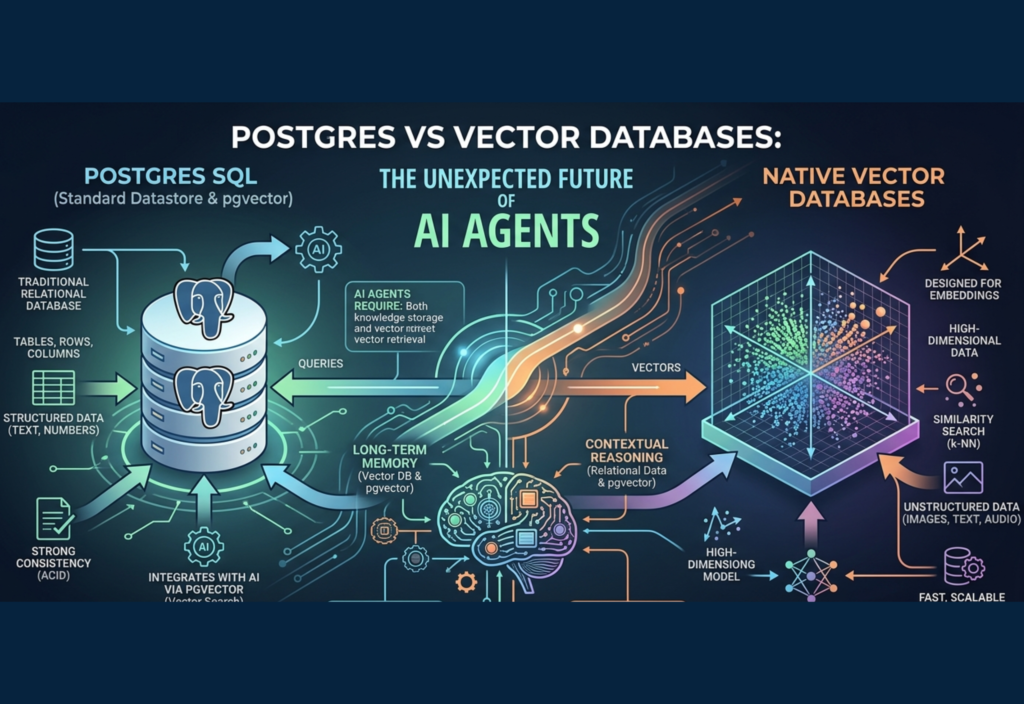
Postgres vs Vector DBs is an important comparison in modern AI development. Postgres vs Vector DBs shows how different database systems impact AI agents, data storage, and future AI applications.
For a long time, developers believed that vector databases would become the backbone of AI applications, especially for large language models (LLMs) and AI agents. However, a surprising shift is now taking place. Instead of replacing traditional systems, many AI architectures are returning to a familiar technology: PostgreSQL (Postgres).
This raises an important question:
Will the future of AI agents belong to vector databases, or will Postgres quietly take the lead?
Understanding the Core Difference
To understand this debate, it is important to first know how both systems work.
PostgreSQL (Postgres)
Postgres is a powerful open-source relational database that has been widely used for decades. It stores data in structured tables and allows users to interact with it using SQL queries.
Its key strengths include:
- Strong consistency and reliability
- Support for complex queries
- High scalability
- Extensibility through plugins and extensions
- Support for structured and semi-structured data
Traditionally, Postgres was not designed for AI or machine learning workloads. However, recent improvements have completely changed its role in modern systems.
Vector Databases
Vector databases are specialized systems designed to store and search vector embeddings—mathematical representations of data generated by AI models.
Instead of searching by keywords, they search by meaning and similarity.
They are commonly used for:
- AI chatbots
- Semantic search engines
- Recommendation systems
- Image and text similarity matching
- Retrieval-Augmented Generation (RAG) systems
Vector databases focus on one main goal: finding the most similar data points in a high-dimensional space as quickly as possible.
Why Vector Databases Became Popular
When large language models like GPT-style systems became mainstream, developers needed a way to store “memory” for AI systems.
Traditional databases were not designed to understand meaning. They only match exact values or patterns. Vector databases solved this problem by:
- Converting text into embeddings
- Storing embeddings as vectors
- Using similarity search instead of keyword matching
This allowed AI systems to:
- Understand context
- Retrieve relevant information
- Generate more accurate responses
Because of this, vector databases quickly became the default choice for AI applications.
The Limitations of Vector Databases
Despite their advantages, vector databases are not perfect.
1. Additional Complexity
Most AI systems already use databases like Postgres, MySQL, or MongoDB. Adding a separate vector database increases system complexity.
Developers must manage:
- Data synchronization
- Multiple storage systems
- Extra infrastructure costs
2. Higher Maintenance Cost
Running multiple databases increases:
- Cloud usage costs
- Operational overhead
- DevOps complexity
3. Limited Flexibility
Vector databases are highly specialized. They are excellent for similarity search but not designed for:
- Complex relational queries
- Transactions
- Structured data management
This creates a gap in full-stack AI applications.
The Rise of Postgres in the AI Era
The biggest surprise in recent years is how Postgres has evolved into an AI-ready database.
This transformation is largely driven by extensions like pgvector, which allow Postgres to store and search embeddings directly.
1. Postgres Becomes a Hybrid Database
With vector support, Postgres can now handle:
- Traditional relational data
- JSON and semi-structured data
- AI embeddings
This makes it a multi-purpose database, reducing the need for separate systems.
2. Unified Architecture Advantage
Instead of using multiple systems, developers can now build AI applications using a single database.
This leads to:
- Simpler architecture
- Easier debugging
- Faster development cycles
- Lower infrastructure cost
3. Strong Ecosystem and Stability
Postgres is one of the most mature databases in the world. It offers:
- Decades of optimization
- Strong community support
- Enterprise-level reliability
- Wide adoption across industries
For AI systems that require stability, this is a major advantage.
4. Better Integration with Existing Systems
Most companies already use Postgres in production systems. Adding vector capabilities allows them to:
- Avoid migrating to new systems
- Reuse existing infrastructure
- Integrate AI features faster
Performance Comparison: Postgres vs Vector Databases
Where Vector Databases Perform Better
Vector databases still outperform Postgres in:
- Large-scale similarity search (millions to billions of vectors)
- Ultra-fast nearest-neighbor queries
- AI-first architecture optimization
They are designed specifically for these workloads, making them very efficient at scale.
Where Postgres Performs Better
Postgres has the advantage in:
- Mixed workloads (structured + AI data)
- Transaction-heavy systems
- Smaller to medium-scale AI applications
- Cost-sensitive environments
In many real-world use cases, Postgres is “good enough” without requiring extra systems.
The Real Shift: Simplicity Over Specialization
The AI industry is now moving toward a new philosophy:
“Use fewer systems, not more systems.”
Instead of building complex stacks with multiple databases, developers are preferring:
- Simpler architecture
- Unified storage systems
- Easier maintenance
This is where Postgres becomes extremely powerful.
The Future of AI Agents
AI agents rely on:
- Memory
- Context retrieval
- Data storage
- Fast reasoning
In early designs, vector databases were considered essential for memory systems. But now, many modern architectures are shifting toward:
Hybrid Approaches
- Postgres for structured + vector data
- Optional vector databases for large-scale search
- External systems only when absolutely needed
This hybrid model is becoming the new standard.
Why Postgres Might Win the Long Game
Postgres is not trying to replace vector databases. Instead, it is evolving into something broader:
- A universal data layer
- A unified AI-ready backend
- A flexible storage engine for modern applications
Its biggest advantage is not speed—it is simplicity and adaptability.
Final Thoughts
The debate between Postgres and vector databases is not about competition—it is about evolution.
Vector databases will continue to play a crucial role in large-scale AI search systems. However, Postgres is proving that many AI workloads do not require specialized infrastructure.
The real future of AI agents is likely to be:
- Less fragmented
- More unified
- More cost-efficient
- More Postgres-centered
Conclusion
While vector databases introduced a powerful way to handle AI embeddings, the rapid evolution of Postgres is changing expectations.
With extensions like pgvector and a growing ecosystem, Postgres is no longer just a traditional database—it is becoming a central pillar of AI infrastructure.
The future of AI agents may not belong to specialized systems alone. It may belong to flexible, hybrid platforms—and Postgres is leading that transformation.