Floating platforms have evolved significantly over the past decade, moving from basic inflatable mats to highly engineered structures capable of supporting heavy loads and maintaining rigidity on water. At the heart of this transformation is drop-stitch technology, a manufacturing method that allows inflatable platforms to behave almost like solid surfaces when fully inflated. Understanding how this technology works explains why modern floating platforms are both strong and practical.
Understanding Drop-Stitch Technology
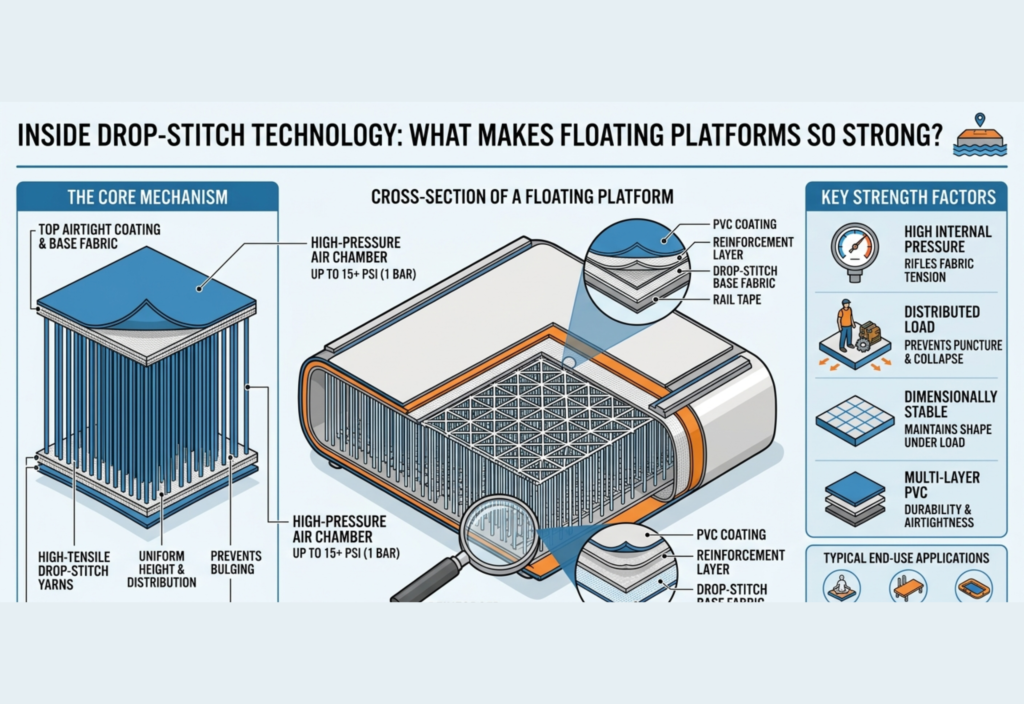
Drop-stitch technology is a specialized construction technique used in inflatable products where two layers of material are connected by thousands of fine internal threads. These threads run vertically between the top and bottom surfaces, holding them together at a fixed distance.
When the structure is inflated with air at high pressure, these threads prevent the material from expanding unevenly. Instead of bulging into a rounded shape like traditional inflatables, the platform becomes flat, firm, and rigid.
This design is commonly used in inflatable paddle boards, floating docks, and modular water platforms. The key idea is simple: air provides buoyancy, while the internal threads provide structural integrity.
How Drop-Stitch Technology Works in Practice
The strength of a drop-stitch floating platform comes from the interaction between internal pressure and thread tension.
When air is pumped inside:
- The internal pressure pushes outward in all directions
- The thousands of internal threads resist expansion vertically
- The top and bottom layers are pulled tightly into a flat plane
- The structure becomes rigid instead of soft or flexible
Because the threads are evenly distributed throughout the structure, the load is spread across the entire surface rather than concentrated in one area. This uniform distribution is what gives drop-stitch platforms their impressive strength and stability.
Internal Structure and Engineering
Inside a drop-stitch platform lies a dense matrix of polyester or similar high-strength fibers. These fibers are precisely aligned and bonded between the upper and lower layers during manufacturing.
The spacing and density of these threads determine how rigid the platform will be:
- Higher thread density → greater stiffness and load capacity
- Lower thread density → more flexibility but less rigidity
Once sealed, the outer layers are typically reinforced with durable materials such as multi-layer PVC, which protects the internal structure from water, UV rays, and physical damage.
Role of Air Pressure in Strength
Air pressure is a critical factor in the performance of drop-stitch platforms. These platforms are usually inflated to much higher pressures compared to standard inflatables.
Higher pressure results in:
- Increased rigidity
- Better weight distribution
- Reduced flexing under load
- Improved stability on water
Because the internal threads limit expansion, the structure can safely handle high pressure without deforming. This is what allows a relatively lightweight inflatable platform to support multiple people or heavy equipment.
Materials Used in Construction
The durability of floating platforms depends heavily on the materials used alongside drop-stitch technology. Common materials include:
- PVC (Polyvinyl Chloride): Used for outer layers due to its waterproof and flexible nature
- Polyester Threads: Provide internal vertical reinforcement
- Laminated Fabric Layers: Add extra resistance against punctures and abrasions
- Heat-Welded Seams: Ensure airtight construction and prevent leakage
These materials are engineered to withstand harsh environments such as sunlight, saltwater, and repeated inflation cycles.
Why Drop-Stitch Platforms Are So Strong
Several factors contribute to the exceptional strength of drop-stitch floating platforms:
1. Internal Thread Reinforcement
The thousands of threads act like an internal skeleton, preventing the structure from expanding beyond its intended shape.
2. High-Pressure Capability
Unlike traditional inflatables, these platforms operate at much higher PSI levels, increasing rigidity.
3. Uniform Load Distribution
Weight placed on the platform is evenly spread across the surface, reducing stress on any single point.
4. Flat Surface Design
The flat, board-like surface enhances stability and usability compared to curved inflatable designs.
5. Multi-Layer Protection
Outer layers shield the internal structure from environmental damage, improving longevity.
Applications of Floating Platforms
Drop-stitch technology enables a wide range of applications beyond simple recreational use.
Recreational Use
Floating platforms are commonly used for swimming, relaxation, sunbathing, and water-based leisure activities.
Water Sports Equipment
Products like paddle boards rely heavily on drop-stitch construction for balance, control, and rigidity.
Floating Docks and Workspaces
Temporary docks, event stages, and working platforms can be assembled quickly and deployed in various water environments.
Commercial and Industrial Use
Floating platforms are used in construction, maintenance, and logistics operations where stable water-based surfaces are required.
Emergency Response
In disaster scenarios such as floods, portable floating platforms can assist in rescue operations and transportation.
Advantages of Drop-Stitch Floating Platforms
Drop-stitch technology offers several advantages that make it ideal for modern applications:
- Lightweight and easy to transport
- Compact when deflated and stored
- High strength-to-weight ratio
- Stable and rigid when inflated
- Quick setup and deployment
- Versatile across multiple environments
These advantages make them suitable for both individual users and large-scale operations.
Limitations and Considerations
Despite their strength, drop-stitch platforms have some limitations:
- Must be inflated to the correct pressure for optimal performance
- Susceptible to punctures if exposed to sharp objects
- Requires regular maintenance and inspection
- Performance depends on build quality and materials used
- May lose rigidity if air pressure drops
Proper handling and maintenance are essential to ensure long-term durability.
Maintenance and Best Practices
To keep a drop-stitch floating platform in good condition:
- Inflate according to manufacturer-recommended pressure levels
- Avoid dragging the platform over rough surfaces
- Rinse with fresh water after exposure to saltwater
- Store in a shaded, dry environment
- Check for leaks, wear, or damage regularly
- Avoid prolonged exposure to extreme heat or sunlight
Following these practices helps extend the lifespan and maintain performance.
Future of Drop-Stitch Technology
As materials science and manufacturing techniques continue to improve, drop-stitch technology is expected to become even more advanced. Future developments may include:
- Stronger and lighter composite materials
- Improved thread bonding techniques
- Enhanced pressure tolerance
- More eco-friendly production methods
- Integration with modular floating systems
These advancements will likely expand the use of floating platforms in commercial, industrial, and recreational sectors.
Conclusion
Drop-stitch technology is the backbone of modern floating platforms, enabling them to combine portability with exceptional strength. By using thousands of internal threads and high-pressure inflation, these platforms maintain a rigid, stable structure capable of supporting significant loads while remaining lightweight and easy to handle.
From recreational use to industrial applications, the versatility and durability of drop-stitch platforms make them an essential innovation in water-based structures. As technology continues to evolve, their role in various industries is only expected to grow, offering even more efficient and reliable solutions for working and recreating on water.