
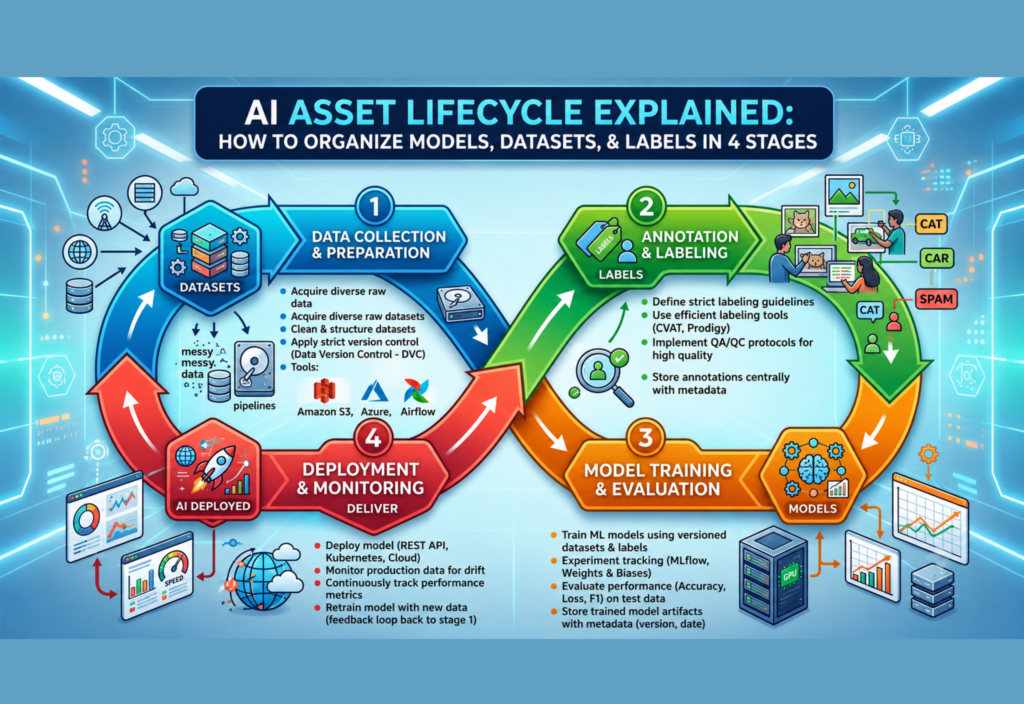
Artificial Intelligence (AI) projects generate enormous amounts of valuable assets, including datasets, labels, trained models, evaluation reports, and deployment artifacts. Without proper organization, these assets can quickly become difficult to manage, leading to inefficiencies, compliance challenges, and poor model performance.
The AI Asset Lifecycle provides a structured approach to managing these resources throughout their entire journey. From data collection to model retirement, every asset should be organized, tracked, and maintained to ensure reliability and scalability.
In this comprehensive guide, you’ll learn how to organize models, datasets, and labels using the four key stages of the AI Asset Lifecycle.
What Is an AI Asset Lifecycle?
The AI Asset Lifecycle refers to the complete process of managing all resources used in AI development and deployment. These assets include:
- Training datasets
- Labels and annotations
- Machine learning models
- Evaluation reports
- Metadata
- Deployment configurations
- Monitoring records
A structured lifecycle helps organizations maintain consistency, improve collaboration, and ensure that AI systems remain accurate and trustworthy over time.
Why AI Asset Management Is Important
AI projects often fail because teams focus only on training models while neglecting asset organization.
Benefits of effective AI asset management include:
- Better model performance
- Improved collaboration
- Easier compliance and auditing
- Faster development cycles
- Reduced operational risks
- Enhanced scalability
Organizations that properly manage their AI assets can build more reliable and sustainable AI solutions.
Stage 1: Data Collection and Asset Creation
The first stage focuses on gathering and organizing the foundational assets required for AI development.
Collect Data from Reliable Sources
High-quality AI systems start with high-quality data.
Common data sources include:
- Business databases
- Mobile applications
- IoT devices
- Customer interactions
- Public datasets
- Research repositories
Every dataset should include metadata that identifies its source, ownership, collection date, and usage permissions.
Organize Datasets Effectively
Proper dataset organization prevents confusion and duplication.
Best practices include:
- Creating versioned datasets
- Using consistent naming conventions
- Maintaining detailed metadata
- Documenting data transformations
Version control ensures that teams can reproduce experiments and track changes over time.
Clean and Validate Data
Raw data frequently contains errors and inconsistencies.
Data preparation should include:
- Removing duplicates
- Handling missing values
- Correcting formatting issues
- Identifying outliers
- Validating records
Clean data improves model accuracy and reduces training issues.
Create and Manage Labels
Labels are essential for supervised machine learning.
Examples include:
- Image annotations
- Sentiment classifications
- Fraud indicators
- Medical diagnosis categories
To maintain label quality:
- Establish annotation guidelines
- Perform quality reviews
- Use multiple reviewers when necessary
- Maintain label version histories
Accurate labels are critical because models learn directly from them.
Stage 2: Model Development and Training
Once datasets and labels are prepared, the next step is building and training AI models.
Perform Feature Engineering
Feature engineering transforms raw data into meaningful inputs for machine learning algorithms.
Examples include:
- Extracting keywords from text
- Creating customer behavior metrics
- Generating image embeddings
- Calculating statistical indicators
Well-designed features often improve performance significantly.
Train Multiple Model Variants
AI teams typically experiment with several models before selecting the best one.
Common approaches include:
- Decision Trees
- Random Forests
- Gradient Boosting Models
- Neural Networks
- Large Language Models
Each training run should be documented carefully.
Implement Model Version Control
Every trained model should receive a unique version identifier.
Model records should include:
- Training date
- Dataset version
- Hyperparameters
- Performance metrics
- Developer notes
Version control allows organizations to roll back models if problems arise after deployment.
Validate Model Performance
Before deployment, models must be thoroughly evaluated.
Common evaluation metrics include:
- Accuracy
- Precision
- Recall
- F1 Score
- ROC-AUC
- Mean Absolute Error
Testing should also examine fairness, bias, robustness, and security vulnerabilities.
Stage 3: Deployment and Operational Management
After validation, AI models move into production environments where they begin generating business value.
Deploy Models Safely
Models may be deployed through:
- APIs
- Cloud platforms
- Enterprise software
- Mobile applications
- Edge devices
Deployment documentation should capture all technical dependencies and configuration details.
Track AI Assets in Production
Organizations should maintain visibility into every deployed asset.
Tracking systems should record:
- Active model versions
- Dataset lineage
- Label sources
- Deployment dates
- Responsible teams
This information is essential for governance and troubleshooting.
Monitor Performance Continuously
Model performance often changes over time due to evolving data patterns.
Monitoring should track:
- Prediction quality
- Error rates
- System latency
- Resource utilization
- User feedback
Continuous monitoring helps identify issues before they affect business operations.
Maintain Security and Compliance
AI assets often contain sensitive or regulated information.
Security measures should include:
- Role-based access controls
- Data encryption
- Audit logging
- Compliance reviews
- Secure storage practices
Strong governance protects both organizations and users.
Stage 4: Optimization, Governance, and Retirement
AI systems require ongoing maintenance and improvement throughout their operational life.
Continuously Improve Models
Performance insights can reveal opportunities for enhancement.
Improvement activities may include:
- Collecting additional data
- Updating labels
- Retraining models
- Optimizing features
- Adjusting algorithms
Continuous improvement ensures long-term effectiveness.
Establish AI Governance Frameworks
Governance promotes transparency and accountability.
Important governance practices include:
- Comprehensive documentation
- Risk assessments
- Bias monitoring
- Regulatory compliance reviews
- Change management processes
Governance becomes increasingly important as AI adoption expands.
Prepare for Audits and Compliance
Organizations should maintain detailed records of:
- Training datasets
- Labeling procedures
- Model versions
- Evaluation reports
- Deployment histories
Proper documentation simplifies audits and regulatory reviews.
Retire Obsolete Models
Eventually, models may become outdated or ineffective.
Retirement procedures should include:
- Archiving model artifacts
- Preserving datasets
- Storing evaluation reports
- Documenting retirement reasons
A structured retirement process preserves organizational knowledge and historical traceability.
Best Practices for Organizing Models, Datasets, and Labels
Centralize Asset Storage
Store all AI assets in a unified repository to improve accessibility and collaboration.
Use Version Control Everywhere
Version control should apply to:
- Datasets
- Labels
- Models
- Configurations
- Documentation
This improves reproducibility and accountability.
Automate Lifecycle Management
Automation can reduce errors and improve efficiency.
Automate tasks such as:
- Data validation
- Quality checks
- Model testing
- Performance monitoring
- Retraining workflows
Assign Clear Ownership
Each asset should have a designated owner responsible for:
- Maintenance
- Compliance
- Documentation
- Quality assurance
Clear ownership prevents confusion and neglect.
Document Everything
Documentation should explain:
- Data origins
- Labeling methods
- Model configurations
- Evaluation results
- Deployment history
Well-documented assets are easier to maintain and audit.
Common AI Asset Management Mistakes
Organizations should avoid:
- Using poor-quality data
- Ignoring label accuracy
- Skipping version control
- Deploying without monitoring
- Maintaining incomplete documentation
- Neglecting governance requirements
- Keeping outdated models active
Avoiding these mistakes significantly increases the chances of AI project success.
Conclusion
The AI Asset Lifecycle provides a systematic framework for organizing models, datasets, and labels throughout the entire AI development process. By following the four stages—Data Collection and Asset Creation, Model Development and Training, Deployment and Operational Management, and Optimization, Governance, and Retirement—organizations can build more reliable, scalable, and trustworthy AI systems.
Proper asset management ensures that every dataset, label, and model remains traceable, secure, and reusable. As AI adoption continues to grow, businesses that invest in effective lifecycle management will be better positioned to achieve long-term success while maintaining compliance, quality, and operational efficiency.