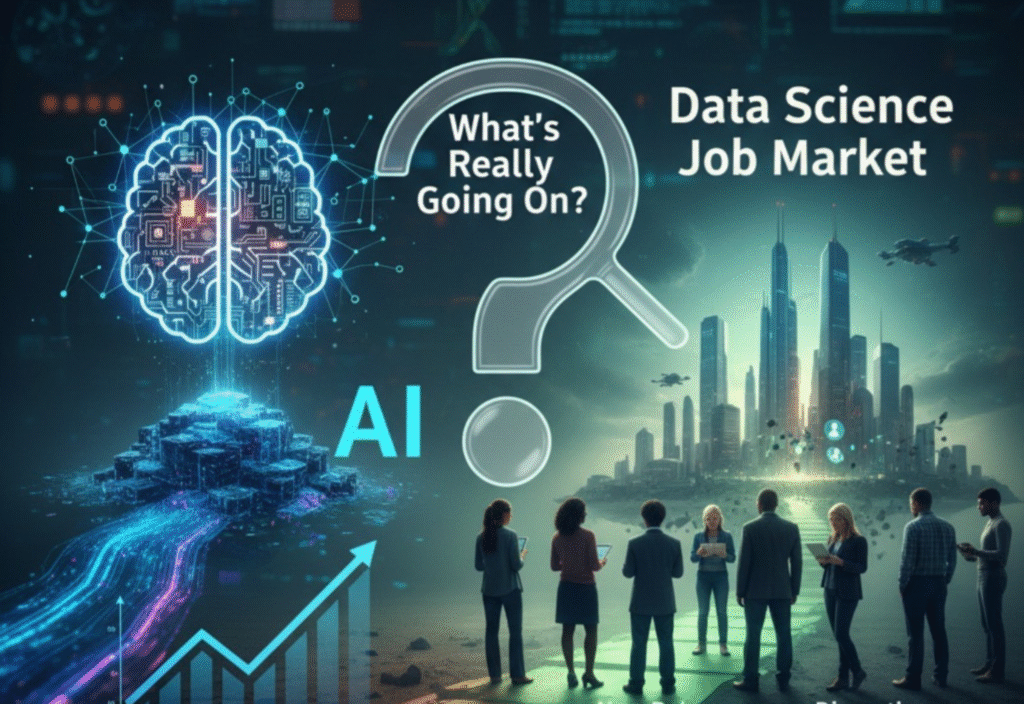
The landscape of AI and the data science job market is changing faster than ever. With rapid advancements in artificial intelligence, many professionals are questioning whether AI will replace data scientists entirely or simply transform their roles. The truth is nuanced: AI is reshaping the field, creating new opportunities, and demanding updated skills. Understanding these changes is essential for anyone looking to build a sustainable career in data science today.
How AI Is Transforming Data Science Work
Artificial Intelligence is no longer just a supporting tool in data science—it is becoming an active participant in the workflow. Modern AI systems are increasingly handling repetitive and time-consuming tasks, such as:
- Data cleaning and preprocessing
- Feature engineering
- Automated exploratory data analysis
- Basic model building and hyperparameter tuning
- Documentation and reporting
This shift is significantly improving productivity. For example, platforms like IBM highlight that AI-powered analytics can reduce manual workload and speed up decision-making processes in enterprise environments.
However, this does not mean data scientists are becoming obsolete. Instead, their role is evolving from “data processor” to “decision architect.” The focus is shifting toward:
- Designing advanced models
- Solving complex business problems
- Interpreting AI outputs in real-world contexts
- Building AI-driven strategies for organizations
AI is essentially removing friction from technical workflows so humans can focus on higher-level thinking.
Why Data Science Roles Are Not Disappearing
A common misconception is that AI will fully replace data scientists. In reality, AI systems still lack key human capabilities:
- Context understanding
- Ethical reasoning
- Domain-specific judgment
- Business alignment and strategic thinking
Even advanced systems struggle to interpret ambiguous real-world problems without human input. This is why companies are increasingly building hybrid teams where AI handles execution and humans handle direction.
In short, AI is not replacing data scientists—it is reshaping what “data science” actually means.
Evolving Skills in High Demand
The job market is rapidly moving away from traditional generalist data science roles toward more specialized and hybrid positions. Employers now prioritize professionals who understand both AI systems and real-world applications.
Some of the most in-demand roles include:
Data Engineer
Focuses on designing and maintaining scalable data pipelines, cloud storage systems, and data architecture.
Machine Learning Engineer
Works on training, optimizing, and deploying machine learning models into production environments.
MLOps Engineer
Manages the lifecycle of machine learning systems, including monitoring, automation, and model deployment.
AI Specialist
Works with generative AI, large language models, and advanced deep learning systems.
Analytics Translator
Bridges technical insights with business decision-making, ensuring AI results are actionable.
Companies like Google Cloud emphasize that hands-on experience with cloud platforms, machine learning systems, and real-world AI projects is becoming more important than theoretical knowledge alone.
Human Expertise Remains Critical
Even in an AI-driven ecosystem, human intelligence remains the core driver of meaningful outcomes. Data scientists are still needed for tasks such as:
- Ensuring fairness, transparency, and ethical AI usage
- Validating model accuracy and reliability
- Interpreting outputs in business contexts
- Making strategic decisions based on data insights
- Identifying risks and limitations in AI systems
AI can generate predictions, but humans decide whether those predictions are useful, safe, and aligned with business goals.
Challenges Facing New Professionals
For newcomers entering the field, the barrier to entry is increasing—not because opportunities are shrinking, but because expectations are rising.
Entry-level professionals now face challenges such as:
- Increased competition due to automation of basic tasks
- Higher expectations for practical, hands-on skills
- Need for cloud computing and MLOps knowledge
- Requirement to build strong project portfolios
- Familiarity with AI tools and frameworks
To stay competitive, aspiring data scientists must go beyond tutorials and focus on real-world problem solving, such as:
- End-to-end machine learning projects
- API-based model deployment
- Cloud-based data workflows
- AI integration in business use cases
Industries Expanding AI and Data Science Jobs
One of the most important trends in 2025 is that AI and data science are no longer limited to tech companies. Almost every major industry is adopting data-driven systems.
Healthcare
AI is used for diagnostics, predictive analysis, and medical imaging.
Finance
Fraud detection, credit scoring, and algorithmic trading are heavily data-driven.
Retail and E-commerce
Personalized recommendations and customer behavior analytics dominate this sector.
Manufacturing
Predictive maintenance and quality control systems reduce downtime and cost.
Transportation
Route optimization, logistics planning, and autonomous systems rely on AI models.
Education
Personalized learning platforms use data to adapt to student performance.
This diversification shows that AI and data science skills are now universal across industries.
The Future Outlook for AI and Data Science Jobs
The future is not about fewer jobs—it is about different types of jobs.
Key trends shaping the next phase include:
- Rise of hybrid roles combining AI, engineering, and business strategy
- Growing importance of AI governance and compliance roles
- Expansion of domain-specific AI expertise
- Strong demand for MLOps and cloud-native workflows
- Increased focus on responsible and explainable AI
Organizations are no longer just hiring data scientists—they are building AI ecosystems.
Conclusion
The AI and data science job market in 2025 is not shrinking—it is transforming into something more advanced, specialized, and opportunity-rich.
AI is automating repetitive tasks, but it is also expanding what humans can achieve. The role of a data scientist is evolving into something more strategic, more technical, and more impactful.
The professionals who will succeed in this new era are not those who resist AI, but those who learn how to work with it—combining machine intelligence with human creativity, judgment, and strategy.
In the end, the future of data science is not human versus AI. It is human plus AI.