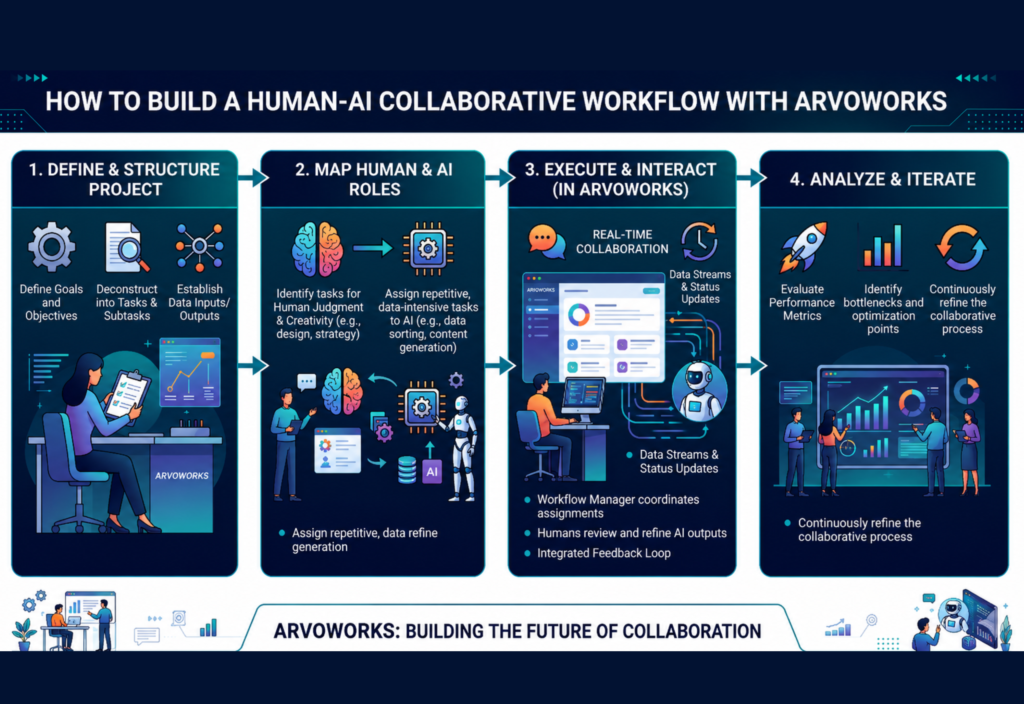
Human-AI Collaborative Workflow is becoming an essential strategy for modern businesses looking to improve productivity, automate routine tasks, and enhance team performance. Instead of replacing employees, organizations are using AI to support human decision-making, creativity, and problem-solving. By combining human expertise with AI-powered automation, a Human-AI Collaborative Workflow helps teams work more efficiently while maintaining accuracy, control, and innovation.
One platform helping organizations create these collaborative environments is ArvoWorks. By integrating AI-powered processes into project management and team collaboration, ArvoWorks enables businesses to improve productivity while maintaining human oversight and control.
This guide explains how to build a Human-AI Collaborative Workflow with ArvoWorks, its benefits, key components, and best practices for long-term success.
What Is a Human-AI Collaborative Workflow?
A Human-AI Collaborative Workflow is a system where humans and artificial intelligence work together on tasks rather than operating independently.
In this model:
- AI handles repetitive tasks.
- Humans make strategic decisions.
- AI analyzes data.
- Humans provide creativity and judgment.
- AI improves efficiency.
- Humans ensure quality and accuracy.
The goal is not to replace employees but to empower them with intelligent tools that reduce workload and increase productivity.
Understanding ArvoWorks
ArvoWorks is a workflow management platform designed to help teams organize projects, automate processes, and improve collaboration.
The platform supports:
- Task management
- Workflow automation
- Team collaboration
- Process tracking
- Productivity monitoring
- AI-assisted operations
By combining structured workflows with AI-powered tools, organizations can create more efficient and scalable business processes.
Why Human-AI Collaboration Matters
Modern businesses face increasing challenges, including:
- Growing workloads
- Limited resources
- Complex projects
- Rising customer expectations
- Faster decision-making requirements
Human-AI collaboration helps address these challenges by allowing teams to focus on high-value activities while AI manages routine processes.
Key Benefits
Increased Productivity
AI can process information and complete repetitive tasks much faster than manual methods.
Better Decision-Making
AI-generated insights help teams make informed decisions based on data.
Reduced Human Error
Automation minimizes mistakes in repetitive processes.
Improved Employee Satisfaction
Employees spend less time on routine tasks and more time on meaningful work.
Faster Project Completion
Tasks move through workflows more efficiently.
Step 1: Identify Repetitive Tasks
Before implementing AI, organizations should identify tasks that consume excessive time.
Examples include:
- Data entry
- Report generation
- Status updates
- Task assignments
- Document organization
- Information retrieval
These activities are ideal candidates for automation within ArvoWorks.
The objective is to free employees from repetitive work while allowing them to focus on strategic activities.
Step 2: Define Human Responsibilities
Not every task should be automated.
Human involvement remains essential for:
Strategic Planning
Business goals require human insight and leadership.
Creative Work
Content creation, innovation, and brainstorming benefit from human creativity.
Relationship Management
Customer interactions often require empathy and understanding.
Quality Control
Humans should review important outputs before final approval.
Clearly defining human responsibilities helps maintain balance within the workflow.
Step 3: Integrate AI Into Daily Operations
Once repetitive tasks are identified, AI can be integrated into workflow processes.
Examples include:
Automated Task Prioritization
AI can analyze deadlines and assign priorities automatically.
Smart Notifications
Team members receive reminders based on workflow activity.
Data Analysis
AI can evaluate large amounts of information and identify trends.
Workflow Recommendations
AI may suggest process improvements based on historical performance.
ArvoWorks can help centralize these functions within a single workspace.
Step 4: Create Structured Workflow Stages
Successful collaboration requires clear workflow stages.
A typical workflow may include:
Planning
Project goals are defined.
Task Assignment
Responsibilities are distributed among team members.
AI Support
Automation handles repetitive operations.
Human Review
Team members verify results.
Approval
Final decisions are made by authorized personnel.
Completion
Projects are finalized and documented.
Structured workflows reduce confusion and improve accountability.
Step 5: Establish Approval Processes
AI can accelerate work, but critical decisions should remain under human control.
Organizations should create approval checkpoints for:
- Financial decisions
- Client communications
- Legal documentation
- Strategic initiatives
- Public content
Human oversight helps maintain quality, compliance, and trust.
Step 6: Use AI for Data-Driven Insights
One of AI’s greatest strengths is analyzing information quickly.
AI tools can help teams:
- Identify performance trends
- Predict project delays
- Monitor productivity
- Track workflow bottlenecks
- Generate reports
These insights help managers make more informed decisions and optimize operations.
Step 7: Encourage Team Adoption
Technology is most effective when employees understand how to use it.
Organizations should provide:
Training Programs
Employees need guidance on AI-assisted workflows.
Documentation
Clear instructions improve adoption rates.
Ongoing Support
Teams should have access to help when needed.
Feedback Opportunities
Employee feedback can identify workflow improvements.
Successful Human-AI collaboration depends on user acceptance and participation.
Best Practices for Human-AI Collaboration
Keep Humans in Control
AI should support decision-making rather than replace it entirely.
Start Small
Begin with simple automation projects before expanding.
Monitor Performance
Regularly review workflow effectiveness.
Maintain Transparency
Employees should understand how AI contributes to workflow processes.
Continuously Improve
Workflow optimization should be an ongoing effort.
Common Challenges and Solutions
Resistance to Change
Some employees may be hesitant to adopt AI-powered systems.
Solution: Provide training and demonstrate practical benefits.
Over-Automation
Automating too many processes can reduce flexibility.
Solution: Maintain human review for important decisions.
Poor Data Quality
AI depends on accurate information.
Solution: Ensure data is organized and regularly updated.
Workflow Complexity
Complicated processes can reduce efficiency.
Solution: Keep workflows simple and scalable.
Real-World Applications
Human-AI Collaborative Workflows can be used across multiple industries.
Marketing
AI assists with analytics while humans create strategies and campaigns.
Customer Support
AI handles routine inquiries while human agents manage complex issues.
Project Management
AI tracks progress while managers oversee project execution.
Content Creation
AI helps with research and drafting while humans refine and approve content.
Business Operations
Automation streamlines administrative processes while leadership focuses on growth.
Future of Human-AI Collaboration
The future workplace will increasingly combine human expertise with AI capabilities.
Organizations that successfully implement collaborative workflows can expect:
- Greater productivity
- Faster project delivery
- Better resource utilization
- Improved employee experiences
- Enhanced innovation
Rather than replacing human workers, AI is becoming a valuable partner that helps teams perform at a higher level.
Conclusion
Building a Human-AI Collaborative Workflow with ArvoWorks allows organizations to combine the strengths of human intelligence and artificial intelligence within a structured environment. By automating repetitive tasks, improving collaboration, and maintaining human oversight, businesses can create more efficient and scalable workflows.
The key to success is balance. AI should handle routine processes and provide insights, while humans continue to lead strategy, creativity, and decision-making. When implemented correctly, a Human-AI Collaborative Workflow can improve productivity, streamline operations, and prepare organizations for the future of work.