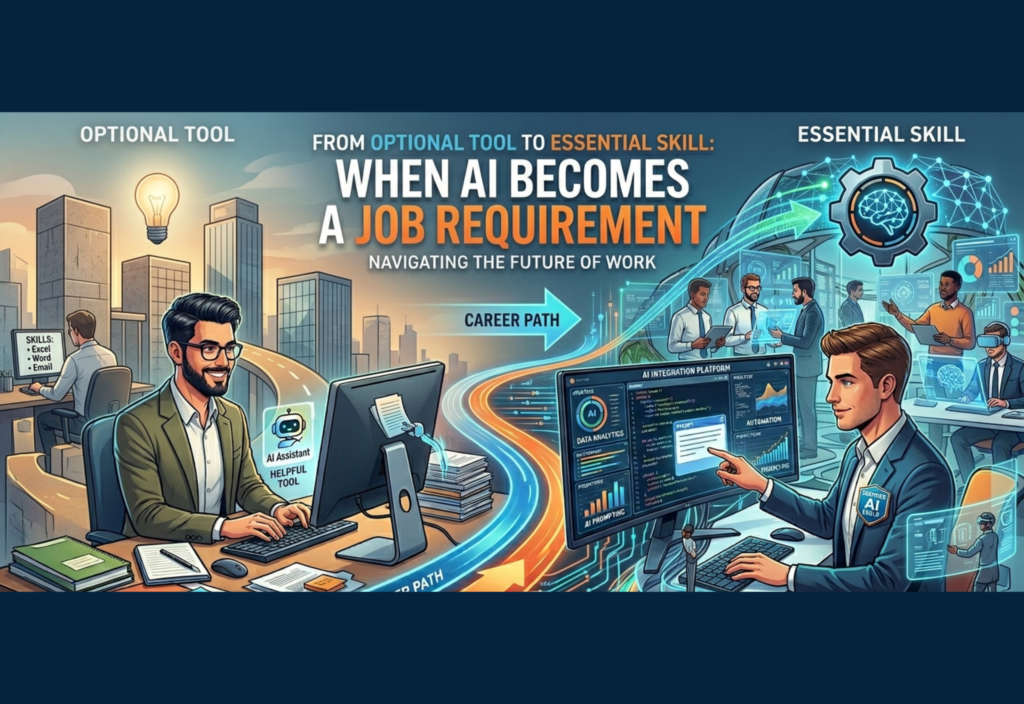
AI Job Requirement is no longer a future idea—it is becoming a reality in today’s workplace. Artificial Intelligence (AI) has moved from being an optional tool to an essential professional skill that every modern employee is expected to understand and use.This shift reflects a broader transformation in the nature of work itself. As businesses strive to stay competitive in an increasingly digital world, they are integrating AI into their operations at every level. From automating repetitive tasks to enabling advanced decision-making, AI is redefining what it means to be effective in the workplace.
The Evolution of Workplace Skills
Every generation of workers has faced a technological shift that redefined essential skills. There was a time when typewriting was considered a valuable ability. Later, computer literacy became mandatory. Then came the internet, email communication, and digital collaboration tools.
AI represents the next stage in this evolution.
Initially, AI tools were seen as optional add-ons—something innovative professionals could use to gain a slight edge. But as these tools became more accessible and powerful, the gap between those who use AI and those who don’t started to widen significantly.
Today, that gap is becoming too large for businesses to ignore. As a result, companies are increasingly expecting employees to be comfortable working with AI, just as they expect them to use computers or smartphones.
Why AI Has Become Essential
There are several reasons behind AI’s transition from optional to essential:
1. Speed and Productivity
AI can complete tasks in seconds that would take humans hours. Whether it’s writing reports, analyzing data, or generating ideas, AI drastically improves efficiency. In fast-paced environments, speed is often the difference between success and failure.
2. Information Overload
Modern workplaces deal with massive amounts of data. AI helps filter, organize, and extract meaningful insights from this data, allowing professionals to make informed decisions quickly.
3. Rising Competition
As more companies adopt AI, those that don’t risk falling behind. This creates pressure on organizations to hire individuals who can leverage AI effectively.
4. Changing Job Expectations
Employers are no longer just looking for experience—they are looking for adaptability. Being able to work with AI shows that a candidate is forward-thinking and ready for future challenges.
AI Is Not Replacing Humans—It’s Reshaping Roles
A common concern is that AI will replace jobs entirely. While automation does reduce the need for certain repetitive roles, it also creates new opportunities and transforms existing ones.
Instead of replacing humans, AI is changing what humans focus on.
Routine tasks such as data entry, basic analysis, and repetitive communication are increasingly handled by AI. This allows professionals to concentrate on higher-value activities like strategy, creativity, problem-solving, and relationship-building.
For example:
- A content writer uses AI to generate drafts but adds human creativity and originality.
- A data analyst uses AI to process datasets but interprets the results for business decisions.
- A customer support agent uses AI chat systems but handles complex or sensitive issues personally.
This shift highlights an important reality: AI works best when combined with human intelligence.
The Emergence of Hybrid Professionals
The modern workforce is giving rise to a new type of professional—someone who blends domain expertise with AI capabilities.
These hybrid professionals are not necessarily experts in AI development, but they understand how to use AI tools effectively within their field. They know how to:
- Frame the right questions for AI systems
- Evaluate and refine AI-generated outputs
- Integrate AI into workflows
- Identify when human judgment is necessary
This combination makes them highly valuable, as they can bridge the gap between technology and real-world application.
AI Across Industries: A Universal Impact
One of the most significant aspects of AI is its universality. It is not limited to one sector—it is transforming nearly every field.
Business and Marketing
AI is used for content creation, audience targeting, campaign optimization, and performance analysis. Marketers who understand AI can create more effective strategies in less time.
Healthcare
AI assists in diagnosing diseases, analyzing patient data, and improving treatment plans. Medical professionals who use AI can provide faster and more accurate care.
Education
Teachers use AI to personalize learning experiences, automate grading, and track student progress.
Finance
AI is used for fraud detection, risk analysis, and financial forecasting.
Software Development
Developers use AI tools to write, debug, and optimize code, significantly reducing development time.
No matter the profession, AI is becoming part of the standard toolkit.
Skills You Need in the AI Era
To stay relevant, professionals must develop a set of complementary skills that allow them to work effectively with AI.
AI Literacy
Understanding how AI works, its strengths, and its limitations.
Prompting Skills
Knowing how to give clear and effective instructions to AI tools.
Critical Thinking
AI can make mistakes. The ability to analyze and verify its outputs is crucial.
Creativity
AI can generate ideas, but human creativity adds uniqueness and emotional depth.
Adaptability
The AI landscape evolves rapidly. Continuous learning is essential.
Ethical Awareness
Understanding issues like bias, privacy, and responsible use of AI.
Challenges in the Transition
Despite its advantages, the rise of AI also presents challenges:
Skill Gaps
Not everyone has access to AI education or resources, creating inequality in opportunities.
Overdependence
Relying too heavily on AI can weaken problem-solving abilities.
Job Disruption
Certain roles may become less relevant, requiring workers to reskill.
Ethical Concerns
AI systems can produce biased or misleading outputs if not used carefully.
These challenges highlight the need for balanced and responsible adoption of AI.
How to Adapt and Stay Ahead
Adapting to the AI-driven world does not require becoming a technical expert. Instead, focus on practical steps:
- Start using AI tools in daily tasks
- Learn through online courses and tutorials
- Stay updated with AI trends and developments
- Experiment and practice regularly
- Build a mindset of continuous learning
The goal is not perfection, but familiarity and confidence.
The Future of Work
Looking ahead, AI will become as common in the workplace as email or spreadsheets. Job descriptions will increasingly include AI-related expectations, and eventually, these expectations may become so standard that they are no longer explicitly mentioned.
The future workforce will consist of individuals who can collaborate with AI effectively. Those who resist this change may find themselves at a disadvantage, while those who embrace it will unlock new opportunities.
Conclusion
The transition of AI from an optional tool to an essential skill marks a defining moment in the evolution of work. It is reshaping industries, redefining roles, and setting new expectations for professionals around the world.
Success in this new era will not depend solely on technical expertise, but on the ability to adapt, learn, and integrate AI into everyday tasks. Those who understand how to combine human intelligence with artificial intelligence will be best positioned to thrive.
AI is not just a trend—it is a fundamental shift. And in this new reality, learning to work with AI is no longer optional. It is a necessity for anyone who wants to remain relevant in the modern job market.