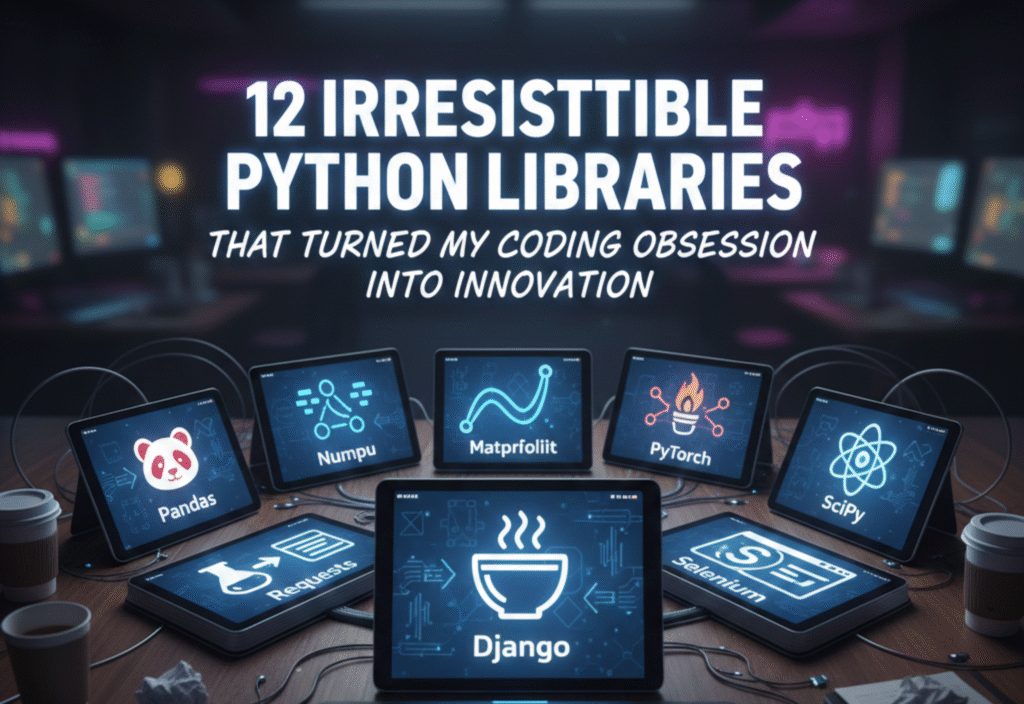
Python is no longer just a programming language—it is a complete ecosystem that powers innovation across artificial intelligence, data science, automation, and web development. In 2026, Python continues to dominate the tech landscape because of its simplicity and its vast collection of powerful libraries.
Whether you are a beginner or an experienced developer, understanding the right libraries can significantly improve your productivity and open doors to advanced development opportunities.
In this updated guide, we explore the most important Python libraries in 2026 based on real-world usage, performance, and long-term relevance.
Why Python Libraries Are More Important Than Ever
Python’s core strength lies in its ecosystem. Libraries allow developers to:
Build complex systems quickly
Reduce development time
Solve advanced problems with minimal code
Scale applications efficiently
In 2026, success with Python depends not just on learning the language, but on mastering the ecosystem around it.
1. Pandas – The Backbone of Data Analysis
Pandas is one of the most widely used libraries for data manipulation and analysis. It provides powerful tools for working with structured data using DataFrames.
It is essential for cleaning, transforming, and analyzing data in almost every data-driven project.
Use Cases:
Data cleaning and preprocessing
ETL pipelines
Financial data analysis
Automation tasks
2. NumPy – High-Performance Numerical Computing
NumPy enables efficient numerical operations with multi-dimensional arrays and matrices. It is the foundation for most scientific and machine learning libraries.
Its performance and speed make it critical for heavy computations.
Use Cases:
Mathematical operations
Matrix calculations
Data preparation for machine learning
3. Matplotlib – Reliable Data Visualization
Matplotlib is a core visualization library that helps turn raw data into meaningful charts and graphs. It remains widely used in 2026 for both simple and advanced visualizations.
It is often combined with other tools for enhanced visual storytelling.
Use Cases:
Data visualization
Reporting
Analytical dashboards
4. Scikit-learn – Practical Machine Learning
Scikit-learn provides simple and efficient tools for machine learning. It is widely used for building and evaluating models quickly.
In 2026, it is especially valuable for explainable AI and production-ready pipelines.
Use Cases:
Classification and regression
Clustering
Model evaluation
5. TensorFlow – Scalable Deep Learning
TensorFlow remains a leading framework for deep learning and large-scale AI applications. It is widely used in both research and production environments.
Its flexibility and scalability make it suitable for complex AI systems.
Use Cases:
Neural networks
AI product development
Predictive modeling
6. Flask – Lightweight Web Development
Flask is a minimal and flexible web framework that allows developers to build applications quickly.
It is ideal for microservices and API development.
Use Cases:
REST APIs
Backend services
Small to medium web applications
7. Django – Full-Stack Web Framework
Django is a powerful framework designed for rapid development and clean design. It includes built-in features for authentication, security, and database management.
It is widely used for building scalable and secure applications.
Use Cases:
Enterprise applications
SaaS platforms
Full-stack development
8. Beautiful Soup – Efficient Web Scraping
Beautiful Soup simplifies the process of extracting data from HTML and XML documents.
It remains one of the most reliable tools for web scraping in 2026.
Use Cases:
Data extraction
Web scraping
Content automation
9. OpenCV – Computer Vision Library
OpenCV enables machines to process and analyze images and videos.
It plays a key role in computer vision applications across industries.
Use Cases:
Image processing
Object detection
Video analysis
10. Pygame – Game Development Made Simple
Pygame is a popular library for building 2D games and interactive applications.
It is especially useful for beginners learning programming through creative projects.
Use Cases:
2D game development
Simulations
Educational projects
11. Streamlit – Fast Data Applications
Streamlit allows developers to convert Python scripts into interactive web applications with minimal effort.
It is widely used for dashboards and AI demonstrations.
Use Cases:
Data apps
Machine learning demos
Analytics dashboards
12. FastAPI – Modern API Framework
FastAPI is a high-performance framework designed for building APIs quickly and efficiently.
Its support for asynchronous programming makes it ideal for modern backend systems.
Use Cases:
High-performance APIs
Microservices
Real-time applications
Emerging Trends in Python (2026 and Beyond)
Python continues to evolve, and several trends are shaping its future:
Increased focus on AI-driven development
Growth of high-performance frameworks
Rise of low-code and no-code integrations
Greater demand for explainable and secure systems
How to Choose the Right Libraries
Choosing the right tools depends on your goals:
For data science: Pandas, NumPy, Scikit-learn
For AI development: TensorFlow, OpenCV
For web development: Django, Flask, FastAPI
For automation and scraping: Beautiful Soup
For visualization: Matplotlib, Streamlit
Final Thoughts
Python’s power in 2026 comes from its ecosystem rather than just its syntax. These libraries are essential tools that help developers build intelligent, scalable, and efficient applications.
Instead of trying to learn everything at once, focus on a few libraries that match your goals and build real-world projects. That approach will provide the most effective path to mastery.