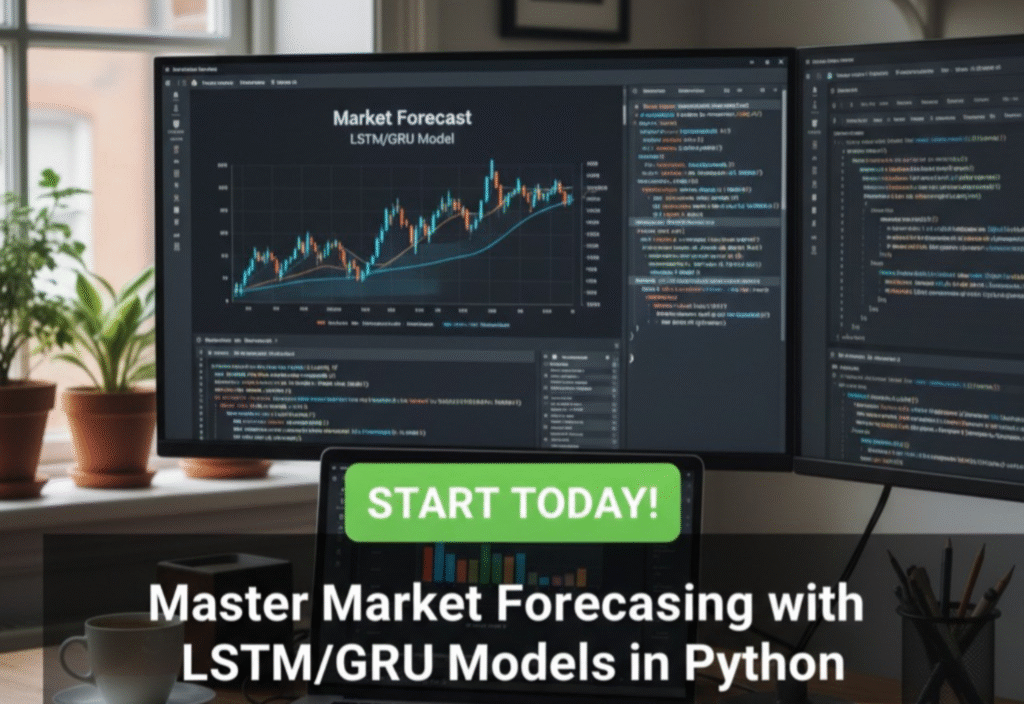
If you want to master market forecasting with LSTM/GRU in Python, this guide will help you create predictive models from scratch. Using Python’s deep learning libraries, you can forecast stock prices, cryptocurrency trends, and other time-series data efficiently. This step-by-step tutorial ensures that even beginners can follow and build a working model today.
1. Understanding LSTM and GRU for Market Forecasting
LSTM (Long Short-Term Memory) and GRU (Gated Recurrent Unit) are types of RNNs designed for sequential data.
LSTM: Handles long-term dependencies, perfect for complex market trends.
GRU: Lightweight alternative that reduces training time while capturing key patterns.
Why it matters
These models allow traders and analysts to predict price movements more accurately than traditional statistical methods.
2. Setting Up Python for Market Forecasting
Install the necessary libraries:
pip install numpy pandas matplotlib tensorflow scikit-learn
NumPy & Pandas: Data manipulation
Matplotlib: Plotting predictions
TensorFlow/Keras: Build LSTM & GRU models
Scikit-learn: Data preprocessing and scaling
3. Preparing Time-Series Data
Load your stock dataset:
import pandas as pd

data = pd.read_csv('stock_data.csv')
Normalize it for better model performance:
from sklearn.preprocessing import MinMaxScaler

scaler = MinMaxScaler(feature_range=(0,1))

scaled_data = scaler.fit_transform(data['Close'].values.reshape(-1,1))
Create sequences for the model:
def create_sequences(data, seq_length):

    X, y = [], []

    for i in range(seq_length, len(data)):

        X.append(data[i-seq_length:i, 0])

        y.append(data[i,0])

    return np.array(X), np.array(y)
seq_length = 60
X, y = create_sequences(scaled_data, seq_length)
X = X.reshape(X.shape[0], X.shape[1], 1)
4. Building the LSTM Model for Market Forecasting
from tensorflow.keras.models import Sequential

from tensorflow.keras.layers import LSTM, Dense, Dropout
model = Sequential()
model.add(LSTM(50, return_sequences=True, input_shape=(X.shape[1],1)))
model.add(Dropout(0.2))
model.add(LSTM(50))
model.add(Dropout(0.2))
model.add(Dense(1))
model.compile(optimizer=‘adam’, loss=‘mean_squared_error’)
model.fit(X, y, epochs=50, batch_size=32)
5. Building the GRU Model
from tensorflow.keras.layers import GRU
model = Sequential()
model.add(GRU(50, return_sequences=True, input_shape=(X.shape[1],1)))
model.add(Dropout(0.2))
model.add(GRU(50))
model.add(Dropout(0.2))
model.add(Dense(1))
model.compile(optimizer=‘adam’, loss=‘mean_squared_error’)
model.fit(X, y, epochs=50, batch_size=32)
6. Making Predictions
predicted_prices = model.predict(X_test)

predicted_prices = scaler.inverse_transform(predicted_prices)
Visualize:
import matplotlib.pyplot as plt

plt.plot(real_prices, color='blue', label='Actual Prices')

plt.plot(predicted_prices, color='red', label='Predicted Prices')

plt.legend()

plt.show()
7. Tips to Improve Market Forecasting Accuracy
Use multiple features: volume, moving averages, RSI.
Tune hyperparameters: layers, units, dropout.
Compare LSTM and GRU performance.
Increase sequence length to capture more patterns.
8. Conclusion
By following this tutorial, you can start market forecasting with LSTM/GRU in Python today. With continuous learning and model improvement, these techniques can help you predict market trends more accurately and make data-driven decisions.
Educational Disclaimer:
This tutorial is for educational purposes only. The Python models demonstrated here (LSTM/GRU) are intended for learning and understanding time-series forecasting. Using these techniques for actual trading involves financial risk and should be done responsibly, ethically, and in compliance with legal regulations.