
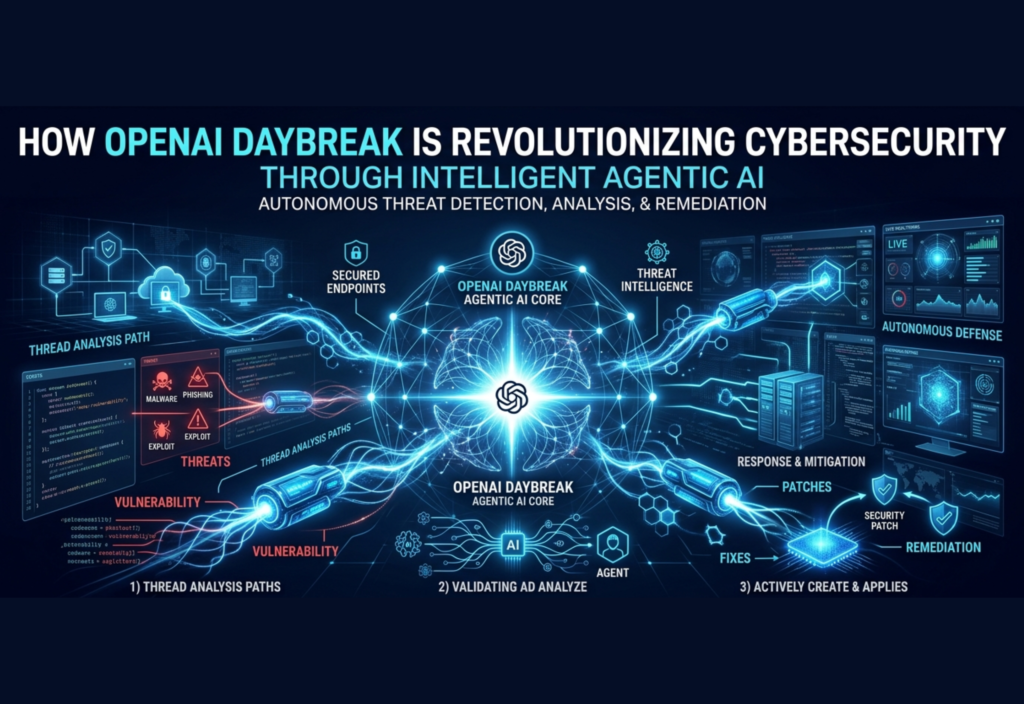
OpenAI Daybreak cybersecurity AI is transforming modern digital security by using intelligent agentic AI systems. Cybersecurity threats are growing faster than ever, and businesses, governments, and even small websites face constant attacks from hackers, ransomware groups, phishing campaigns, and automated bots. Traditional security systems often struggle to keep up because cybercriminals now use advanced automation and artificial intelligence to launch attacks at massive scale.
This is where OpenAI Daybreak cybersecurity AI enters the picture. It represents a new generation of intelligent agentic AI systems designed to transform how cybersecurity teams detect, analyze, and respond to digital threats. Instead of relying only on manual monitoring or fixed security rules, Daybreak introduces AI agents that can think, adapt, and assist security professionals in real time.
The rise of intelligent agentic AI is changing cybersecurity from a reactive process into a proactive defense system. With OpenAI Daybreak cybersecurity AI, organizations can identify suspicious behavior earlier, automate complex investigations, and reduce the time it takes to stop attacks before major damage occurs.
Understanding OpenAI Daybreak
OpenAI Daybreak is an advanced AI-driven cybersecurity framework focused on intelligent automation, threat detection, and adaptive response systems. Unlike traditional cybersecurity tools that mainly follow pre-programmed instructions, Daybreak uses agentic AI capabilities to understand situations, make decisions, and continuously improve through learning.
The core idea behind Daybreak is simple: cybersecurity systems should behave more like intelligent security analysts rather than static software. By combining machine learning, large language models, and autonomous reasoning, Daybreak can process enormous amounts of security data while helping organizations respond to threats faster and more accurately.
Modern companies generate millions of security events every day. Human analysts alone cannot investigate every alert. Daybreak helps solve this challenge by prioritizing risks, filtering false alarms, and guiding security teams toward the most dangerous threats.
What Is Agentic AI in Cybersecurity?
Agentic AI refers to AI systems capable of independently performing tasks, analyzing information, and making contextual decisions with limited human intervention. In cybersecurity, this means AI can actively participate in defending networks rather than simply reporting suspicious activity.
Traditional AI tools usually perform one narrow task. For example, they may identify malware signatures or detect spam emails. Agentic AI goes further by connecting multiple pieces of information, understanding attacker behavior, and taking coordinated actions.
An intelligent cybersecurity agent can:
- Detect unusual network activity
- Investigate suspicious files
- Analyze phishing attempts
- Recommend security responses
- Automate repetitive tasks
- Continuously learn from new threats
- Assist security operation centers in real time
This creates a more adaptive and intelligent defense system capable of responding to modern cyberattacks.
How OpenAI Daybreak Improves Threat Detection
One of the biggest challenges in cybersecurity is identifying real threats among massive amounts of data. Security teams often deal with thousands of alerts daily, many of which are false positives.
OpenAI Daybreak improves threat detection by using advanced AI reasoning and contextual understanding. Instead of relying only on fixed rules, the system studies patterns, behaviors, and anomalies across networks.
Behavioral Analysis
Daybreak focuses heavily on behavioral analysis. Rather than searching only for known malware signatures, it observes how users, devices, and applications behave over time.
For example, if an employee account suddenly downloads sensitive files at unusual hours from a different location, Daybreak may flag the behavior as suspicious even if no malware is detected.
Behavior-based detection is extremely important because many modern attacks avoid traditional signature detection systems.
Real-Time Threat Intelligence
Cyber threats evolve constantly. Attack techniques that worked yesterday may change today. Daybreak integrates real-time threat intelligence to stay updated with emerging attack methods.
The system can analyze:
- Global attack trends
- New malware variants
- Phishing techniques
- Ransomware behavior
- Suspicious domains
- Vulnerability exploitation patterns
This allows organizations to react quickly before threats spread across systems.
Reduced False Positives
Many security teams waste valuable time investigating harmless alerts. Daybreak reduces false positives through contextual reasoning and advanced AI analysis.
Instead of overwhelming analysts with endless notifications, the system prioritizes the alerts most likely to represent genuine danger.
This improves efficiency and reduces analyst burnout.
Automated Incident Response
Responding quickly during a cyberattack is critical. Delayed responses can lead to stolen data, downtime, financial loss, and reputational damage.
OpenAI Daybreak enhances incident response by automating several security tasks.
Faster Investigation
AI agents can gather logs, analyze endpoints, track attacker behavior, and summarize findings within seconds.
Human analysts no longer need to manually collect data from multiple systems. This dramatically speeds up investigations.
Intelligent Recommendations
Daybreak can suggest security actions based on the nature of the attack. These recommendations may include:
- Isolating infected devices
- Blocking malicious IP addresses
- Resetting compromised accounts
- Updating firewall rules
- Patching vulnerabilities
Security teams maintain control while benefiting from intelligent AI assistance.
Continuous Monitoring
Cybersecurity is not a one-time task. Organizations require continuous monitoring around the clock.
Daybreak provides 24/7 intelligent surveillance capable of identifying suspicious behavior even when security staff are unavailable.
This constant monitoring improves resilience against attacks occurring outside regular working hours.
The Role of Large Language Models in Cybersecurity
Large language models are becoming increasingly valuable in cybersecurity because they can understand and process human language alongside technical data.
OpenAI Daybreak uses language intelligence to improve several areas of security operations.
Security Report Analysis
Organizations produce large amounts of documentation, including incident reports, threat intelligence feeds, compliance documents, and vulnerability assessments.
AI models can summarize these documents quickly and extract important insights for analysts.
Phishing Detection
Phishing attacks often rely on convincing language to trick victims.
Language models can identify suspicious wording, deceptive communication patterns, and social engineering tactics more effectively than many traditional filters.
Security Training
AI-powered systems can also assist in cybersecurity education by generating realistic attack simulations and training exercises for employees.
This helps organizations improve awareness against phishing scams and other threats.
Benefits of OpenAI Daybreak for Businesses
Businesses adopting intelligent cybersecurity systems can gain several advantages.
Improved Efficiency
AI automation reduces repetitive manual tasks, allowing security teams to focus on strategic defense activities.
Faster Response Times
Rapid detection and automated analysis help organizations stop attacks earlier.
Better Scalability
As businesses grow, security demands increase. AI-powered systems can scale more effectively than manual security operations alone.
Enhanced Accuracy
Behavioral analysis and contextual intelligence improve threat detection accuracy while reducing false alarms.
Cost Optimization
Automating security workflows can reduce operational costs while improving protection.
Challenges and Ethical Considerations
Although intelligent agentic AI offers many advantages, cybersecurity AI systems also introduce important challenges.
AI-Powered Cyberattacks
Cybercriminals may use AI technologies to create more advanced attacks, including automated phishing campaigns and adaptive malware.
This creates an ongoing technological arms race between attackers and defenders.
Privacy Concerns
AI cybersecurity systems often analyze large amounts of user data. Organizations must ensure responsible data handling and privacy compliance.
Human Oversight
AI should support cybersecurity professionals rather than replace them completely.
Human expertise remains essential for critical decision-making, ethical judgment, and strategic defense planning.
Bias and Reliability
AI systems must be carefully tested to avoid inaccurate decisions or biased threat assessments.
Organizations should continuously monitor AI performance and maintain transparent security policies.
The Future of AI-Driven Cybersecurity
The future of cybersecurity will likely depend heavily on intelligent AI systems capable of adaptive defense and autonomous analysis.
As digital threats continue evolving, traditional security approaches alone may no longer be sufficient. Organizations will increasingly rely on AI agents to assist human analysts in detecting attacks, automating investigations, and improving overall resilience.
OpenAI Daybreak represents a major step toward this future by introducing more intelligent, context-aware, and proactive cybersecurity systems.
Future developments may include:
- Autonomous threat hunting
- Self-healing security systems
- Predictive cyber defense
- AI-driven vulnerability management
- Advanced cloud security automation
- Intelligent identity protection
These innovations could significantly strengthen global cybersecurity capabilities.
Why OpenAI Daybreak Matters
Cybersecurity is no longer just an IT concern. It has become a business, economic, and national security priority. Every organization connected to the internet faces evolving digital threats.
OpenAI Daybreak demonstrates how intelligent agentic AI can improve security operations by combining automation, contextual understanding, and real-time threat analysis.
Rather than replacing cybersecurity professionals, Daybreak enhances their capabilities and helps them respond more effectively in an increasingly complex digital environment.
As AI technology continues advancing, intelligent cybersecurity systems may become essential tools for protecting businesses, governments, and individuals against the next generation of cyber threats.
Conclusion
OpenAI Daybreak is helping redefine modern cybersecurity through intelligent agentic AI. By combining behavioral analysis, real-time monitoring, automated investigations, and advanced language intelligence, the platform offers a smarter approach to digital defense.
Traditional cybersecurity systems often struggle against modern threats because attackers constantly adapt their methods. Daybreak addresses this challenge by introducing AI agents capable of learning, reasoning, and assisting security teams proactively.
The integration of agentic AI into cybersecurity could significantly improve threat detection, reduce response times, and strengthen overall digital resilience. While challenges such as privacy, ethics, and AI-powered attacks remain important considerations, the future of cybersecurity will likely depend on intelligent collaboration between humans and AI systems.
Organizations that embrace AI-driven security solutions today may be better prepared to face tomorrow’s cyber threats in an increasingly connected world.