
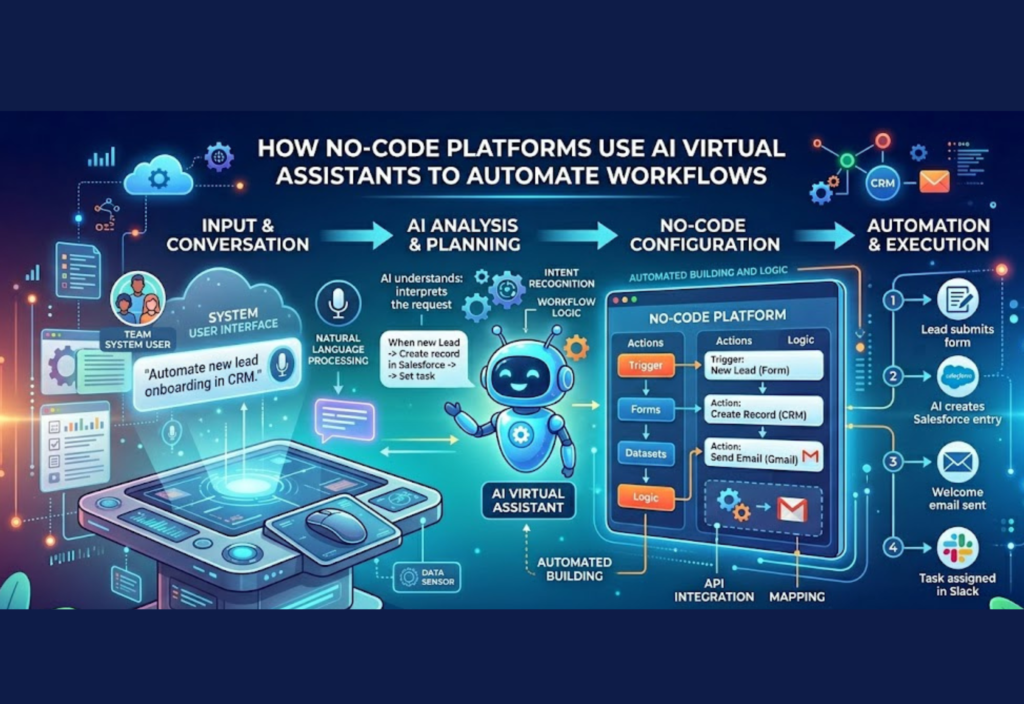
AI No-Code Automation is changing the way businesses manage daily tasks and build digital systems. Today, companies want faster, smarter, and more affordable solutions to improve productivity and reduce manual work. Because of this, many businesses now combine no-code platforms with AI virtual assistants to automate workflows without needing advanced coding skills.
No-code platforms help users create applications, workflows, and automation systems through drag-and-drop tools instead of traditional programming. At the same time, AI virtual assistants make these systems smarter by handling communication, organizing data, answering questions, and completing tasks automatically.
When these technologies work together, businesses can save time, reduce costs, and improve efficiency. For example, companies can automate customer support, manage emails, process data, schedule meetings, and monitor workflows with minimal human effort.
In this article, we will explain how AI-powered no-code systems work, their benefits, real-world use cases, challenges, and the future of workflow automation.
What Is AI No-Code Automation?
AI No-Code Automation refers to the use of artificial intelligence inside no-code platforms to automate tasks and workflows without writing code. It combines simple visual development tools with smart AI systems that can make decisions and complete actions automatically.
Traditionally, businesses needed software developers to build automation systems. However, no-code platforms now allow non-technical users to create workflows quickly and easily. AI makes these workflows more intelligent because the system can analyze information, understand requests, and respond automatically.
As a result, businesses can build smart digital systems without large development teams.
Understanding No-Code Platforms
No-code platforms are tools that help users create applications and workflows using visual interfaces instead of programming languages. These platforms are designed for beginners, startups, and businesses that want to automate processes quickly.
Users can simply drag and drop elements to create workflows and connect different services together.
Popular no-code platforms include:
- Bubble
- Zapier
- Airtable
- Make
- Notion
- Webflow
These tools help businesses save development time and reduce technical complexity.
What Are AI Virtual Assistants?
AI virtual assistants are software systems powered by artificial intelligence. They help users complete tasks automatically and improve communication between people and digital systems.
These assistants can:
- Answer customer questions
- Organize data
- Schedule meetings
- Send reminders
- Generate reports
- Manage workflows
Some AI virtual assistants also use Natural Language Processing (NLP), which allows them to understand human language more naturally.
Examples include:
- AI chatbots
- AI customer service agents
- Voice assistants
- AI scheduling tools
- AI writing assistants
Because of AI technology, these systems continue learning and improving over time.
How AI No-Code Automation Works
AI-powered no-code systems work through automated workflows. A workflow is a series of actions that happen automatically after a trigger occurs.
For example:
- A customer submits a form
- AI reads the information
- The system analyzes the request
- An automatic email response is sent
- Data is stored in a database
- A task notification is created for the team
This entire process can happen automatically without manual work.
No-code platforms make workflow creation simple, while AI helps the system make smart decisions during the process.
Benefits of AI No-Code Automation
Saves Time
One of the biggest advantages is time-saving. Businesses no longer need to complete repetitive tasks manually. Instead, workflows run automatically in the background.
For example, AI can instantly sort emails, process forms, and send customer replies.
Reduces Costs
Traditional software development can be expensive. Businesses often need developers, designers, and technical experts. However, no-code automation reduces these costs because users can create systems themselves.
As a result, startups and small businesses can build powerful workflows with lower budgets.
Improves Productivity
Employees waste less time on repetitive work when automation handles routine tasks. Therefore, teams can focus on strategy, creativity, and customer relationships.
This increases overall productivity and improves business performance.
Easy for Beginners
No-code platforms are designed for non-technical users. People without programming knowledge can still build applications and workflows easily.
This makes automation accessible to a much larger audience.
Better Customer Experience
AI virtual assistants improve response speed and customer communication. For example, chatbots can answer questions instantly instead of making customers wait for human support.
As a result, businesses provide faster and better customer service.
Role of AI Virtual Assistants in Workflow Automation
AI virtual assistants act as the intelligent layer behind workflow systems. They help businesses automate decision-making and communication tasks.
These assistants can:
- Handle customer support
- Analyze incoming data
- Organize tasks
- Monitor workflow performance
- Send alerts and notifications
- Schedule appointments automatically
Because of this, businesses can create smarter and more efficient systems.
AI Chatbots and Customer Support Automation
Customer support is one of the most common uses of AI automation.
AI chatbots can:
- Answer common questions
- Provide product information
- Guide customers through processes
- Handle basic troubleshooting
- Redirect complex issues to human agents
For example, an online store may use a chatbot to answer shipping questions instantly. This improves response time and reduces support workload.
Moreover, chatbots can work 24/7 without breaks.
Email Automation with AI
Managing emails manually can take hours every day. AI-powered automation helps businesses organize communication more efficiently.
AI systems can:
- Filter spam emails
- Sort messages by priority
- Generate automatic replies
- Schedule follow-ups
- Send reminders
As a result, teams save time and improve communication efficiency.
AI Data Processing and Organization
Businesses collect large amounts of data every day. Manual data processing is slow and can lead to errors.
AI helps automate:
- Data collection
- Form processing
- Information extraction
- Database updates
- Report generation
For example, AI can automatically extract customer details from online forms and save them directly into a CRM system.
This improves accuracy and reduces human mistakes.
Project Management Automation
Many businesses now use AI-powered no-code tools for project management.
AI systems can:
- Assign tasks automatically
- Track deadlines
- Send reminders
- Monitor progress
- Create reports
Therefore, teams stay organized and complete projects more efficiently.
AI Automation in E-Commerce
E-commerce businesses use AI virtual assistants to improve customer experiences and automate store operations.
Automation features include:
- Product recommendations
- Inventory management
- Order tracking
- Customer support
- Marketing emails
For example, AI can recommend products based on customer behavior, which helps increase sales.
Marketing Automation
Marketing teams also benefit from AI-powered workflows.
AI can help businesses:
- Schedule social media posts
- Generate content ideas
- Send email campaigns
- Analyze marketing performance
- Manage leads automatically
This allows businesses to reach customers more effectively while reducing manual work.
Industries Using AI No-Code Automation
Many industries already use AI-powered automation systems.
Healthcare
Hospitals use automation for appointment scheduling, patient communication, and record management.
Education
Schools and online learning platforms automate assignments, student support, and notifications.
Finance
Banks use AI systems for fraud detection, customer service, and transaction monitoring.
Retail
Retail businesses automate inventory tracking, support systems, and customer engagement.
Real Estate
Real estate companies use automation for property inquiries, scheduling, and customer communication.
Challenges of AI No-Code Automation
Although automation offers many benefits, businesses may still face some challenges.
Limited Customization
Some no-code platforms may not support highly advanced features.
AI Errors
AI systems can sometimes misunderstand information or provide incorrect responses.
Security Concerns
Businesses must protect sensitive customer data carefully.
Platform Dependency
Companies may become dependent on third-party platforms for automation systems.
Despite these challenges, technology continues to improve every year.
The Future of AI-Powered No-Code Systems
The future of AI automation looks very promising. AI systems are becoming smarter, faster, and more accurate.
In the future, businesses may use:
- Fully automated operations
- Advanced AI decision-making
- Smarter virtual assistants
- More personalized customer experiences
- Better workflow optimization
As technology evolves, even small businesses will be able to build powerful automation systems without coding knowledge.
Conclusion
AI No-Code Automation is transforming modern business operations. By combining no-code platforms with AI virtual assistants, companies can automate workflows, reduce manual tasks, improve productivity, and deliver better customer experiences.
From customer support and email management to project tracking and marketing automation, AI-powered systems are becoming an important part of digital business growth.
As AI technology continues to advance, no-code automation will become even more powerful and accessible. Businesses that adopt these systems early may gain a strong competitive advantage in the future.