
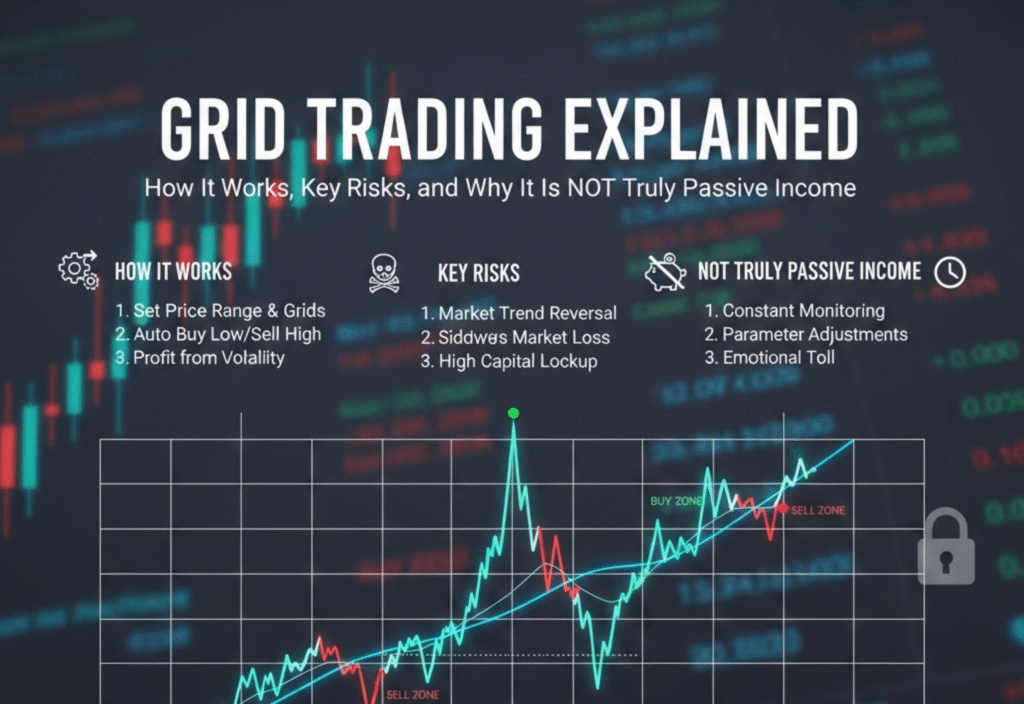
Grid trading has become a popular topic in the world of cryptocurrency and forex trading. While many consider it a “set-and-forget” strategy, it is important to understand how grid trading works, the potential risks involved, and why it cannot be considered a fully passive income method. This article will provide a comprehensive, educational, and safe overview.
What Is Grid Trading?
Grid trading is a trading strategy that involves placing multiple buy and sell orders at predetermined intervals above and below a set price. The goal is to profit from price fluctuations in a ranging or volatile market.
Unlike traditional trading, where you might buy low and sell high just once, grid trading creates a network of orders (or “grid”) to capture profits repeatedly as the price moves.
Key Features of Grid Trading:
-
Multiple buy and sell orders placed automatically
-
Profits taken incrementally as the market fluctuates
-
No need to predict exact market tops or bottoms
Important Note: Grid trading is purely technical and does not guarantee profit. It requires careful planning and risk management.
How Grid Trading Works
-
Setting a Grid
Traders define a price range in which the asset is likely to move. For example, if a cryptocurrency is trading between $20,000 and $25,000, the grid might be set within this range. -
Placing Orders
Buy and sell orders are automatically placed at intervals. For instance:-
Buy orders at $20,000, $20,500, $21,000
-
Sell orders at $21,000, $21,500, $22,000
-
-
Profit from Fluctuations
Each time the price moves up and triggers a sell order, the trader locks in a small profit. Similarly, when the price drops and hits a buy order, the trader purchases the asset at a lower price. -
Repeat Cycle
As long as the market continues to fluctuate within the grid range, the strategy repeats automatically, generating incremental gains.
Key Advantages of Grid Trading
-
Automation-Friendly: Many exchanges support bots to automate the strategy.
-
Profit from Volatility: Works well in markets with frequent price movements.
-
Non-Directional Strategy: Grid trading does not rely on predicting the overall trend.
However: Automation does not remove risk, and traders must actively monitor positions.
Key Risks of Grid Trading
While grid trading can generate profits, it is not risk-free.
-
Market Trend Risk
-
If the market strongly trends in one direction, your buy orders may accumulate assets that continue to fall in value.
-
Grid trading performs best in sideways or range-bound markets.
-
-
Capital Requirements
-
A larger price range requires more capital to maintain the grid.
-
Running out of funds may force the bot to stop operating or close positions at a loss.
-
-
Volatility Risk
-
Extreme market volatility can trigger losses faster than the grid can recover.
-
-
Technical or Execution Risk
-
Bots may malfunction, or exchange downtime can affect trades.
-
Errors in grid settings can result in unintended losses.
-
Why Grid Trading Is Not Truly Passive Income
Many marketing materials present grid trading as a passive income method. However, this is misleading for several reasons:
-
Active Monitoring Required
-
Even automated bots require supervision.
-
Adjustments may be necessary as market conditions change.
-
-
Market Risks Cannot Be Eliminated
-
Unexpected events, sharp market moves, or liquidity issues can cause losses.
-
-
Strategy Maintenance
-
Grids need to be reset if the market breaks out of the planned range.
-
Failing to adjust the grid can reduce profits or increase losses.
-
-
Psychological Stress
-
Watching assets fluctuate can cause anxiety if traders expect passive income without effort.
-
Conclusion: Grid trading can supplement a trading strategy but should never be treated as guaranteed passive income.
Tips for Safer Grid Trading
-
Start Small
-
Use a small portion of your capital to understand how the strategy works.
-
-
Set Realistic Expectations
-
Treat grid trading as a technical tool, not a guaranteed profit generator.
-
-
Use Stop-Loss or Risk Limits
-
Protect your capital against extreme price moves.
-
-
Choose the Right Market
-
Avoid highly trending markets for grid trading; sideways or volatile markets are preferable.
-
-
Educate Yourself
-
Learn market behavior, bot settings, and risk management techniques.
-
Final Thoughts
Grid trading is a useful tool for traders who want to capitalize on price fluctuations in a structured manner. However, it is not a shortcut to passive income. Understanding its mechanics, limitations, and risks is essential for anyone looking to implement this strategy safely.