
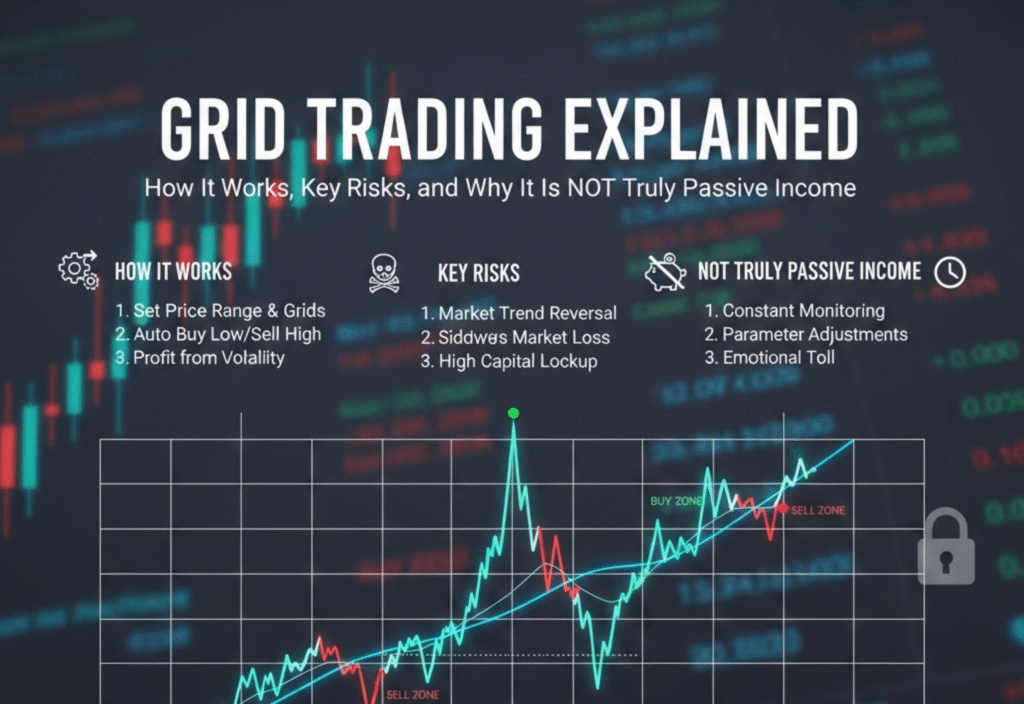
Grid trading has become a popular topic in the world of cryptocurrency and forex trading. While many consider it a “set-and-forget” strategy, it is important to understand how grid trading works, the potential risks involved, and why it cannot be considered a fully passive income method. This article will provide a comprehensive, educational, and safe overview.
What Is Grid Trading?
Grid trading is a trading strategy that involves placing multiple buy and sell orders at predetermined intervals above and below a set price. The goal is to profit from price fluctuations in a ranging or volatile market.
Unlike traditional trading, where you might buy low and sell high just once, grid trading creates a network of orders (or “grid”) to capture profits repeatedly as the price moves.
Key Features of Grid Trading:
Multiple buy and sell orders placed automatically
Profits taken incrementally as the market fluctuates
No need to predict exact market tops or bottoms
Important Note: Grid trading is purely technical and does not guarantee profit. It requires careful planning and risk management.
How Grid Trading Works
Setting a Grid
Traders define a price range in which the asset is likely to move. For example, if a cryptocurrency is trading between $20,000 and $25,000, the grid might be set within this range.Placing Orders
Buy and sell orders are automatically placed at intervals. For instance:Buy orders at $20,000, $20,500, $21,000
Sell orders at $21,000, $21,500, $22,000
Profit from Fluctuations
Each time the price moves up and triggers a sell order, the trader locks in a small profit. Similarly, when the price drops and hits a buy order, the trader purchases the asset at a lower price.Repeat Cycle
As long as the market continues to fluctuate within the grid range, the strategy repeats automatically, generating incremental gains.
Key Advantages of Grid Trading
Automation-Friendly: Many exchanges support bots to automate the strategy.
Profit from Volatility: Works well in markets with frequent price movements.
Non-Directional Strategy: Grid trading does not rely on predicting the overall trend.
However: Automation does not remove risk, and traders must actively monitor positions.
Key Risks of Grid Trading
While grid trading can generate profits, it is not risk-free.
Market Trend Risk
If the market strongly trends in one direction, your buy orders may accumulate assets that continue to fall in value.
Grid trading performs best in sideways or range-bound markets.
Capital Requirements
A larger price range requires more capital to maintain the grid.
Running out of funds may force the bot to stop operating or close positions at a loss.
Volatility Risk
Extreme market volatility can trigger losses faster than the grid can recover.
Technical or Execution Risk
Bots may malfunction, or exchange downtime can affect trades.
Errors in grid settings can result in unintended losses.
Why Grid Trading Is Not Truly Passive Income
Many marketing materials present grid trading as a passive income method. However, this is misleading for several reasons:
Active Monitoring Required
Even automated bots require supervision.
Adjustments may be necessary as market conditions change.
Market Risks Cannot Be Eliminated
Unexpected events, sharp market moves, or liquidity issues can cause losses.
Strategy Maintenance
Grids need to be reset if the market breaks out of the planned range.
Failing to adjust the grid can reduce profits or increase losses.
Psychological Stress
Watching assets fluctuate can cause anxiety if traders expect passive income without effort.
Conclusion: Grid trading can supplement a trading strategy but should never be treated as guaranteed passive income.
Tips for Safer Grid Trading
Start Small
Use a small portion of your capital to understand how the strategy works.
Set Realistic Expectations
Treat grid trading as a technical tool, not a guaranteed profit generator.
Use Stop-Loss or Risk Limits
Protect your capital against extreme price moves.
Choose the Right Market
Avoid highly trending markets for grid trading; sideways or volatile markets are preferable.
Educate Yourself
Learn market behavior, bot settings, and risk management techniques.
Final Thoughts
Grid trading is a useful tool for traders who want to capitalize on price fluctuations in a structured manner. However, it is not a shortcut to passive income. Understanding its mechanics, limitations, and risks is essential for anyone looking to implement this strategy safely.