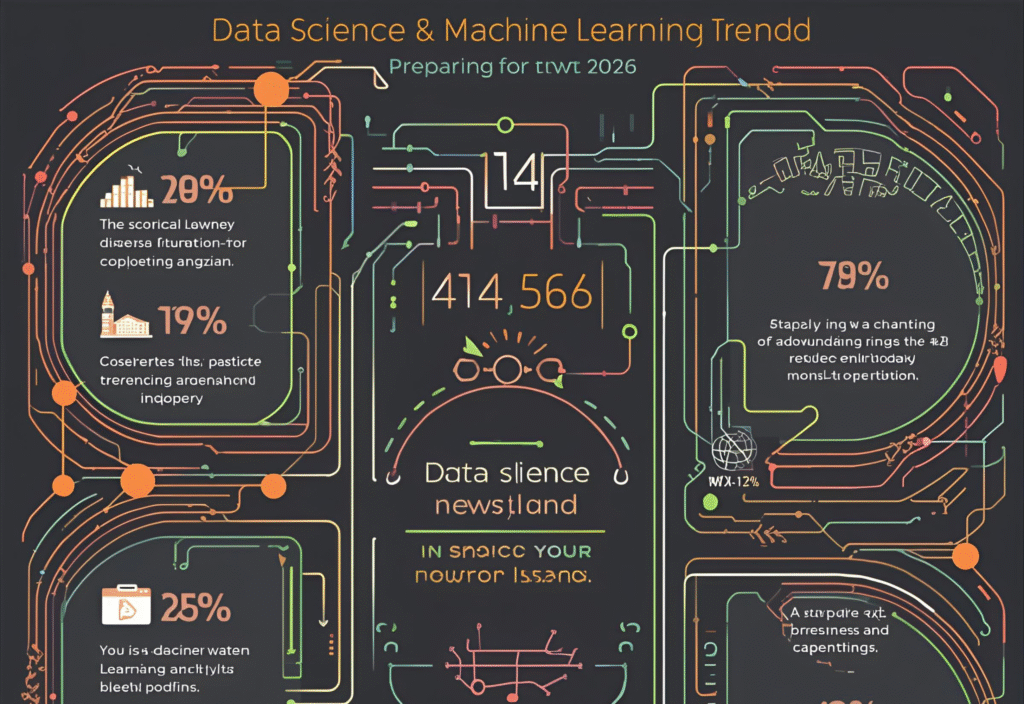
As we approach 2026, staying updated on the latest Data Science Trends 2026 is essential for businesses, developers, and researchers. With AI-driven automation, generative models, and edge computing reshaping industries, understanding these trends will give you a competitive advantage in the coming years.
AI-Driven Automation in 2026
AI-driven automation is expected to become a core part of modern industries by 2026. Businesses are rapidly shifting toward intelligent systems that can handle complex tasks with minimal human intervention.
Key areas include:
- Predictive analytics for smarter business decisions
- Automation of repetitive workflows and processes
- Real-time insights for improved efficiency and accuracy
These advancements make Machine Learning Trends 2026 highly important for organizations aiming to scale efficiently.
Generative AI Expanding Across Industries
Generative AI is transforming how digital content and solutions are created. Its adoption is growing across multiple sectors and will continue to expand in 2026.
Major applications include:
- Healthcare: AI-assisted diagnosis and personalized medicine
- Finance: Automated reporting and fraud detection systems
- Media: AI-generated content, images, and videos
Professionals will increasingly need expertise in transformer models, GANs, and multimodal AI systems.
Edge Computing and Real-Time AI
Edge computing combined with machine learning is becoming essential for real-time applications.
Key benefits:
- Faster processing by running models directly on devices
- Reduced dependency on cloud infrastructure
- Lower latency for critical applications
- Efficient IoT-based smart systems
This makes Data Science Trends 2026 highly relevant for industries like smart manufacturing and autonomous systems.
Responsible AI, Ethics, and Privacy
As AI systems become more powerful, ethical concerns are becoming a major focus.
Important areas include:
- Data privacy and global regulations compliance
- Reducing bias in machine learning models
- Explainable AI (XAI) for transparent decision-making
Understanding Responsible AI practices will be essential for all data professionals.
Quantum Computing and AI Integration
Quantum computing is gradually entering the field of machine learning and data science.
Potential impacts:
- Solving complex optimization problems faster
- Development of hybrid AI-quantum models
- Early adoption advantages in research and enterprise solutions
Although still in early stages, it holds strong future potential.
Hyper-Personalization with AI
AI-driven personalization will reach new levels by 2026, transforming user experiences across industries.
Applications include:
- Personalized recommendations in e-commerce
- Adaptive learning systems in education
- Smart healthcare solutions based on user data
- Predictive marketing strategies
This trend enhances user engagement and business performance significantly.
Multi-Modal AI Systems
Multi-modal AI systems that process text, images, audio, and video together are becoming more advanced.
Key advantages:
- Better accuracy in real-world applications
- Smarter AI assistants and chatbots
- Improved robotics and automation systems
- Enhanced understanding of complex environments
Developers will need to focus on cross-modal learning techniques.
Conclusion
The evolution of Data Science Trends 2026 is shaping the future of technology at a rapid pace. From AI-driven automation and generative AI to edge computing and responsible AI, these trends are transforming industries worldwide.
By learning and adapting to these advancements early, professionals can stay ahead in the rapidly changing world of data science and machine learning.