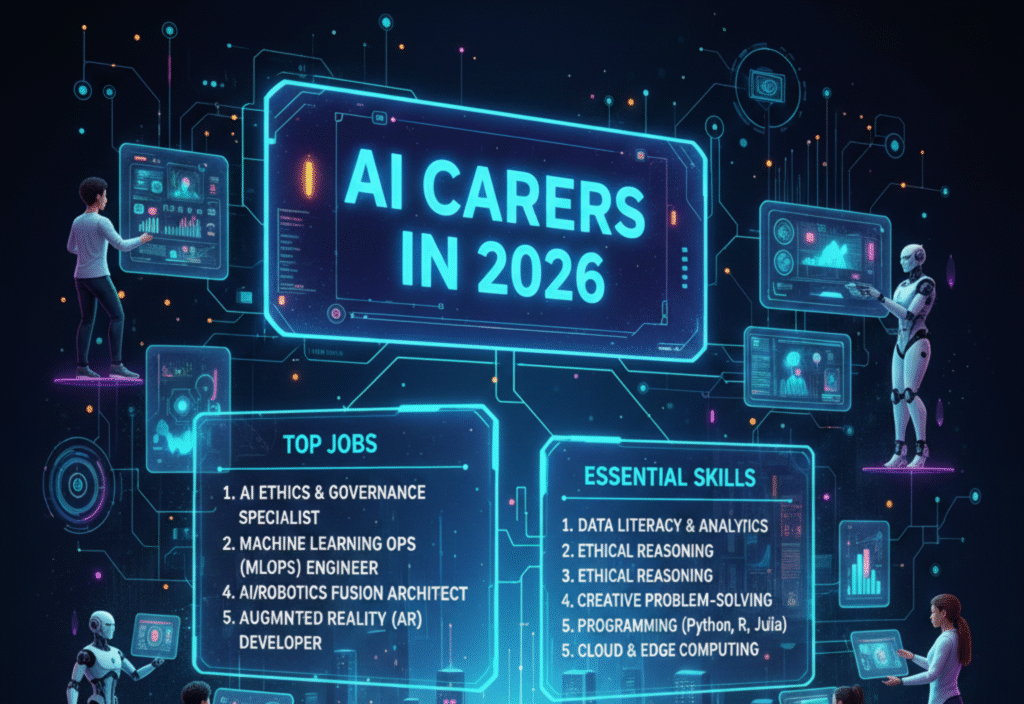
AI Careers in 2026 are expected to become some of the fastest-growing and highest-paying jobs in the world. Artificial Intelligence (AI) is transforming industries by automating tasks, improving decision-making, and creating smarter technologies for businesses and consumers.
Today, AI is used in healthcare, finance, education, marketing, cybersecurity, and many other industries. As companies continue adopting AI technologies, the demand for skilled AI professionals is increasing rapidly.
This guide explores the top AI careers in 2026, the essential skills you need, and how you can prepare for a successful future in the AI industry.
Why AI Careers Are in High Demand
AI adoption continues to grow rapidly across industries. Businesses use AI to automate repetitive tasks, improve customer experiences, analyze large datasets, and make smarter business decisions.
Some major reasons behind the growing demand for AI professionals include:
- Automation of business operations
- Increased use of big data and analytics
- Growth of AI-powered applications
- Expansion of cloud computing technologies
- Rising investment in AI research and development
- Demand for intelligent cybersecurity solutions
AI is no longer limited to tech giants. Small businesses, startups, hospitals, banks, eCommerce companies, and educational institutions are also investing heavily in AI technologies.
Top AI Careers in 2026
1. AI and Machine Learning Engineer
AI and Machine Learning Engineers design intelligent systems that can learn from data and improve over time. They build machine learning models, recommendation systems, automation tools, and AI-powered applications.
Skills Needed
- Python, Java, or R programming
- TensorFlow and PyTorch
- Deep learning and neural networks
- Data preprocessing
- Cloud computing knowledge
Career Outlook
Machine Learning Engineers are expected to remain among the most in-demand professionals because businesses increasingly rely on intelligent automation and predictive systems.
2. Data Scientist
Data Scientists analyze large datasets to uncover insights that help organizations make better decisions. They combine statistics, machine learning, and data visualization techniques to solve business problems.
Skills Needed
- SQL and database management
- Statistical analysis
- Python or R programming
- Tableau or Power BI
- Machine learning fundamentals
Career Outlook
Data Scientists will continue playing a major role in helping organizations understand customer behavior, market trends, and operational performance.
3. AI Product Manager
AI Product Managers oversee the development and strategy of AI-powered products. They work closely with engineers, designers, and business teams to ensure AI solutions meet user needs and company goals.
Skills Needed
- Leadership and communication
- Product management experience
- Understanding of AI technologies
- Market research
- Strategic planning
Career Outlook
As companies launch more AI-driven products, the need for professionals who understand both technology and business strategy will continue growing.
4. AI Research Scientist
AI Research Scientists focus on developing new AI algorithms and improving existing technologies. They often work in research institutions, universities, and advanced technology companies.
Skills Needed
- Advanced mathematics
- Deep learning expertise
- Research methodology
- Python and C++ programming
- Analytical thinking
Career Outlook
Research Scientists are critical for advancing AI innovation and discovering new applications for artificial intelligence.
5. Robotics Engineer
Robotics Engineers develop intelligent robots used in manufacturing, healthcare, logistics, and automation industries. They combine AI with mechanical and electronic engineering.
Skills Needed
- Robotics frameworks
- AI integration
- Automation systems
- Programming knowledge
- Problem-solving skills
Career Outlook
The rise of smart factories and autonomous machines is creating strong demand for Robotics Engineers worldwide.
6. AI Ethics Specialist
AI Ethics Specialists ensure that AI systems are fair, transparent, secure, and compliant with regulations. They help organizations address issues like bias, privacy, and accountability.
Skills Needed
- AI ethics knowledge
- Data privacy regulations
- Communication skills
- Risk analysis
- Policy development
Career Outlook
As governments introduce AI regulations, organizations increasingly require professionals who can ensure responsible AI development.
Emerging AI Careers to Watch
Several new AI-related job roles are also expected to grow significantly by 2026.
Prompt Engineer
Prompt Engineers create optimized instructions for AI systems like chatbots and generative AI tools to improve outputs and efficiency.
AI Cybersecurity Specialist
These professionals use AI to detect threats, monitor suspicious activities, and strengthen digital security systems.
Generative AI Content Strategist
Businesses are hiring specialists who can manage AI-generated content for blogs, advertising, and social media campaigns.
AI Business Consultant
AI Consultants help organizations identify opportunities for automation and AI integration.
Essential Skills for AI Careers
Programming Skills
Programming languages such as Python, Java, R, and C++ are essential for building AI systems and applications.
Mathematics and Statistics
AI professionals need strong foundations in linear algebra, calculus, probability, and statistics to understand machine learning algorithms.
Machine Learning and Deep Learning
Understanding supervised learning, unsupervised learning, neural networks, and model optimization is crucial.
Data Analysis and Visualization
Professionals must know how to analyze data and present findings using tools like Tableau, Power BI, and Excel.
Cloud Computing
Cloud platforms such as AWS, Microsoft Azure, and Google Cloud are increasingly important for deploying scalable AI systems.
Communication Skills
AI professionals must explain technical concepts clearly to non-technical teams, executives, and clients.
How to Prepare for an AI Career
Take Online Courses and Certifications
Platforms like Coursera, Udemy, edX, and DeepLearning.AI offer valuable AI courses and certifications for beginners and professionals.
Build Real Projects
Hands-on experience is one of the best ways to learn AI. Building projects such as chatbots, recommendation systems, and prediction tools helps improve practical skills.
Participate in Kaggle Competitions
Kaggle competitions allow aspiring professionals to work on real-world machine learning problems and improve their expertise.
Create a Strong Portfolio
Publishing projects on GitHub helps demonstrate your abilities to employers and recruiters.
Stay Updated With AI Trends
AI changes rapidly, so continuous learning is essential. Follow AI blogs, conferences, podcasts, research papers, and technology news regularly.
Join AI Communities
Networking with other AI professionals can open new opportunities and collaborations. Join LinkedIn groups, GitHub communities, Reddit forums, and online tech communities.
Challenges in AI Careers
Despite the exciting opportunities, AI careers also come with challenges.
Rapid Technological Changes
AI technologies evolve quickly, requiring professionals to constantly update their knowledge and skills.
High Competition
As more people enter the AI industry, competition for top positions is increasing.
Ethical Concerns
AI professionals must ensure systems are ethical, unbiased, secure, and privacy-compliant.
Future Outlook for AI Careers
By 2026, AI is expected to create millions of new jobs globally. AI will continue transforming industries including healthcare, transportation, finance, education, entertainment, and manufacturing.
Future AI workplaces may involve:
- Human and AI collaboration
- Autonomous transportation systems
- AI-powered healthcare diagnostics
- Personalized education platforms
- Smart cities and intelligent infrastructure
Professionals who combine technical expertise with creativity, ethical understanding, and business knowledge will have the strongest competitive advantage.
Final Thoughts
Artificial Intelligence is shaping the future of work faster than ever before. As businesses continue adopting intelligent technologies, AI professionals will become increasingly valuable across nearly every industry.
Whether you want to become a Machine Learning Engineer, Data Scientist, Robotics Engineer, AI Product Manager, or AI Ethics Specialist, now is the ideal time to start learning AI skills and building practical experience.
The future belongs to professionals who can adapt to innovation, solve real-world problems, and work effectively alongside intelligent technologies. By investing in AI education and hands-on learning today, you can prepare yourself for a successful and future-proof career in the rapidly evolving world of artificial intelligence.