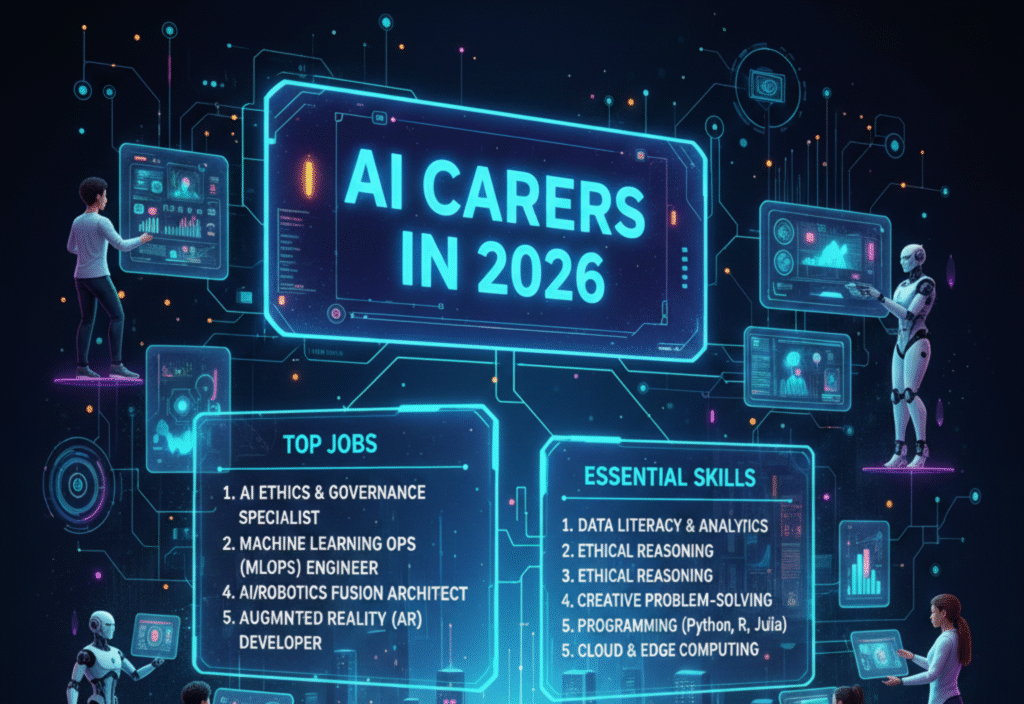
Artificial Intelligence (AI) is revolutionizing industries across the globe, creating new career opportunities and transforming traditional job roles. As we approach 2026, the demand for AI professionals is expected to grow exponentially. This guide explores the top AI careers, essential skills needed, and how you can prepare for the future of work in AI.
Why AI Careers Are in High Demand
AI is no longer limited to tech companies. Its applications span healthcare, finance, education, marketing, transportation, and more. Organizations increasingly rely on AI for:
Automating repetitive tasks
Making data-driven decisions
Improving customer experiences
Predicting trends and outcomes
As a result, professionals with AI skills are highly sought after, and AI careers offer competitive salaries, job stability, and opportunities for growth.
Top AI Careers in 2026
1. AI/Machine Learning Engineer
AI and Machine Learning (ML) Engineers design and implement algorithms that allow machines to learn and improve over time. They work on natural language processing, computer vision, predictive analytics, and recommendation systems.
Skills Needed:
Python, R, or Java programming
Machine learning frameworks like TensorFlow or PyTorch
Data preprocessing and modeling
Understanding of neural networks and deep learning
2. Data Scientist
Data Scientists analyze large datasets to extract actionable insights. They create predictive models and help organizations make informed decisions.
Skills Needed:
Data visualization and analysis (Tableau, Power BI)
Statistical modeling and probability
SQL and database management
Machine learning and AI integration
3. AI Product Manager
AI Product Managers oversee the development of AI-driven products, ensuring that AI technologies align with business goals. They bridge the gap between technical teams and business stakeholders.
Skills Needed:
Project management and leadership
Understanding of AI concepts and applications
Strong communication skills
Market analysis and strategic planning
4. AI Research Scientist
AI Research Scientists focus on developing new algorithms, improving AI models, and advancing AI theory. They often work in research labs or universities.
Skills Needed:
Advanced mathematics and statistics
Deep learning and reinforcement learning
Programming (Python, C++)
Research and analytical skills
5. Robotics Engineer
Robotics Engineers design AI-powered robots for manufacturing, healthcare, logistics, and more. They combine AI, mechanical engineering, and electronics to create intelligent machines.
Skills Needed:
Robotics and automation frameworks
AI integration for robotics applications
Programming (Python, C++)
Problem-solving and system design
6. AI Ethics Specialist
AI Ethics Specialists ensure AI systems are fair, transparent, and compliant with regulations. They address bias, privacy, and accountability concerns in AI systems.
Skills Needed:
Understanding of AI ethics and regulations
Data privacy and compliance knowledge
Analytical thinking
Communication skills for policy and advisory roles
Essential Skills for AI Careers
Programming and Software Development: Proficiency in Python, R, Java, or C++ is essential.
Mathematics and Statistics: Strong foundation in linear algebra, calculus, and probability is crucial.
Machine Learning and Deep Learning: Knowledge of algorithms, frameworks, and model evaluation.
Data Analysis and Visualization: Ability to interpret data and present actionable insights.
Problem-Solving and Critical Thinking: Innovative approaches to complex problems.
Communication Skills: Explain complex AI concepts to non-technical stakeholders.
How to Prepare for AI Careers
Online Courses and Certifications: Platforms like Coursera, Udemy, and edX offer specialized AI programs.
Hands-On Projects: Build portfolios with AI projects, Kaggle competitions, and GitHub repositories.
Stay Updated: AI technology evolves rapidly; follow AI research papers, blogs, and conferences.
Networking: Join AI communities, attend webinars, and connect with industry experts.
Future Outlook for AI Careers
By 2026, AI is expected to create millions of new jobs worldwide. Professionals who combine technical expertise with business understanding, ethical awareness, and problem-solving abilities will have a competitive advantage. AI careers are not just about coding—they involve creativity, strategy, and impact.