
Artificial Intelligence (AI) is transforming modern software development by enabling systems that can think, adapt, and act with increasing autonomy. As AI agents become more advanced, developers need structured methods to understand and improve how these agents operate. One such approach is agent journey mapping, a technique used to visualize and analyze the complete lifecycle of an AI agent as it interacts with users, processes data, and produces outcomes.
This guide explains the concept in detail, how it works, why it matters, and how it can help in building smarter and more efficient AI-powered systems.
What is Agent Journey Mapping?
Agent journey mapping is the process of outlining the step-by-step flow an AI agent follows from receiving an input to delivering a final output. It helps developers understand how an agent behaves, what decisions it makes, and how it interacts with different systems.
Instead of treating an AI agent as a black box, this approach breaks its behavior into clear stages. By doing so, developers gain visibility into internal processes and can optimize performance more effectively.
Why Agent Journey Mapping Matters
Understanding the journey of an AI agent is essential for building reliable and scalable systems. It provides clarity and structure, which are critical when dealing with complex workflows.
Key benefits include:
- Improved transparency in decision-making
- Better debugging and error tracking
- Enhanced system performance
- More predictable outputs
- Easier integration with tools and APIs
- Scalable architecture for multi-agent systems
By mapping the agent’s workflow, teams can identify inefficiencies and improve overall system design.
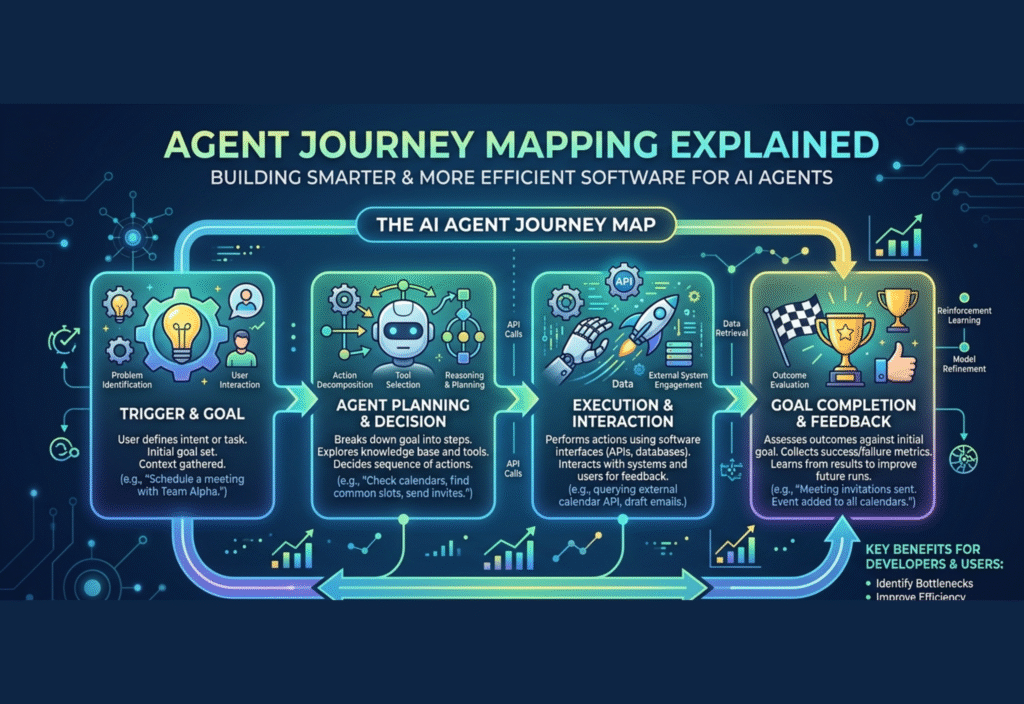
Core Stages of an AI Agent Journey
An AI agent typically goes through several stages during its operation. These stages represent the complete lifecycle of its interaction.
1. Input Stage
The process begins when the agent receives input from a user, application, or external data source. This could be a query, command, or structured information.
2. Processing Stage
The agent analyzes the input using algorithms, models, or predefined rules. It interprets the request and may break it into smaller tasks.
3. Decision-Making Stage
Based on the processed data, the agent determines the best possible action. This may involve selecting tools, generating responses, or triggering workflows.
4. Action Execution Stage
The agent performs the chosen action. This could include responding to the user, calling an API, updating a database, or executing a task.
5. Feedback Stage
After execution, the agent receives feedback from the environment or user. This feedback can be used to refine future responses and improve accuracy.
How Agent Journey Mapping Improves AI Systems
By analyzing each stage of the agent’s workflow, developers can gain deeper insights into system behavior. This leads to better optimization and more efficient software design.
Some of the key improvements include:
- Reduced processing delays
- Better resource utilization
- Increased accuracy of outputs
- Improved user experience
- Enhanced reliability of automated systems
This structured approach allows developers to move from experimental AI models to production-grade systems.
Steps to Build an Agent Journey Map
Creating an effective agent journey map involves a systematic process:
Step 1: Define the Purpose
Identify what the AI agent is designed to do and what problems it solves.
Step 2: Identify Inputs and Outputs
Understand what type of data the agent receives and what it is expected to produce.
Step 3: Break Down the Workflow
Divide the agent’s operation into logical stages such as input, processing, decision-making, execution, and feedback.
Step 4: Map Interactions
Identify how the agent interacts with users, APIs, databases, and external systems.
Step 5: Visualize the Flow
Use diagrams or flowcharts to represent the journey clearly for better understanding.
Step 6: Test and Refine
Continuously evaluate the system and update the mapping based on performance and real-world usage.
Real-World Applications
Agent journey mapping is widely used in many AI-driven applications:
- Chatbots handling customer queries
- Virtual assistants managing tasks and schedules
- Recommendation engines analyzing user behavior
- Automation systems integrating multiple services
- Intelligent systems making real-time decisions
In each case, understanding the agent’s workflow helps ensure consistent and efficient performance.
Challenges in Implementation
While the concept is powerful, it also presents some challenges:
- Increasing complexity in multi-agent systems
- Difficulty in tracking autonomous decisions
- Integration issues with external tools
- Need for continuous updates and monitoring
- Handling unpredictable or edge-case scenarios
Addressing these challenges requires careful planning and iterative improvements.
Best Practices
To effectively implement agent journey mapping, consider the following:
- Keep the workflow simple and well-structured
- Use visual diagrams for clarity
- Update the mapping regularly
- Incorporate feedback loops
- Test under different scenarios
- Document each stage for better collaboration
These practices help maintain consistency and improve system performance over time.
Future Outlook
As AI continues to evolve, agent-based systems will become more common in real-world applications. Multi-agent collaboration, autonomous decision-making, and advanced orchestration will require deeper understanding of workflows.
Agent journey mapping will play a key role in helping developers design transparent, scalable, and efficient AI systems that can handle increasing complexity.
Conclusion
Agent journey mapping is a valuable approach for understanding and improving AI agent behavior. By breaking down the lifecycle into clear stages, developers can gain better control over workflows, optimize performance, and build more reliable systems.
In an era where AI is becoming central to software development, this method provides a structured foundation for designing intelligent, scalable, and efficient solutions.