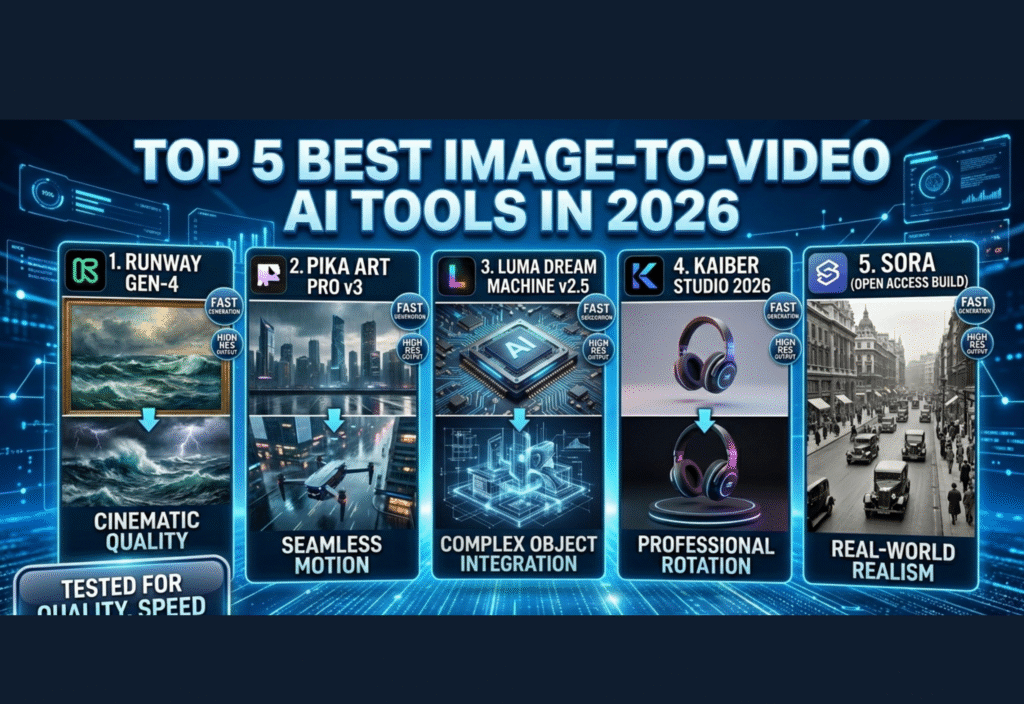
Artificial intelligence has significantly changed how digital content is created, and in 2026, image-to-video AI tools have become one of the most powerful innovations in this space. These tools allow users to convert static images into dynamic, visually appealing videos using advanced machine learning models. What once required professional video editing skills, expensive software, and hours of manual work can now be done in minutes.
From content creators and freelancers to businesses and marketers, image-to-video AI tools are being widely adopted because they save time, reduce production costs, and improve creative output. In this detailed guide, we will explore the top 5 best image-to-video AI tools in 2026 based on real testing, focusing on quality, speed, usability, and practical results.
1. Runway ML (Gen-3)
Runway ML remains one of the most advanced AI video platforms available in 2026. Its Gen-3 model has set a new standard for realistic video generation. It allows users to transform images into cinematic sequences with smooth motion, realistic lighting, and camera effects.
One of the strongest aspects of Runway ML is its ability to understand prompts deeply. Users can guide the motion, camera angles, and scene behavior with a high level of precision. This makes it especially useful for professional creators who want full control over the output.
In terms of quality, Runway ML consistently produces high-resolution videos that look close to real footage. The speed is also impressive, although rendering complex scenes may take slightly longer compared to simpler tools. The interface is clean and beginner-friendly, making it accessible even to users who are new to AI tools.
Runway ML is best suited for cinematic storytelling, advertisements, and high-end content creation where visual quality matters the most.
2. Pika Labs (Pika 2.0)
Pika Labs has evolved rapidly and is now considered one of the easiest and fastest image-to-video AI tools available. The platform focuses on simplicity without sacrificing quality, making it ideal for beginners and social media creators.
The main advantage of Pika Labs is its speed. It can convert images into short videos within seconds, which is perfect for platforms like TikTok, YouTube Shorts, and Instagram Reels. Users can simply upload an image, write a short prompt, and generate a video almost instantly.
While it may not offer the same level of cinematic control as Runway ML, it excels in producing engaging, stylized animations. It also supports different visual styles, including realistic, cartoon, and anime-inspired outputs.
Pika Labs is best for users who need fast results and want to create content regularly without spending too much time on editing.
3. Stable Video Diffusion (by Stability AI)
Stable Video Diffusion is a powerful option for users who prefer flexibility and customization. Developed by Stability AI, this tool is based on open-source technology, allowing developers and advanced users to modify and control the generation process.
Unlike many web-based tools, Stable Video Diffusion can be run locally on a high-performance computer or used through cloud services. This gives users more control over data privacy and customization.
The tool allows detailed control over frames, motion consistency, and transitions. However, it requires some technical knowledge to use effectively. Beginners may find it slightly complex compared to other tools on this list.
In terms of output quality, Stable Video Diffusion delivers strong results, especially when properly configured. It may be slower than simpler tools, but the level of control it offers makes it a valuable choice for professionals and developers.
This tool is ideal for users who want complete control over their projects and are comfortable working with advanced settings.
4. Kaiber AI
Kaiber AI is widely known for its creative and artistic capabilities. It is particularly popular among musicians, designers, and visual storytellers who want to create unique and expressive videos.
One of Kaiber AI’s standout features is its ability to sync visuals with audio. This makes it a great tool for music videos, promotional content, and artistic storytelling. Users can upload an image and a soundtrack, and the AI will generate visuals that match the rhythm and mood of the music.
The platform also offers a variety of styles and visual effects, allowing users to experiment with different creative directions. The interface is simple and easy to navigate, making it accessible for users of all skill levels.
While Kaiber AI may not focus on hyper-realistic video output, it excels in creativity and visual expression. It is best for projects where artistic style is more important than realism.
5. LeiaPix Converter
LeiaPix Converter takes a different approach compared to other tools by focusing on depth-based animation. It converts 2D images into 3D-like videos by generating depth maps and adding motion effects.
This tool is extremely easy to use. Users can upload an image and instantly generate a video with smooth camera movement and depth effects. It is particularly useful for creating eye-catching visuals for social media and presentations.
LeiaPix is known for its speed and simplicity. While it does not provide complex animation features like some other tools, it delivers consistent and visually appealing results.
It is best suited for users who want quick, attractive animations without dealing with complicated settings or editing processes.
Detailed Comparison
When comparing these tools, each one has its own strengths and ideal use cases. Runway ML leads in overall quality and cinematic output, while Pika Labs stands out for speed and ease of use. Stable Video Diffusion offers unmatched customization but requires technical knowledge. Kaiber AI focuses on creativity and artistic visuals, and LeiaPix provides simple yet effective 3D-style animations.
Choosing the right tool depends on your specific needs. If you are creating professional videos or advertisements, quality should be your priority. If you are posting daily content on social media, speed and simplicity matter more. For experimental or technical projects, flexibility and control become important.
Final Thoughts
Image-to-video AI tools in 2026 have reached a level where they can be used reliably in real-world projects. They are no longer just experimental technologies but practical solutions that are transforming content creation across industries.
These tools allow individuals and businesses to produce high-quality video content without requiring advanced technical skills or expensive equipment. As AI continues to evolve, we can expect even better realism, faster processing, and more creative possibilities in the near future.
Conclusion
The rise of image-to-video AI tools marks a major shift in digital content creation. Whether you are a beginner or a professional, these tools provide an opportunity to create engaging videos quickly and efficiently.
By selecting the right tool based on your needs, you can improve your workflow, save time, and produce content that stands out. The tools listed in this article represent the best options available in 2026, offering a balance of quality, speed, and real-world performance.
If you want to stay competitive in the digital world, adopting these AI tools is no longer optional but essential.