
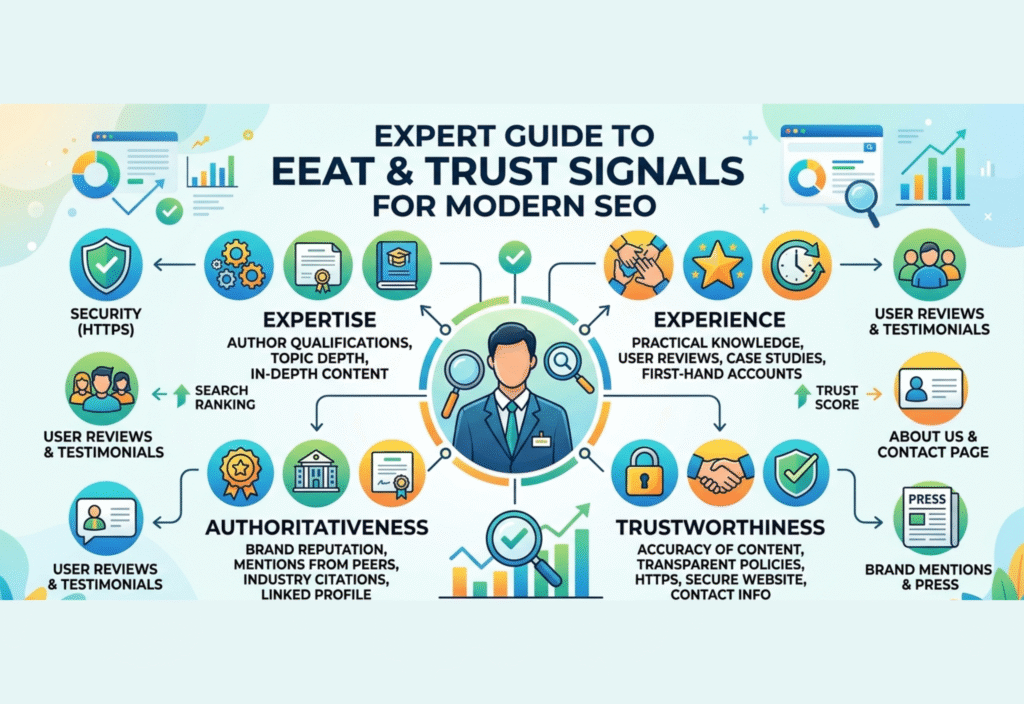
In the modern era of search engine optimization, ranking on Google is no longer just about inserting keywords or building random backlinks. Search engines have become much more intelligent, focusing on the quality, reliability, and usefulness of content. This shift has made EEAT — Experience, Expertise, Authoritativeness, and Trustworthiness — one of the most important factors in SEO.
This guide explains EEAT in depth, how trust signals work, and how you can apply both to build a strong, future-proof SEO strategy without relying on shortcuts or low-quality practices.
Understanding EEAT in Depth
EEAT is part of Google’s Search Quality Evaluation framework. It helps determine whether a piece of content is reliable and valuable for users. Although it is not a direct ranking factor in the traditional sense, it strongly influences how content is assessed and ranked.
Experience refers to whether the content creator has actually used or interacted with the topic. For example, a product review written by someone who has tested the product carries more weight than a generic overview.
Expertise relates to the level of knowledge demonstrated in the content. This is especially important in niches where accuracy matters, such as health, finance, and technology.
Authoritativeness is about reputation. If a website or author is widely recognized in a specific field, it becomes easier for search engines to trust their content.
Trustworthiness is the foundation of EEAT. It includes accuracy, transparency, and safety. A website that lacks trust will struggle to rank, regardless of how well it performs in other areas.
Why EEAT Matters More Than Ever
Search engines are continuously evolving to provide users with the most reliable information. With the rise of AI-generated content, the internet is flooded with generic and low-quality articles. As a result, Google has shifted its focus toward identifying content that demonstrates real value and authenticity.
Websites that fail to meet EEAT standards often experience unstable rankings or complete drops after algorithm updates. On the other hand, websites that consistently produce trustworthy and high-quality content tend to perform better over time.
EEAT is especially critical for what Google calls “Your Money or Your Life” topics. These include health advice, financial decisions, legal guidance, and any information that can impact a person’s well-being. In these areas, even small inaccuracies can lead to serious consequences, so search engines apply stricter evaluation criteria.
Experience: The First Layer of Credibility
Experience is a relatively newer addition to EEAT, but it has quickly become essential. It focuses on whether the content is based on real-world use or direct involvement.
To demonstrate experience, content creators should include practical insights, personal observations, and real examples. Instead of writing general information, they should explain what actually works, what doesn’t, and why.
For instance, in a software review, mentioning specific features tested, challenges faced, and results achieved adds depth and authenticity. Similarly, in tutorials, step-by-step instructions based on actual usage are far more valuable than theoretical explanations.
Search engines are increasingly capable of identifying content that lacks real experience. Articles that feel generic or overly polished without substance often fail to perform well.
Expertise: Depth and Knowledge Matter
Expertise is about demonstrating a clear understanding of the topic. This does not always require formal qualifications, but it does require accuracy, clarity, and depth.
High-quality content should answer user queries comprehensively. It should avoid vague statements and instead provide detailed explanations supported by examples or data.
Writers can strengthen expertise by focusing on a specific niche. A website that covers a narrow subject area consistently is more likely to be seen as an expert compared to one that publishes on unrelated topics.
Another important aspect of expertise is clarity. Even complex topics should be explained in a way that is easy to understand. This not only improves user experience but also increases engagement and trust.
Authoritativeness: Building a Strong Reputation
Authority is not built overnight. It develops over time through consistent effort and recognition from others.
One of the strongest indicators of authority is backlinks from reputable websites. When other trusted sources reference your content, it signals to search engines that your website is credible.
Brand presence also plays a significant role. Websites that are frequently mentioned across the internet, whether through blogs, forums, or social platforms, gain more authority.
Consistency is another key factor. Publishing high-quality content regularly within a specific niche helps establish a clear identity and strengthens authority over time.
Authoritativeness is closely linked with both expertise and trust. Without them, it is difficult to build a lasting reputation.
Trustworthiness: The Core of SEO Success
Trust is the most important element of EEAT. Even if a website demonstrates experience and expertise, it will struggle to rank if users do not trust it.
Trustworthiness includes several aspects. Accuracy is essential. Information should be correct, up to date, and free from misleading claims. Transparency is equally important. Websites should clearly display information about the author, company, and purpose of the content.
Security also contributes to trust. A secure website with HTTPS encryption reassures users that their data is safe. This is particularly important for eCommerce websites or platforms that collect personal information.
Another key factor is honesty. Content should not exaggerate or make unrealistic promises. Users can easily detect misleading information, and once trust is lost, it is difficult to regain.
Understanding Trust Signals
Trust signals are elements that help users and search engines evaluate the reliability of a website. These signals work together to create a sense of credibility and safety.
One of the most basic trust signals is a secure connection. Websites with HTTPS encryption are considered safer and more reliable.
Clear contact information is another important signal. Users should be able to find details such as email addresses, phone numbers, or physical locations. This shows that the website is legitimate and accountable.
Author profiles also play a crucial role. Including information about the writer, their experience, and their expertise adds credibility to the content.
User reviews and testimonials provide social proof. Positive feedback from real users can significantly enhance trust, especially for products or services.
Policies such as privacy policies, terms of service, and refund policies are also essential. They demonstrate transparency and professionalism.
Practical Steps to Improve EEAT
Improving EEAT requires a combination of content strategy, technical optimization, and branding.
Start by focusing on content quality. Every article should aim to solve a specific problem or answer a clear question. It should provide value rather than simply targeting keywords.
Add author information to all content. Even a simple bio explaining the writer’s background can make a difference.
Work on building backlinks from reputable sources. This can be achieved through guest posting, collaborations, and creating high-quality content that others want to reference.
Ensure that your website is technically sound. It should load quickly, work well on mobile devices, and provide a smooth user experience.
Regularly update old content. Information can become outdated quickly, and refreshing content helps maintain accuracy and relevance.
Common Mistakes That Hurt EEAT
Many websites struggle with EEAT because they focus on shortcuts instead of long-term strategies.
One common mistake is publishing low-quality or generic content. Articles that lack depth or originality fail to engage users and do not build trust.
Another issue is the absence of author information. Anonymous content often appears less credible.
Misleading headlines and exaggerated claims can also damage trust. While they may attract clicks initially, they often lead to higher bounce rates and lower user satisfaction.
Ignoring website security is another critical mistake. Users are unlikely to trust a website that appears unsafe.
Finally, copying content from other sources not only harms credibility but can also lead to penalties from search engines.
EEAT in Different Industries
The importance of EEAT varies depending on the type of content.
In health-related topics, accuracy and expertise are essential. Content should ideally be reviewed or written by qualified professionals.
In finance, trust and reliability are critical. Users rely on accurate information to make important decisions, so content must be precise and well-researched.
In technology, practical experience plays a major role. Reviews, tutorials, and comparisons should be based on real usage.
In eCommerce, trust signals such as secure payments, customer reviews, and clear policies are particularly important.
The Future of EEAT in SEO
As search engines continue to evolve, EEAT will become even more important. The increasing use of artificial intelligence in content creation means that search engines need better ways to distinguish high-quality content from generic output.
Future SEO strategies will likely focus more on authenticity, real-world experience, and brand credibility. Websites that invest in these areas will have a significant advantage.
User behavior will also play a bigger role. Engagement metrics such as time on page, click-through rates, and user satisfaction will continue to influence rankings.
Conclusion
EEAT and trust signals are not temporary trends. They represent a fundamental shift in how search engines evaluate content.
Success in modern SEO requires a long-term approach. Instead of trying to manipulate rankings, focus on building genuine value for users. Provide accurate information, demonstrate real experience, and maintain transparency in all aspects of your website.
By consistently applying these principles, you can create a strong foundation for sustainable growth and higher search rankings.