
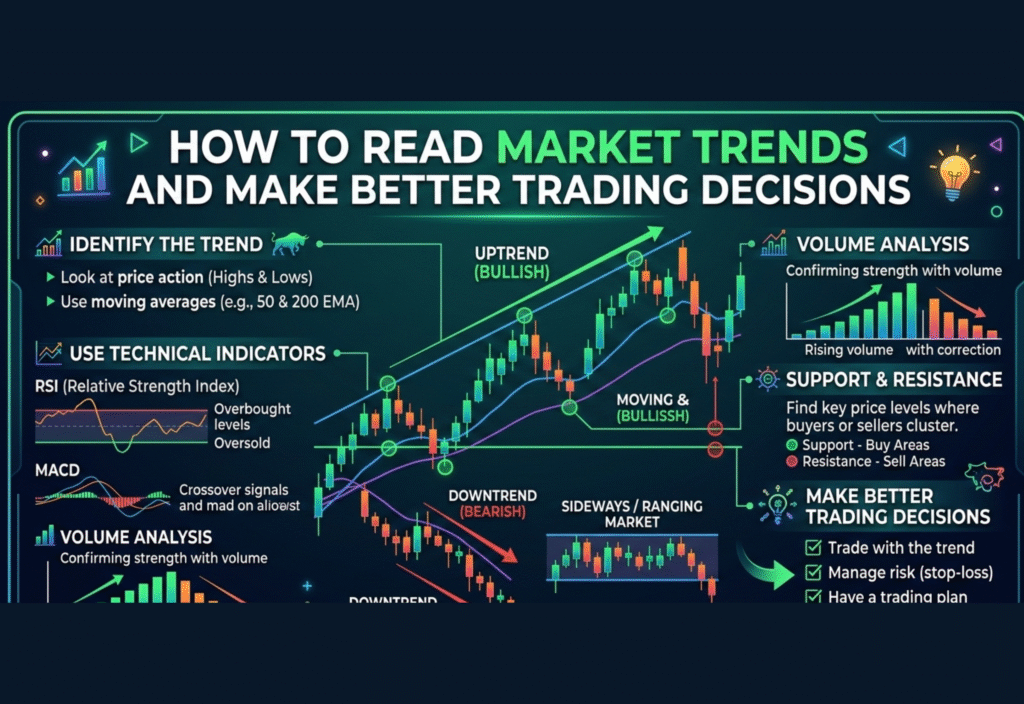
In today’s fast-moving financial world, understanding market trends is essential for anyone who wants to succeed in trading. Whether you are dealing in stocks, forex, or commodities, your ability to read trends can directly impact your profits and losses. Many beginners enter the market without proper knowledge and rely on guesswork, which often leads to poor decisions. However, by learning how to analyze market trends correctly, you can make informed, disciplined, and responsible trading choices.
Understanding the Concept of Market Trends
A market trend represents the overall direction in which the price of an asset is moving over a specific period. Trends are not random; they reflect the behavior, emotions, and decisions of thousands or even millions of traders.
There are three primary types of market trends:
1. Uptrend (Bullish Market)
An uptrend occurs when prices consistently move higher over time. This means buyers are stronger than sellers. You will notice:
-
Higher highs
-
Higher lows
In such a market, traders usually look for buying opportunities because the general direction is upward.
2. Downtrend (Bearish Market)
A downtrend is the opposite of an uptrend. Prices move lower over time, showing that sellers are dominating the market.
Key characteristics include:
-
Lower highs
-
Lower lows
In this case, traders often focus on selling or staying out of the market to avoid losses.
3. Sideways Trend (Range-Bound Market)
Sometimes, the market does not move clearly up or down. Instead, it moves within a range. This is called a sideways trend.
In such conditions:
-
Prices bounce between support and resistance
-
There is no clear direction
Traders often wait for a breakout before making decisions.
Why Market Trends Matter in Trading
Understanding trends helps traders align their strategies with the market direction. One of the most widely accepted principles is:
“Trade with the trend, not against it.”
When you follow the trend:
-
Your probability of success increases
-
Risk is relatively lower
-
Decisions become clearer
Ignoring trends often leads to emotional trading and unnecessary losses.
Key Tools to Identify Market Trends
Successful traders do not rely on guesswork. They use tools and techniques to analyze price movements. Below are some essential methods:
Moving Averages
Moving averages are one of the simplest yet most powerful tools in trading. They smooth out price fluctuations and help identify the overall direction.
Common types include:
-
20-day moving average (short-term trend)
-
50-day moving average (medium-term trend)
-
200-day moving average (long-term trend)
If the price stays above the moving average, it usually signals strength. If it stays below, it indicates weakness.
Trendlines
Trendlines help visually represent the market direction. They are drawn by connecting important points on a chart.
-
Uptrend line connects higher lows
-
Downtrend line connects lower highs
A strong trendline acts as support or resistance and helps traders plan entry and exit points.
Support and Resistance Levels
Support and resistance are key price levels where the market tends to react.
-
Support: A level where price stops falling and may bounce upward
-
Resistance: A level where price stops rising and may reverse downward
When these levels break, it often signals the start of a strong trend.
Volume Analysis
Volume shows how active the market is.
-
High volume confirms strong trends
-
Low volume indicates weak or uncertain movement
For example, if prices rise with high volume, it means many traders support the move, making it more reliable.
Understanding Market Sentiment
Market sentiment reflects the overall mood of traders and investors. It plays a major role in price movement.
There are two main types:
-
Bullish Sentiment: Traders expect prices to rise
-
Bearish Sentiment: Traders expect prices to fall
News events, economic data, and global developments can quickly change sentiment. A wise trader always stays informed but avoids reacting emotionally.
Combining Technical and Fundamental Analysis
To make better trading decisions, it is important to combine two major approaches:
Technical Analysis
This focuses on:
-
Price charts
-
Indicators
-
Patterns
It helps identify entry and exit points.
Fundamental Analysis
This involves studying:
-
Economic conditions
-
Interest rates
-
Company performance (for stocks)
-
Political and global events
It helps understand the reasons behind market movements.
Risk Management: Protecting Your Capital
No matter how skilled you are, losses are a part of trading. The key is to manage risk effectively.
Important principles include:
-
Never risk more than a small portion of your capital on a single trade
-
Always use a stop-loss to limit losses
-
Avoid overtrading
-
Do not chase the market
A disciplined approach ensures long-term success and stability.
Psychological Discipline in Trading
Trading is not just about charts and numbers; it is also about controlling emotions.
Common emotional challenges include:
-
Fear
-
Greed
-
Overconfidence
Successful traders:
-
Follow a clear plan
-
Stay patient
-
Avoid impulsive decisions
Maintaining discipline is often more important than having a perfect strategy.
Common Mistakes Traders Should Avoid
Many traders fail due to avoidable mistakes, such as:
-
Entering trades without proper analysis
-
Ignoring the overall trend
-
Risking too much money
-
Following rumors instead of facts
-
Letting emotions drive decisions
Learning from these mistakes can greatly improve your performance.
Building a Simple Trading Strategy
A good trading strategy does not need to be complicated. A simple approach may include:
-
Identify the trend using moving averages
-
Confirm with support and resistance
-
Check volume for strength
-
Enter trade with a clear plan
-
Set stop-loss and target levels
Consistency is more important than complexity.
Final Thoughts
Reading market trends is a skill that develops over time with practice and experience. It is not about predicting the future with certainty, but about understanding probabilities and making informed decisions.
If you remain patient, disciplined, and committed to learning, you can improve your trading abilities and make better decisions over time. Always remember to trade responsibly and avoid anything uncertain or unethical. A clean, honest, and well-planned approach leads to sustainable success.