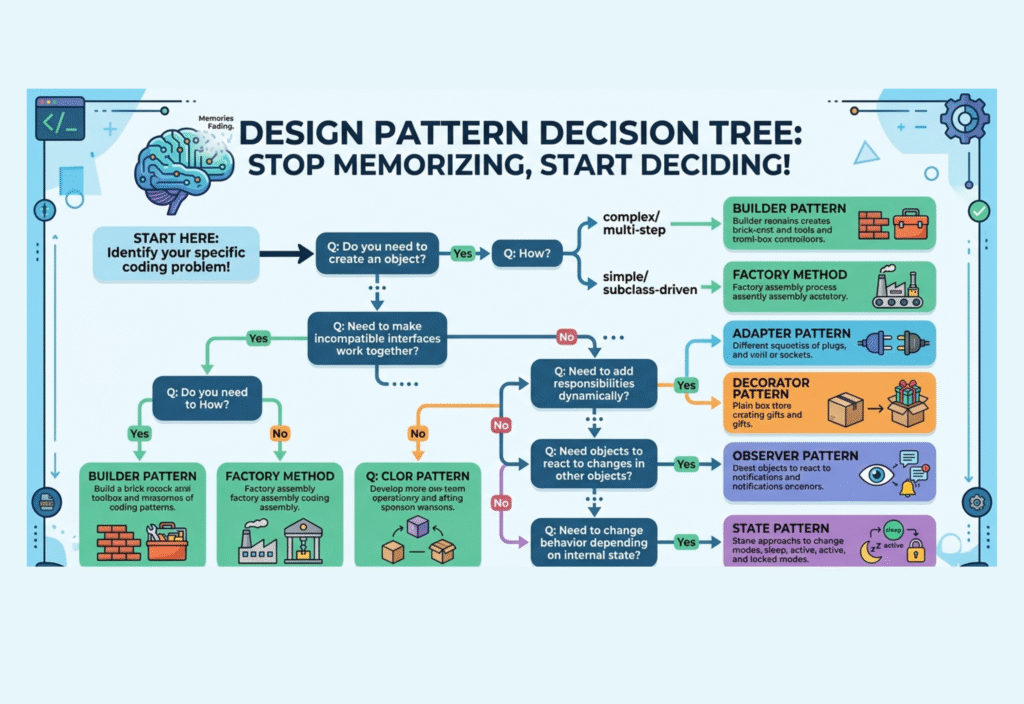
In modern software development, many programmers try to memorize dozens of design patterns. However, memorizing patterns is not always the best way to improve coding skills. A better approach is using a Design Pattern Decision Tree. This simple method helps developers choose the right pattern by asking practical questions instead of remembering complicated definitions.
The Design Pattern Decision Tree focuses on understanding problems first. Instead of forcing a specific pattern into your code, developers analyze the situation and select the most suitable solution. This approach makes software architecture cleaner, easier to maintain, and more flexible.
The reality is that professional developers rarely memorize patterns word-for-word. Instead, they understand the type of problem they are solving and then apply a suitable structure. This is where a decision tree approach becomes extremely useful.
The Problem With Memorizing Design Patterns
Memorizing patterns may sound like a productive learning strategy, but it often leads to several problems in practical development.
1. Overengineering Problems
When developers memorize patterns, they sometimes feel compelled to use them everywhere. This can lead to overly complicated code structures.
For example, a simple object creation problem might be solved using a basic constructor. But a developer who recently studied the Factory Method might unnecessarily introduce factories, interfaces, and multiple classes. Instead of simplifying the design, the pattern ends up adding unnecessary complexity.
Good software design should reduce complexity, not increase it.
2. Real Problems Don’t Match Textbook Examples
Design patterns are usually explained with clean diagrams and small examples. Real software systems are much messier. Problems often combine several different concerns at once.
For instance, a notification system might involve both an event system and a communication layer. In this case, a developer might combine ideas similar to the Observer Pattern and other architectural strategies. The real solution may not look exactly like any single textbook pattern.
This is why rigid memorization can limit creativity instead of encouraging it.
3. Slower Decision Making
When developers rely on memorization, they often pause during design discussions trying to recall the “correct” pattern. This slows down development and interrupts the problem-solving process.
Experienced engineers instead ask a series of simple questions about the system they are building. These questions naturally guide them toward the right structure.
A Better Approach: The Decision Tree Method
Instead of memorizing dozens of design patterns, you can use a simple decision tree. This approach focuses on identifying the type of problem you are facing.
Below is a simplified decision process that many experienced developers follow.
Step 1: Do You Need Flexible Object Creation?
If your application needs to create objects in multiple ways or based on runtime conditions, then you may need a creation abstraction.
Typical examples include:
-
Supporting multiple database drivers
-
Switching between payment gateways
-
Loading plugins dynamically
-
Creating UI components for different platforms
In these situations, developers often use an approach similar to the Factory Method or other factory-style structures.
The key question becomes:
“Do I need to create objects without tightly coupling my code to specific classes?”
If the answer is yes, a factory-like design can help.
Step 2: Do Many Components Need Updates When Something Changes?
Some systems require automatic updates when data changes. For example:
-
A stock market dashboard updating live prices
-
A chat application notifying users of new messages
-
A user interface updating when application data changes
In these cases, developers often use an event-driven architecture similar to the Observer Pattern.
The guiding question becomes:
“Do multiple components need to react automatically when one object changes?”
If yes, an observer-style approach can simplify the system.
Step 3: Should Only One Instance Exist?
Some objects should exist only once across the application. Common examples include:
-
Application configuration managers
-
Logging systems
-
Global caching systems
In these situations, developers sometimes apply an approach similar to the Singleton Pattern.
The decision question becomes:
“Should the system have only one shared instance of this object?”
However, experienced developers also treat singletons carefully because excessive use can create hidden dependencies.
Step 4: Is the System Becoming Too Complex?
Large software systems often contain many classes and interactions. When this complexity grows too large, developers may create a simplified interface.
For example:
-
Wrapping a complex third-party API
-
Simplifying access to multiple subsystems
-
Creating a single entry point for a module
A solution similar to the Facade Pattern can provide a clean interface while hiding internal complexity.
The question to ask is:
“Do I need a simple interface to interact with a complex subsystem?”
If the answer is yes, a facade-style structure can improve maintainability.
The Hidden Secret of Senior Developers
One of the biggest surprises for junior developers is that experienced engineers rarely discuss patterns by name during design meetings.
Instead of saying:
“Let’s implement the Strategy Pattern.”
They often say:
“Let’s separate the algorithm so we can swap it later.”
That idea closely resembles the Strategy Pattern, but the team focuses on the problem, not the pattern name.
Over time, as developers gain experience, they begin recognizing recurring problems naturally. Patterns become mental shortcuts, not memorized formulas.
Learning Design Patterns the Right Way
If memorization is not the best strategy, how should developers learn design patterns?
A more effective method includes:
1. Focus on the Problem First
Instead of memorizing pattern definitions, study the type of problem each pattern solves.
2. Study Real Codebases
Open-source projects often contain practical implementations of patterns. Studying real systems reveals how patterns are adapted to fit real constraints.
3. Build Small Projects
Experimenting with small systems helps developers understand when patterns actually improve code.
4. Understand Trade-Offs
Every pattern introduces both benefits and drawbacks. Good developers understand when not to use a pattern.
Why the Decision Tree Method Works
Using a decision tree instead of memorization provides several advantages.
Clarity – Developers focus on solving the real problem.
Flexibility – Solutions can adapt to the project’s needs.
Efficiency – Teams spend less time debating pattern names.
Maintainability – Code stays simpler and easier to understand.
Most importantly, this approach mirrors the way experienced software architects think about system design.
Final Thoughts
Design patterns remain one of the most valuable concepts in software engineering. They capture decades of experience about how to structure software effectively. However, their real value lies in understanding the problems they solve, not in memorizing their definitions.
Instead of trying to memorize dozens of patterns from books like Design Patterns: Elements of Reusable Object-Oriented Software, developers should focus on building a simple decision-making framework.