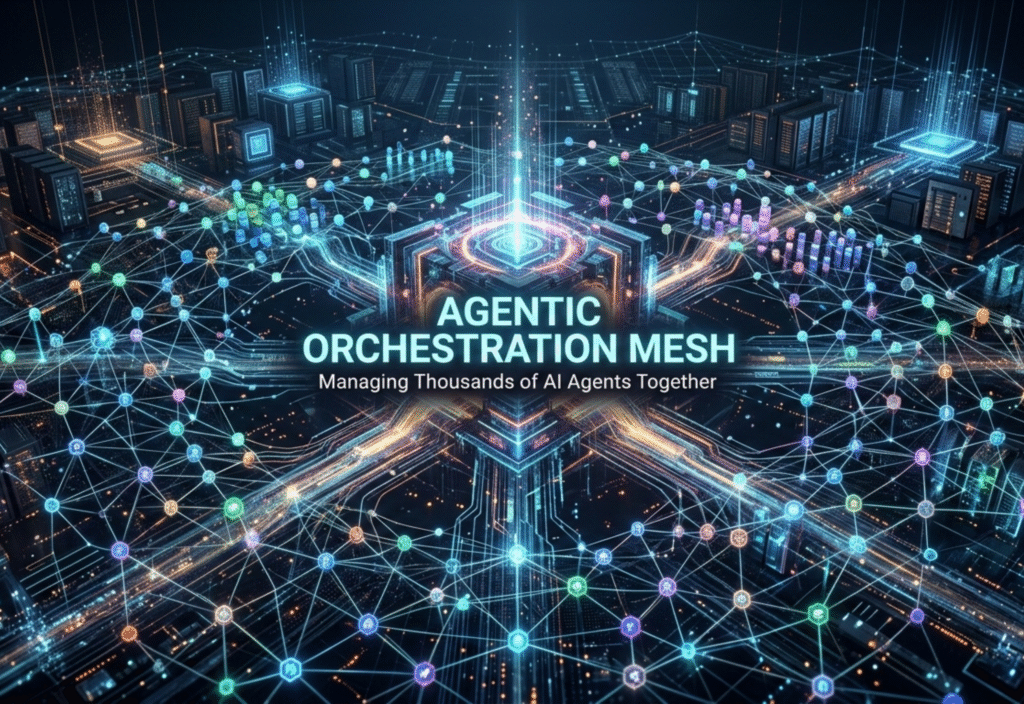
Artificial intelligence is evolving rapidly, moving beyond simple chatbots and automation tools toward more advanced systems capable of independent decision-making and collaboration. One of the most important emerging concepts in this transformation is the Agentic Orchestration Mesh. This innovative framework allows organizations to manage and coordinate thousands of AI agents working together across complex digital environments.
As companies adopt autonomous AI systems, the need for structured coordination becomes essential. Without proper orchestration, multiple AI agents could conflict, duplicate tasks, or operate inefficiently. An agentic orchestration mesh solves this problem by organizing AI agents into a connected ecosystem where they collaborate, communicate, and perform tasks efficiently.
This approach represents a major step forward in scalable artificial intelligence and is expected to play a significant role in the future of automation, enterprise systems, and intelligent digital infrastructure.
Understanding Agentic AI
To understand an agentic orchestration mesh, it is important to first understand agentic AI.
Agentic AI refers to artificial intelligence systems designed to act as autonomous agents. These agents can make decisions, plan actions, interact with other systems, and complete tasks without constant human supervision.
Unlike traditional AI tools that respond only to direct commands, AI agents can:
Analyze complex data
Plan multi-step tasks
Communicate with other agents
Adapt to changing environments
Improve performance over time
For example, in a business environment, different AI agents might handle customer service, data analysis, logistics planning, or cybersecurity monitoring. When thousands of these agents operate together, a system is required to manage their interactions effectively.
What Is an Agentic Orchestration Mesh?
An Agentic Orchestration Mesh is a structured network that coordinates and manages large numbers of AI agents. It acts as the control layer that ensures each agent performs the correct task while collaborating efficiently with others.
The mesh architecture connects AI agents through a distributed system where communication, task allocation, and monitoring are carefully managed.
In simple terms, it works like a digital management system for AI agents, ensuring that thousands of autonomous systems operate in harmony rather than chaos.
The orchestration mesh performs several critical functions:
Assigning tasks to appropriate agents
Managing communication between agents
Monitoring agent performance
Preventing conflicts between systems
Ensuring security and reliability
By providing these capabilities, the mesh allows organizations to scale AI operations without losing control.
Core Components of an Agentic Orchestration Mesh
Several components work together to form a complete orchestration mesh.
Agent Registry
The agent registry is a centralized or distributed directory that keeps track of all active AI agents within the system. It stores information such as:
Agent capabilities
Task specialization
Performance metrics
System permissions
This registry helps the orchestration system identify which agent is best suited for a particular task.
Task Coordination Engine
The coordination engine assigns tasks to agents and ensures that workflows are completed efficiently. It can break complex problems into smaller subtasks and distribute them across multiple agents.
For example, a large data analysis task might be divided among several AI agents that each handle different data segments.
Communication Layer
AI agents must communicate effectively to collaborate. The communication layer provides secure messaging channels that allow agents to exchange data, share insights, and coordinate actions.
This communication system ensures that agents work together rather than duplicating efforts.
Monitoring and Governance System
Monitoring tools track the performance and behavior of each AI agent in real time. This system detects errors, performance issues, or unusual activities that could affect the overall system.
Governance mechanisms also ensure that AI operations follow ethical guidelines, security policies, and operational rules.
Security and Access Control
Because AI agents may interact with sensitive data or critical infrastructure, security is essential. Access control systems determine what resources each agent can access and what actions they are allowed to perform.
Why Organizations Need Agentic Orchestration
As AI adoption grows, companies are deploying more AI agents across different departments. Without orchestration, managing thousands of agents becomes extremely difficult.
Agentic orchestration meshes provide several key benefits.
Scalable AI Operations
Organizations can deploy thousands of AI agents without losing oversight or control. The orchestration system manages complexity and ensures smooth operation.
Improved Efficiency
Tasks can be automatically distributed among agents based on capability and workload. This improves efficiency and reduces processing time.
Reduced Operational Conflicts
Without orchestration, multiple agents might attempt the same task or interfere with each other’s operations. The mesh prevents these conflicts through coordinated management.
Better Resource Utilization
The system ensures that computing resources are used effectively by assigning tasks to the most suitable agents.
Enhanced Reliability
Monitoring and governance tools help detect issues quickly and maintain system stability.
Real-World Applications
Agentic orchestration meshes can be applied across many industries where large-scale AI systems are required.
Enterprise Automation
Businesses can deploy AI agents to handle customer support, marketing analysis, financial forecasting, and operational planning. The orchestration mesh ensures these agents collaborate effectively.
Smart Cities
In smart city environments, thousands of AI systems manage traffic signals, energy distribution, transportation networks, and public safety monitoring. An orchestration mesh helps coordinate these systems.
Cybersecurity
AI agents can monitor network traffic, detect threats, analyze vulnerabilities, and respond to security incidents. Orchestration ensures these agents work together to provide comprehensive protection.
Scientific Research
Large research projects often require analyzing enormous datasets. Multiple AI agents can process different data segments simultaneously while an orchestration mesh manages the workflow.
Supply Chain Management
Logistics networks rely on predictive analytics, inventory tracking, and delivery optimization. AI agents can manage these processes while the orchestration system coordinates their actions.
Challenges and Considerations
While agentic orchestration meshes offer many benefits, they also introduce challenges.
System Complexity
Managing thousands of AI agents requires advanced infrastructure and sophisticated management tools.
Security Risks
Large AI ecosystems can become targets for cyberattacks. Strong security protocols are essential to protect data and systems.
Ethical Governance
Autonomous systems must operate within ethical guidelines to prevent harmful decisions or unintended consequences.
Performance Optimization
Maintaining efficiency across thousands of agents requires continuous monitoring and optimization.
The Future of Agentic Orchestration
The concept of agentic orchestration is still emerging, but it is expected to become a core component of future AI ecosystems. As artificial intelligence becomes more autonomous, organizations will increasingly rely on orchestration systems to manage complex networks of intelligent agents.
Future developments may include:
Fully autonomous AI ecosystems
Self-organizing agent networks
Advanced AI collaboration frameworks
Real-time adaptive orchestration systems
Technology companies and research institutions are already exploring new frameworks and platforms designed to support large-scale AI agent management.
Conclusion
Agentic orchestration mesh systems represent a powerful solution for managing large networks of autonomous AI agents. By coordinating communication, task distribution, monitoring, and governance, these systems ensure that thousands of intelligent agents can work together effectively.