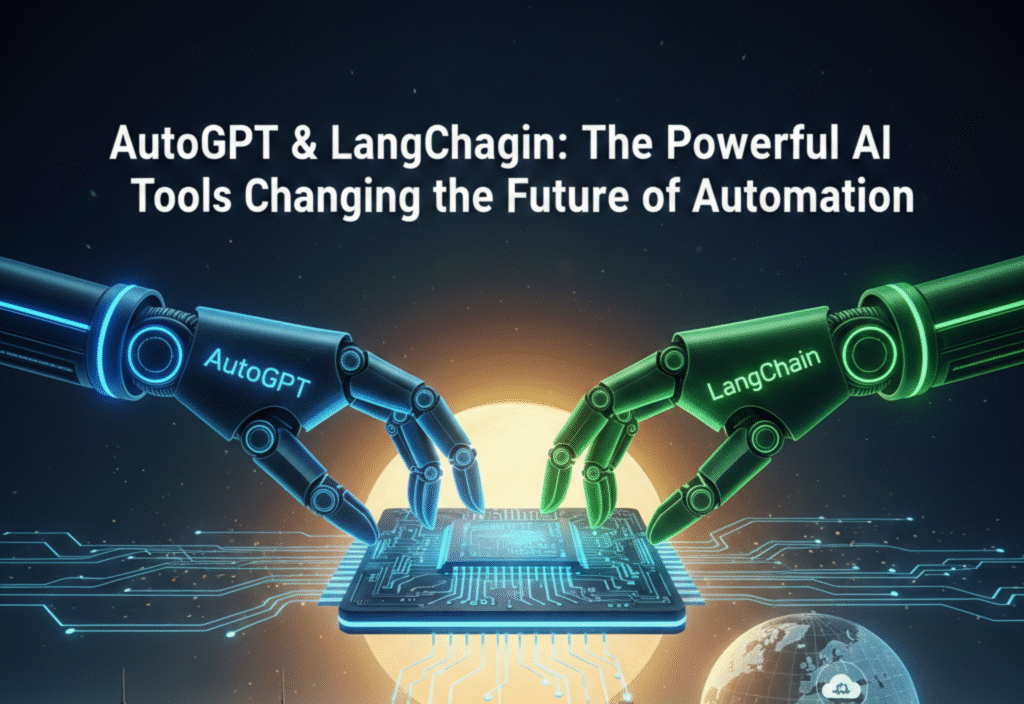
Artificial intelligence is no longer a futuristic concept — it is actively reshaping how businesses, developers, and individuals approach work. Among the most exciting developments in AI are AutoGPT & LangChain automation tools, which are redefining productivity, workflow efficiency, and autonomous task execution. By combining large language models with structured frameworks, these tools empower both technical and non-technical users to build systems that can think, plan, and act with minimal human intervention.
This article explores these tools in depth, their key features, real-world applications, benefits, challenges, and the future of AI-driven automation.
What is AutoGPT?
AutoGPT is an autonomous AI agent designed to perform complex tasks without requiring continuous human input. Unlike traditional AI that relies on step-by-step prompts, AutoGPT can:
Set and pursue goals independently – It interprets objectives and formulates a plan to achieve them.
Break tasks into manageable steps – Each step is executed automatically, ensuring progress toward the goal.
Integrate with digital tools – AutoGPT can use APIs, web browsers, and databases to collect and process information.
Learn and adapt – It evaluates outcomes and adjusts its approach for better results in future tasks.
Practical Uses of AutoGPT
Conducting automated research and generating reports.
Drafting content or summarizing large datasets.
Enhancing customer support with intelligent responses.
Optimizing workflows in enterprises and startups.
By leveraging autonomy, AutoGPT reduces manual intervention, making processes faster and more efficient.
What is LangChain?
LangChain is a development framework that allows developers to build sophisticated AI applications by connecting large language models with data sources and workflows. LangChain is ideal for creating structured and scalable AI systems.
Core Capabilities
Prompt Chaining: Allows multiple AI interactions to be linked together for advanced reasoning.
Memory Management: Retains context over interactions to provide coherent and intelligent responses.
Data Integration: Connects with databases, documents, and APIs for dynamic and real-time information retrieval.
Agent Creation: Enables building AI agents that decide actions based on context and goals.
LangChain acts as the backbone for AI applications, ensuring that autonomous agents like AutoGPT operate within a reliable, structured framework.
How AutoGPT and LangChain Work Together
While AutoGPT focuses on autonomous execution of tasks, LangChain provides the framework to structure these tasks efficiently. Together, they allow developers and organizations to:
Build autonomous AI systems that are both intelligent and structured.
Ensure reliability in multi-step processes.
Scale AI operations without proportional human intervention.
Integrate AI with business workflows, databases, and digital tools.
This combination makes it possible to create end-to-end automation pipelines for complex processes, from content generation to data analysis and customer service.
Real-World Applications
1. Business Process Automation
AI tools can streamline reporting, data analysis, and decision-making processes. Companies save time and reduce human error by automating repetitive tasks.
2. Customer Experience Enhancement
Autonomous AI agents provide consistent, personalized responses to customers, improving satisfaction and reducing response times.
3. Content and Media Production
AI can draft articles, summarize reports, or generate insights, allowing creative teams to focus on strategy and high-value tasks.
4. Software Development Support
Developers use AI tools to debug code, write documentation, and accelerate development cycles with fewer errors.
5. Education and Research
AI agents assist students and researchers with literature reviews, tutoring, and discovering new knowledge efficiently.
Benefits of AI Automation Tools
Increased Productivity: Automates repetitive and time-consuming tasks.
Cost Efficiency: Reduces operational costs while maintaining high performance.
Scalability: Handles growing workloads without additional human resources.
Enhanced Decision-Making: Provides data-driven insights for faster and more informed choices.
Challenges and Considerations
Despite their potential, these tools come with challenges:
Accuracy and Reliability: AI can make mistakes or generate biased outputs if not monitored.
Security Risks: Sensitive information must be protected during AI operations.
Ethical Use: AI should be used responsibly to prevent misuse or misinformation.
Need for Human Oversight: AI augments human work but should not replace critical decision-making.
Organizations must implement guidelines and monitoring to maximize benefits while minimizing risks.
Future of AI Automation
The next wave of AI automation will likely feature:
Fully autonomous digital assistants capable of handling multiple workflows.
Deeper integration with enterprise systems, IoT devices, and robotics.
Smarter decision-making tools powered by continuous learning AI agents.
Transparent and explainable AI for better trust and adoption.
As AutoGPT & LangChain automation tools evolve, they will reshape industries and redefine productivity across sectors.
Conclusion
AutoGPT & LangChain automation tools represent a major leap in AI-driven workflow automation. By combining autonomous task execution with structured frameworks, these tools help businesses, developers, and individuals achieve more with less effort.
Adopting these technologies responsibly allows organizations to:
Increase efficiency and productivity
Reduce operational costs
Make smarter, data-driven decisions
Scale operations without proportional human resources
The future of automation is no longer just about speed — it’s about smarter, adaptive systems working alongside humans to unlock unprecedented innovation and performance.