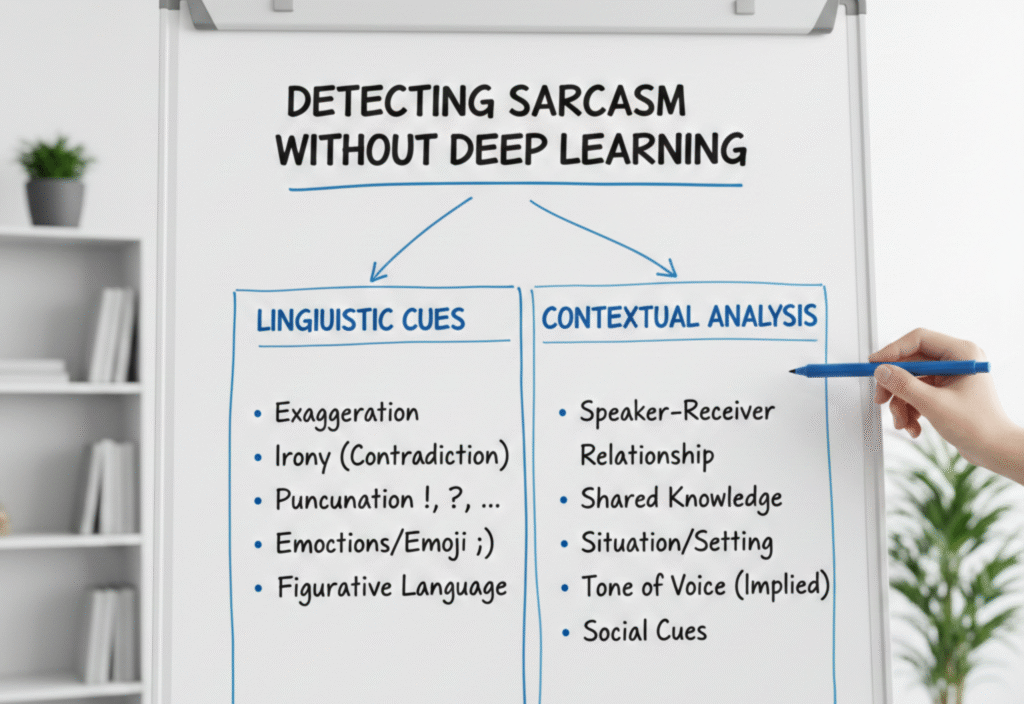
Sarcasm detection is one of the more challenging problems in natural language processing (NLP). Human communication is nuanced, and sarcasm often relies on subtle cues, context, and tone rather than just the literal meaning of words. While deep learning models, such as transformers, have achieved significant success in understanding these complexities, they are not the only solution. For many applications, simpler, resource-efficient methods can still provide reliable sarcasm detection. This article explores alternative approaches to sarcasm detection in AI that do not rely on deep learning, focusing on rule-based systems, traditional machine learning, and hybrid methods.
Understanding the Challenge of Sarcasm Detection
Sarcasm is a form of verbal irony where the speaker says something but means the opposite. For instance, the sentence “Oh great, another Monday!” often implies frustration rather than joy. Detecting such nuances is difficult because:
Context Matters: Sarcasm often depends on the broader context or prior knowledge of the conversation.
Tone and Intonation: In spoken language, vocal cues help convey sarcasm, which text-based systems may not capture.
Subtle Wordplay: Sarcasm frequently relies on exaggeration, contrast, or contradictions, which can be challenging for literal parsing.
Given these challenges, it is clear why detecting sarcasm requires more than just simple keyword matching.
Rule-Based Approaches
Rule-based systems are among the earliest methods used for sentiment and sarcasm detection. They rely on predefined linguistic rules, patterns, and lexicons.
1. Lexicon-Based Methods
Lexicons are dictionaries of words annotated with sentiment scores or semantic meaning. In sarcasm detection, researchers often use sentiment lexicons to identify contradictions. For example, if a positive word appears in a negative context, it may signal sarcasm.
Example Rule:
If a positive sentiment word appears alongside a negative situation word, flag as potential sarcasm.
Sentence: “I just love being stuck in traffic for hours.”
Analysis: “love” (positive) contrasts with “stuck in traffic” (negative context).
2. Punctuation and Emoticons
Punctuation such as exclamation marks, ellipses, and quotation marks can provide cues to sarcastic intent. Similarly, emoticons and emojis often indicate tone in informal text, like social media posts.
Example Rule:
Sentences ending with “!” following a negative event may indicate sarcasm.
Advantages of Rule-Based Methods
Simple to implement and explain.
Computationally inexpensive, suitable for low-resource settings.
Limitations
Highly domain-specific; rules may not generalize well across datasets.
Cannot handle subtle sarcasm without extensive rules.
Traditional Machine Learning Approaches
Machine learning methods can go beyond simple rule matching by learning patterns from annotated data. These approaches do not require deep neural networks and can work effectively with features engineered from text.
1. Feature Engineering
Key features for sarcasm detection include:
N-grams: Sequences of words that capture context.
Sentiment Contrasts: Detecting words with conflicting sentiment.
Part-of-Speech Tags: Certain syntactic patterns often correlate with sarcasm.
Punctuation Counts: Exclamation marks, ellipses, question marks.
2. Classifiers
Traditional classifiers such as Support Vector Machines (SVMs), Random Forests, and Logistic Regression can be trained on these features. For example:
Sentences are vectorized into feature sets.
Classifier predicts sarcastic or non-sarcastic label.
Advantages
Requires less data than deep learning models.
Easier to interpret than neural networks.
Limitations
May struggle with highly contextual sarcasm.
Performance heavily depends on quality of feature engineering.
Hybrid Approaches
Hybrid approaches combine rule-based and machine learning methods to leverage the strengths of both. For instance:
Preprocessing with Rules: Apply rule-based filters to identify obvious sarcastic cues.
Machine Learning Classification: Feed the filtered sentences into a classifier using engineered features.
This method can improve accuracy while keeping computational costs low. It is particularly useful in social media analysis, chatbots, and customer feedback monitoring.
Practical Applications
Even without deep learning, sarcasm detection has valuable applications:
Social Media Monitoring: Brands can understand customer sentiment more accurately.
Chatbots and Virtual Assistants: Systems can respond more appropriately to user queries containing sarcasm.
Market Analysis: Detecting sarcastic reviews can help companies better assess product feedback.
Content Moderation: Automatically flagging potentially sarcastic or ironic comments that may be offensive.
Challenges and Future Directions
While non-deep-learning methods can be effective, they face certain challenges:
Context Sensitivity: Sarcasm often relies on broader discourse, which simple models may miss.
Cultural and Language Differences: Sarcasm varies widely across languages and cultures.
Data Annotation: Creating labeled datasets for sarcasm detection is challenging due to subjective interpretation.
Future research could focus on knowledge-based systems, graph-based context modeling, and transfer learning from other NLP tasks to enhance non-deep-learning approaches.
Conclusion
Detecting sarcasm without deep learning is entirely feasible using rule-based, traditional machine learning, or hybrid approaches. While deep learning offers state-of-the-art performance, alternative methods remain valuable, especially for applications with limited computational resources or the need for interpretability. By combining linguistic insights with smart feature engineering, AI systems can effectively understand sarcastic communication, making human-computer interaction more natural and context-aware.