Artificial intelligence is evolving from standalone tools into cooperative digital ecosystems. One important development in this shift is multi-agent systems, where multiple intelligent programs work together to complete tasks efficiently. Instead of relying on one centralized system, these collaborative AI structures distribute responsibilities across several agents, improving flexibility, speed, and reliability.
As industries adopt automation and data-driven decision-making, understanding how these systems enhance collaboration and efficiency has become increasingly valuable.
Understanding Multi-Agent Systems
A multi-agent environment involves several intelligent agents interacting within a shared space. Each agent can analyze information, make decisions, and perform actions independently while coordinating with others when necessary.
This decentralized approach helps manage complex operations more effectively. For example, in logistics or smart infrastructure, separate digital agents may handle scheduling, monitoring, forecasting, and optimization simultaneously.
Core Features of Collaborative AI Systems
Autonomous Operation
Each agent works independently based on predefined rules or learned behavior, reducing the need for constant human supervision.
Cooperation and Communication
Agents share information to achieve collective goals. Effective communication ensures smoother workflows and faster problem solving.
Adaptability
Modern AI agents often learn from experience, allowing them to adjust their actions as environments change.
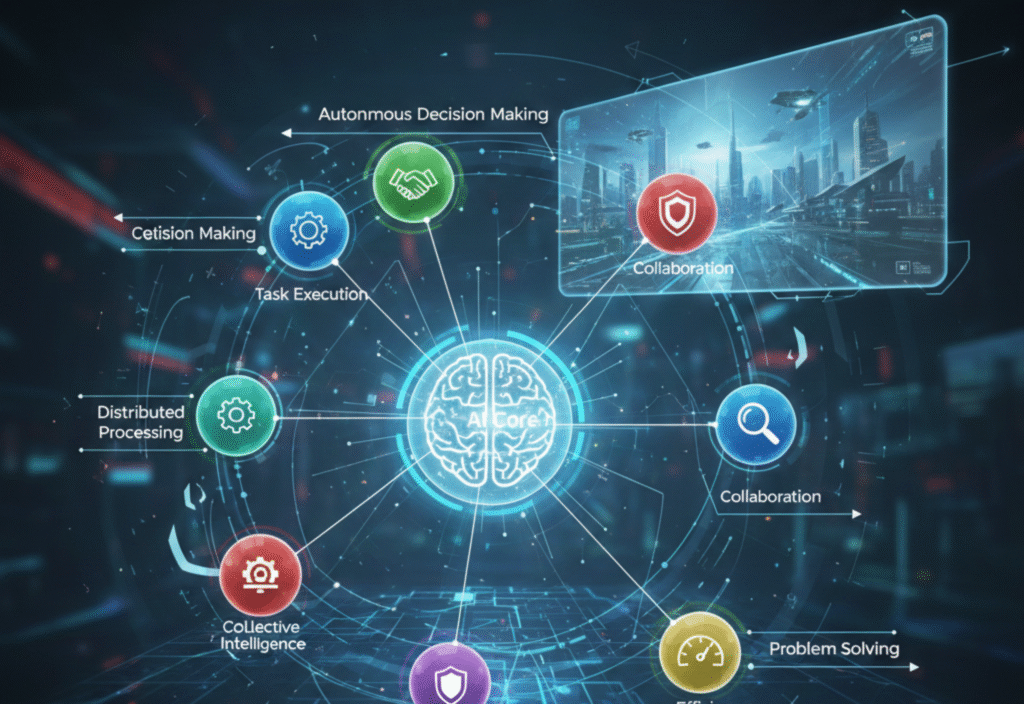
Distributed Intelligence
Instead of concentrating control in one system, intelligence spreads across multiple components, improving efficiency and resilience.
Benefits for Modern Industries
Improved Efficiency
Parallel processing allows multiple tasks to run simultaneously, saving time and resources.
Better Decision-Making
Collaborative AI can analyze large datasets collectively, providing more accurate insights.
Greater Reliability
If one agent encounters a problem, others can continue functioning, minimizing disruptions.
Scalable Infrastructure
Organizations can expand systems by adding new agents without redesigning the entire framework.
Common Applications
These AI collaboration frameworks are used in various sectors:
Smart cities: traffic management, energy optimization, and public safety monitoring
Healthcare support: scheduling systems, data analysis, and patient monitoring tools
Business automation: workflow coordination, customer service bots, and analytics
Manufacturing robotics: synchronized production processes
Cybersecurity monitoring: continuous threat detection and response
Their versatility makes them suitable for both digital and physical environments.
Technologies Driving Adoption
Several technological advances support these intelligent networks:
Machine learning for adaptive decision-making
Cloud computing for scalable processing
Internet of Things devices providing real-time data
High-speed connectivity enabling fast coordination
Together, these technologies create efficient ecosystems where autonomous agents can collaborate effectively.
Challenges to Consider
While beneficial, collaborative AI systems require thoughtful implementation:
Coordination complexity between agents
Security considerations in distributed environments
Integration with existing infrastructure
Governance and ethical design practices
Careful planning helps maximize benefits while minimizing risks.
Future Outlook
The future of AI collaboration is expected to involve more advanced automation, smarter infrastructure management, and closer human-AI cooperation. As technology progresses, intelligent agent ecosystems will likely become standard across industries seeking efficiency and innovation.
Conclusion
Multi-agent systems represent a significant advancement in artificial intelligence by enabling coordinated collaboration among intelligent agents. Their distributed structure improves efficiency, scalability, and resilience across many applications.