
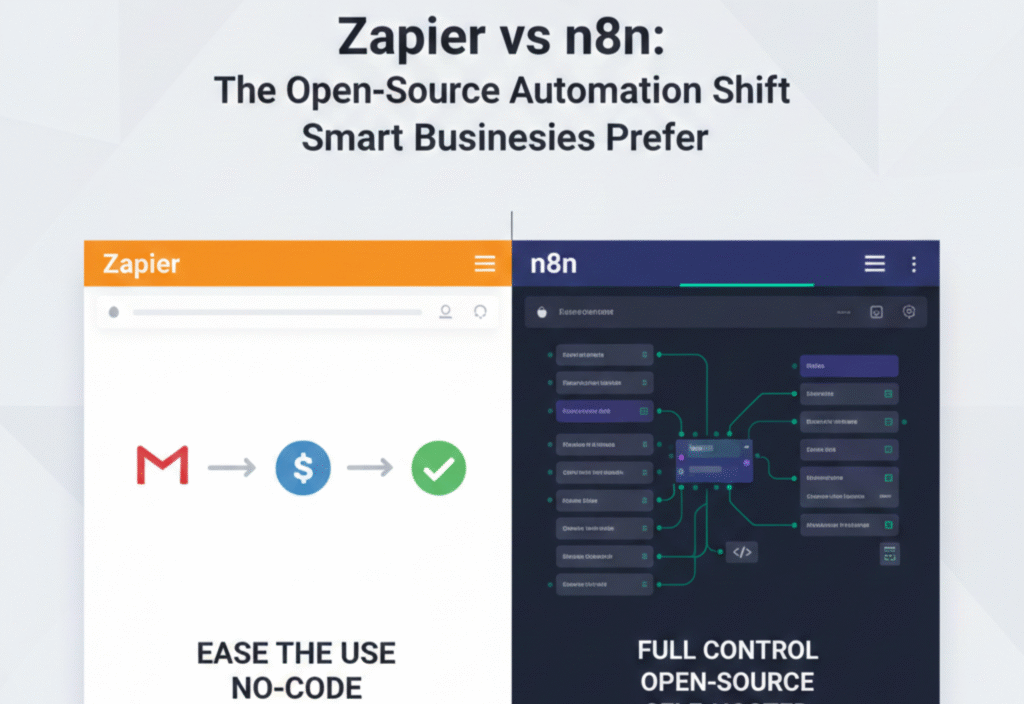
In today’s business world, automation is essential for efficiency and growth. Many companies face a choice between n8n vs Zapier when deciding how to streamline workflows. While Zapier has long been popular for connecting apps and automating tasks, open-source alternatives like n8n are rapidly gaining attention. In this article, we’ll explore why smart businesses are switching to n8n and what advantages open-source automation offers over traditional platforms.
Understanding Workflow Automation
Workflow automation allows businesses to link different software applications and automate repetitive tasks. For example, you can automatically save email attachments to cloud storage, notify your team when new leads enter your CRM, or even generate reports without lifting a finger. This saves hours of manual work, reduces human error, and allows employees to focus on higher-value activities.
While Zapier has long dominated the automation landscape with its ease of use and massive app integrations, open-source platforms like n8n are disrupting the status quo.
What is Zapier?
Zapier is a cloud-based automation tool that connects thousands of apps via “Zaps,” which are automated workflows triggered by specific actions. For instance, when a new email arrives in Gmail, Zapier can automatically create a task in Trello. It’s widely praised for its simplicity, pre-built templates, and reliability.
However, Zapier is a proprietary platform, which comes with certain limitations:
-
Cost: As your automation needs grow, Zapier’s pricing can become expensive, especially for businesses with high-volume workflows.
-
Flexibility: Zapier’s platform, while easy to use, may not provide the granular control that complex workflows require.
-
Data Privacy: Since Zapier is cloud-based, businesses must rely on a third party to handle their sensitive data.
These constraints have prompted companies to explore alternatives that offer more control, transparency, and scalability.
Enter n8n: The Open-Source Automation Platform
n8n (pronounced “n-eight-n”) is an open-source workflow automation tool that provides similar functionality to Zapier but with added flexibility and control. Being open-source means that businesses can host n8n on their own servers, modify the code to suit their needs, and avoid vendor lock-in.
Key Advantages of n8n
-
Open-Source and Customizable
Unlike Zapier, n8n allows users to access and modify the underlying code. This means businesses can customize workflows, integrate niche tools, and create complex logic that isn’t possible with proprietary solutions. -
Cost-Effective Scaling
n8n offers a free self-hosted version. For growing businesses, this can significantly reduce automation costs compared to Zapier’s subscription-based pricing. -
Enhanced Privacy and Security
Hosting n8n on your own infrastructure ensures that sensitive business data remains under your control, which is crucial for companies with strict compliance requirements. -
Complex Workflow Capabilities
n8n supports advanced features such as conditional logic, loops, and branching workflows. This allows businesses to design automation that is highly sophisticated and tailored to specific needs. -
Community-Driven Development
Being open-source means n8n benefits from an active community of developers constantly building new integrations, improving features, and ensuring the platform evolves with the latest business needs.
Why Businesses are Making the Switch
Businesses are increasingly realizing that automation isn’t just about saving time—it’s about flexibility, control, and cost-efficiency. Here are a few reasons why companies are transitioning from Zapier to n8n:
-
Customization Needs: Proprietary tools like Zapier may fall short for complex processes that require unique logic or integration with in-house systems.
-
Cost Optimization: High-volume workflows can make Zapier expensive. n8n’s self-hosted option provides a scalable alternative without the recurring costs.
-
Data Control: Regulatory requirements and privacy concerns make self-hosted solutions more appealing.
-
Innovation and Experimentation: Open-source platforms allow teams to experiment and innovate freely, creating custom workflows without waiting for vendor support.
Use Cases Where n8n Excels
-
E-commerce: Automate order processing, inventory updates, and customer notifications without relying on cloud-based services.
-
Marketing Automation: Create complex marketing workflows combining email campaigns, social media updates, and CRM triggers.
-
Enterprise Operations: Integrate internal systems, automate HR workflows, or manage large-scale reporting processes.
-
Data Syncing and ETL: Collect, transform, and push data across multiple databases and platforms while maintaining control over sensitive information.
The Future of Automation: Open-Source First
While Zapier remains an excellent tool for simple workflows and non-technical users, the rise of n8n and other open-source automation platforms signals a shift in the market. Businesses are increasingly valuing flexibility, cost-effectiveness, and control over convenience. Open-source solutions like n8n empower organizations to build automation systems that grow with their needs rather than being constrained by proprietary limitations.
Switching to n8n doesn’t just save money—it opens the door to a new level of automation sophistication, security, and customization that can give businesses a competitive edge.
Conclusion
The automation landscape is evolving. While Zapier introduced millions of businesses to the power of connecting apps and automating workflows, open-source platforms like n8n are taking the next step. For businesses that demand flexibility, advanced features, and full control over their processes, n8n provides a compelling alternative. By embracing open-source automation, companies can future-proof their operations, optimize costs, and unlock efficiencies that proprietary platforms simply cannot match.