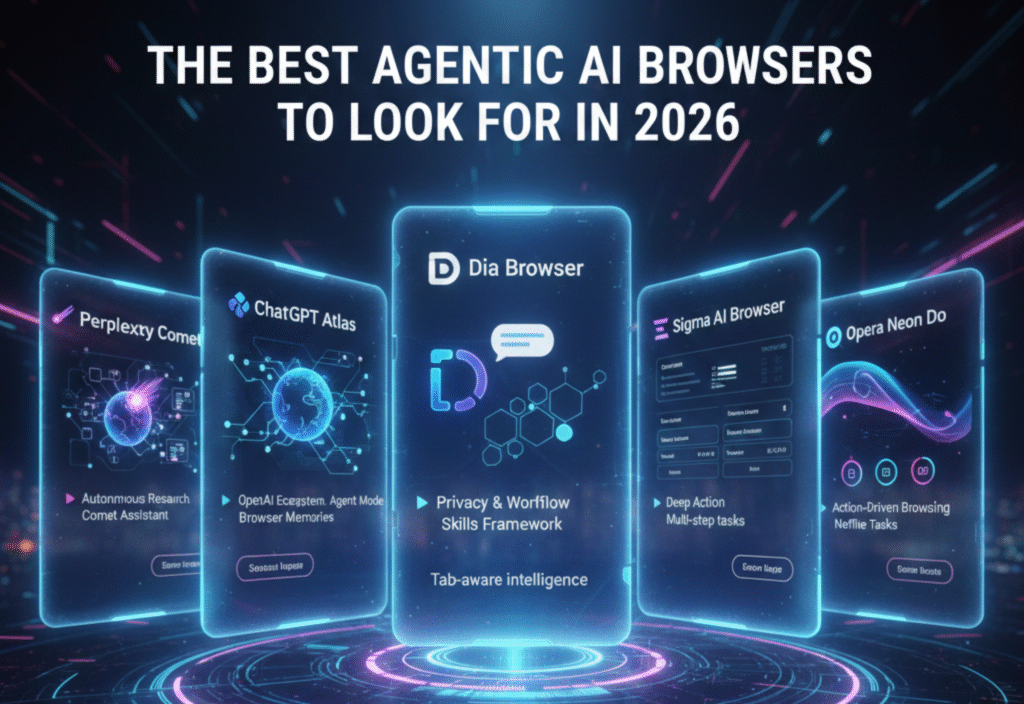
The traditional web browser is undergoing a massive transformation. In 2026, browsing the internet is no longer just about opening tabs and typing URLs—it’s about delegating tasks, automating workflows, and letting AI act on your behalf. This evolution has given rise to Agentic AI Browsers, a new generation of browsers that don’t just assist users but actively perform multi-step actions, make decisions, and adapt to user intent.
Agentic AI browsers combine artificial intelligence, autonomous agents, natural language understanding, and contextual memory to deliver a hands-free, goal-oriented browsing experience. As AI continues to mature, these browsers are becoming essential tools for professionals, developers, researchers, and everyday users.
What Is an Agentic AI Browser?
An Agentic AI Browser goes beyond AI-powered search or chat features. It can:
-
Understand high-level goals (e.g., “Plan my trip within budget”)
-
Break tasks into steps automatically
-
Browse multiple websites independently
-
Fill forms, compare options, and execute actions
-
Learn from user behavior and preferences
-
Operate continuously without manual input
Unlike traditional browsers, agentic AI browsers act like digital employees, not just tools.
Why Agentic AI Browsers Matter in 2026
By 2026, the internet is more complex, data-heavy, and time-consuming than ever. Agentic AI browsers help users:
-
Save hours of manual work
-
Reduce cognitive overload
-
Automate repetitive online tasks
-
Improve productivity and decision-making
-
Access information faster and more accurately
They are especially valuable in industries like software development, marketing, research, finance, e-commerce, and education.
Top Agentic AI Browsers to Watch in 2026
1. Arc Browser (AI-First Evolution)
Arc has already disrupted traditional browsing with its minimalist design and workflow-focused interface. By 2026, Arc is expected to fully embrace agentic AI capabilities, allowing users to assign goals instead of clicking through tabs.
Key Agentic Features:
-
Task-based browsing instead of tab-based
-
AI agents that research, summarize, and act
-
Context-aware workspaces
-
Personalized automation flows
Why It Stands Out:
Arc is redefining how users interact with the web, making it one of the strongest contenders in the agentic browser space.
2. Microsoft Edge with Copilot Agents
Microsoft Edge has rapidly evolved into an AI-integrated browser powered by Copilot. In 2026, Edge is expected to offer fully autonomous browsing agents deeply connected with Microsoft’s ecosystem.
Key Agentic Features:
-
Multi-step task execution via natural language
-
AI agents for shopping, research, and reporting
-
Integration with Office, Teams, and Windows
-
Enterprise-grade security and compliance
Why It Stands Out:
Edge excels in professional and enterprise use cases, making it ideal for business users and organizations.
3. Opera One (AI-Native Browser)
Opera One has positioned itself as an AI-native browser from the ground up. With its modular design and built-in AI assistant, Opera is pushing toward self-operating browsing experiences.
Key Agentic Features:
-
Autonomous AI sidebar agents
-
Built-in web automation
-
Smart tab clustering and task delegation
-
Privacy-focused AI processing
Why It Stands Out:
Opera balances innovation with privacy, appealing to users who want AI control without data overexposure.
4. Brave Agentic Browser (Privacy-First AI)
Brave is known for privacy, and by 2026 it is expected to deliver local-first agentic AI browsing, minimizing cloud dependency.
Key Agentic Features:
-
On-device AI agents
-
Autonomous research and comparison tools
-
Built-in ad and tracker blocking
-
Crypto and Web3 automation
Why It Stands Out:
Brave is ideal for users who want powerful AI agents without sacrificing privacy or data ownership.
5. Open-Source Agentic Browsers (Auto-GPT + Browser Hybrids)
A growing ecosystem of open-source agentic browsers is emerging, often combining Auto-GPT-like agents with Chromium-based browsers.
Key Agentic Features:
-
Fully customizable AI agents
-
Local LLM integration (e.g., Ollama)
-
Workflow automation via plugins
-
Developer-friendly architecture
Why It Stands Out:
These browsers are perfect for developers and AI enthusiasts who want complete control over their browsing agents.
6. AI-Native Research Browsers
By 2026, specialized agentic browsers focused on research, academia, and data analysis will gain popularity.
Key Agentic Features:
-
Automated literature reviews
-
Source credibility scoring
-
Long-form summarization
-
Citation and reference generation
Why It Stands Out:
These browsers turn research tasks that once took days into minutes.
Key Features to Look for in Agentic AI Browsers
When evaluating an agentic AI browser in 2026, look for:
-
Goal-Oriented Task Execution
-
Autonomous Web Navigation
-
Memory and Context Retention
-
Natural Language Commands
-
Local and Cloud AI Options
-
Privacy and Data Control
-
Plugin and Automation Support
Challenges and Ethical Considerations
Despite their benefits, agentic AI browsers also raise concerns:
-
Data privacy and surveillance risks
-
Over-reliance on autonomous systems
-
Potential misuse for automation abuse
-
Transparency in AI decision-making
The best browsers will address these concerns with ethical AI design, user control, and transparency.
The Future of Browsing Beyond 2026
Agentic AI browsers are only the beginning. In the near future, we can expect:
-
Browsers that negotiate services on your behalf
-
AI agents that collaborate with other AI agents
-
Fully voice-driven browsing
-
Deep integration with personal and work AI systems
The browser will no longer be a passive window—it will be an active digital partner.
Conclusion
The best agentic AI browsers to look for in 2026 are those that combine autonomy, intelligence, privacy, and usability. As AI agents become more capable, browsers will evolve into powerful assistants that think, act, and learn alongside users.