
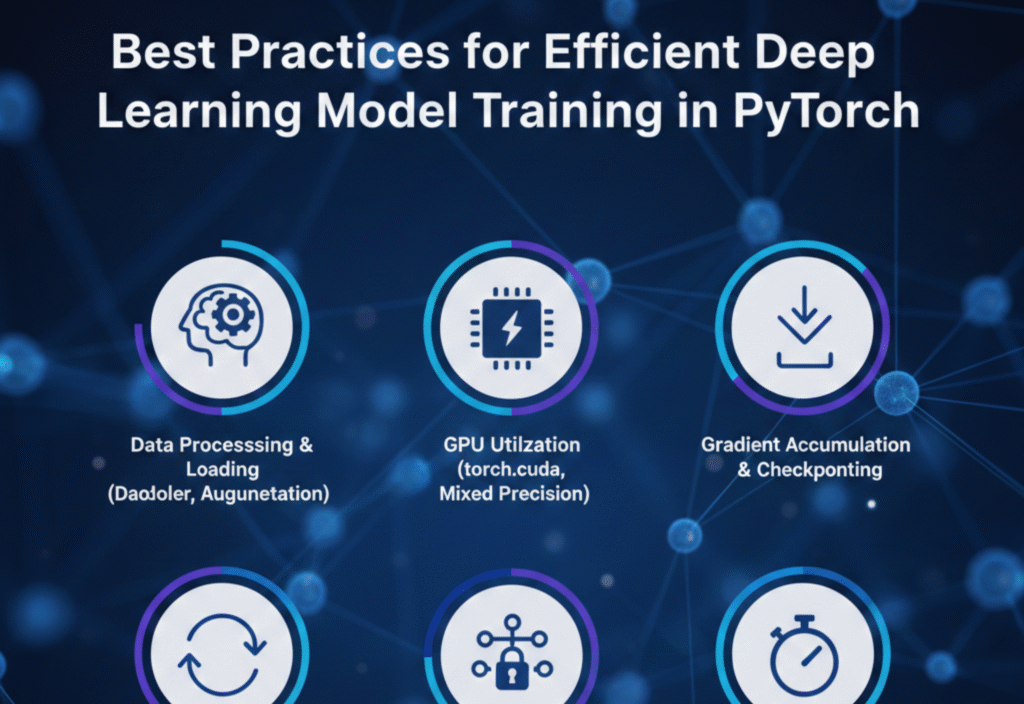
Efficient PyTorch training is essential for building fast and scalable deep learning models. Many developers struggle with slow training speeds and high resource usage because they do not apply proper optimization techniques. In this guide, you will learn how to improve efficient PyTorch training using practical methods, real examples, and proven strategies to speed up model performance.
Efficient training is not just about making models run faster. It is about designing a complete workflow where data loading, model computation, memory usage, and evaluation all work together smoothly. A well-optimized training pipeline can reduce training time by more than half while improving model performance and reducing costs.
In this guide, you will learn practical and real-world strategies to train deep learning models efficiently in PyTorch. These techniques are based on proven practices used in production-level machine learning systems.
1. Choose the Right Model Architecture
Why Architecture Selection Matters
The architecture of your model determines how much computation is required during training. Many beginners assume that larger models always perform better, but this is not always true. In many cases, oversized models lead to overfitting, slow convergence, and unnecessary resource usage.
Best Practices for Model Selection
- Start with a simple baseline model and measure its performance
- Use pre-designed efficient architectures such as EfficientNet or MobileNet
- Avoid adding unnecessary layers without clear benefits
- Focus on models that balance performance and computational cost
Choosing an efficient architecture early can save significant time during experimentation and training.
2. Build an Optimized Data Pipeline
Why Data Loading Becomes a Bottleneck
Even if your model is highly optimized, slow data loading can cause your GPU to remain idle. This leads to wasted resources and longer training times.
Techniques to Improve Data Loading
- Use multiple workers to load data in parallel
- Enable pinned memory for faster GPU transfers
- Keep preprocessing lightweight during training
Example
from torch.utils.data import DataLoader
train_loader = DataLoader(
dataset,
batch_size=64,
shuffle=True,
num_workers=4,
pin_memory=True
)
Additional Tips
- Avoid heavy transformations inside the training loop
- Cache frequently used data if possible
- Use efficient file formats for large datasets
An optimized data pipeline ensures that your GPU is always busy processing data.
3. Find the Optimal Batch Size
How Batch Size Affects Training
Batch size influences training speed, memory usage, and model generalization.
Guidelines
- Use the largest batch size that fits into GPU memory
- Use gradient accumulation if memory is limited
- Monitor validation accuracy when increasing batch size
Very large batch sizes may reduce model generalization, so balance is important.
4. Use GPU and Hardware Acceleration Properly
Correct Device Handling
import torch
device = torch.device(“cuda” if torch.cuda.is_available() else “cpu”)
model.to(device)
inputs = inputs.to(device)
Best Practices
- Always ensure model and data are on the same device
- Monitor GPU utilization using system tools
- Use multiple GPUs for large-scale models
Scaling with Multiple GPUs
For large projects, use DistributedDataParallel instead of DataParallel for better performance and scalability.
5. Apply Mixed Precision Training
What is Mixed Precision Training
Mixed precision uses both 16-bit and 32-bit floating-point operations to improve performance.
Implementation
from torch.cuda.amp import autocast, GradScaler
scaler = GradScaler()
with autocast():
outputs = model(inputs)
loss = loss_function(outputs, targets)
Advantages
- Faster training on modern GPUs
- Reduced memory usage
- Ability to train larger models
Mixed precision is widely used in modern deep learning systems.
6. Optimize the Training Loop
Why Training Loop Efficiency Matters
The training loop runs thousands of times, so even small inefficiencies can significantly impact performance.
Best Practices
- Avoid redundant computations inside loops
- Keep operations minimal and efficient
- Use optimized loss functions
Efficient Evaluation
model.eval()
This prevents unnecessary gradient calculations and reduces memory usage.
7. Choose the Right Optimizer and Learning Strategy
Example
Optimization Tips
- Use AdamW for most general tasks
- Use SGD with momentum for large datasets
- Apply learning rate schedulers such as CosineAnnealing or StepLR
- Use warm-up strategies for stable training
A well-tuned optimizer can reduce training time and improve final accuracy.
8. Reduce Unnecessary Computation
Common Inefficiencies
- Recomputing values inside loops
- Keeping gradients enabled during evaluation
- Updating layers that do not need training
Solutions
- Freeze unused layers using requires_grad = False
- Disable gradients during validation
- Remove debugging operations in production runs
Efficient code leads to faster and cleaner training.
9. Monitor Training and Detect Problems Early
Why Monitoring is Important
Without proper monitoring, you may waste hours training a model that is not improving.
Key Metrics to Track
- Training loss
- Validation loss
- Accuracy or other relevant metrics
Tools
- TensorBoard
- Custom logging systems
Early Stopping
Stop training when performance stops improving to save time and resources.
10. Real-World Example of Optimization Impact
Before Optimization
- Training time: around 2 hours
- GPU utilization: 40 percent
- Frequent idle time
After Optimization
- Training time reduced to less than 1 hour
- GPU utilization increased significantly
- Stable and faster convergence
This shows that optimization can dramatically improve performance without changing hardware.
11. Profile and Benchmark Your Training Process
Why Profiling is Necessary
Instead of guessing, profiling helps identify exact bottlenecks.
What to Analyze
- CPU vs GPU usage
- Data loading delays
- Memory consumption
Tools
- PyTorch Profiler
- Timing functions
- Memory monitoring tools
Optimization should always be based on measurable data.
12. Common Mistakes Beginners Should Avoid
- Not using GPU acceleration
- Poor data loading configuration
- Extremely small batch sizes
- Ignoring mixed precision training
- Not monitoring training performance
Avoiding these mistakes can immediately improve training efficiency.
Conclusion
Efficient deep learning training in PyTorch requires a complete approach that includes model design, data pipeline optimization, hardware utilization, and proper monitoring. By applying the strategies discussed in this guide, you can significantly reduce training time, improve model performance, and make better use of your computational resources.
As models continue to grow in complexity, efficient training will become even more important. Developers who focus on optimization early will gain a strong advantage in building scalable and high-performing machine learning systems.