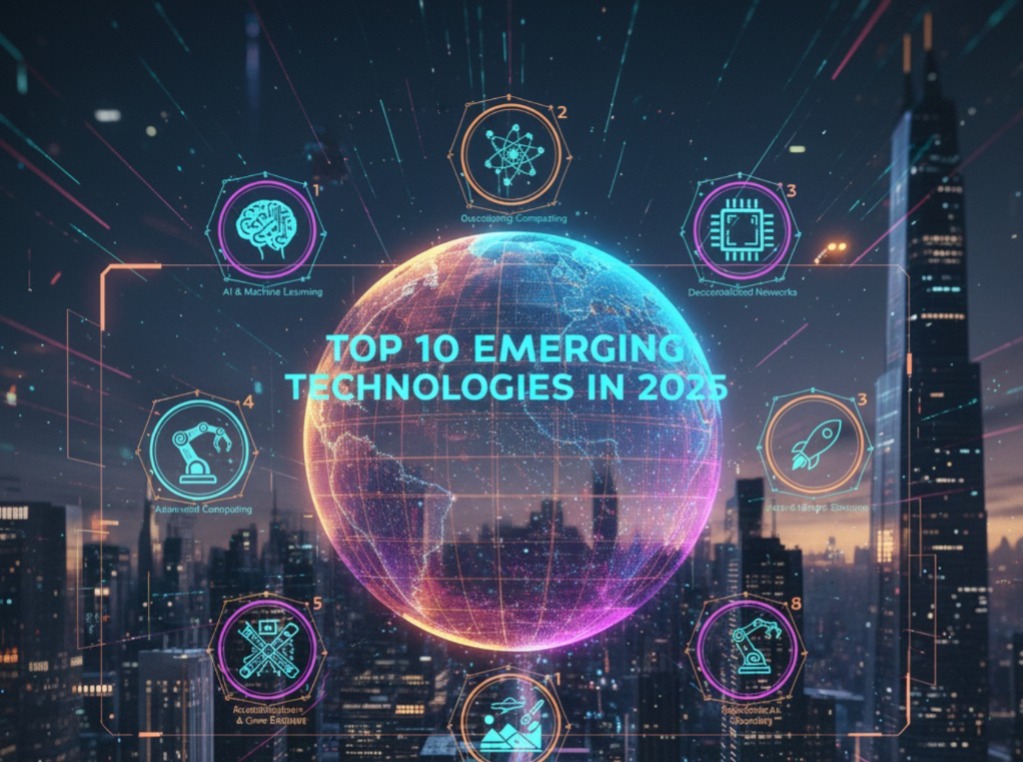
Emerging technologies 2025 are set to transform the world in remarkable ways, impacting industries, daily life, and global innovation. From artificial intelligence (AI) and blockchain to renewable energy solutions and quantum computing, these advanced technologies are reshaping how we work, communicate, and solve some of the world’s biggest challenges.
1. Artificial Intelligence (AI) and Machine Learning
AI continues to dominate the tech landscape, with smarter algorithms capable of predicting trends, automating tasks, and improving decision-making.
-
Applications: Healthcare diagnostics, personalized recommendations, autonomous vehicles.
-
Impact: AI will enhance productivity across industries and enable smarter cities and businesses.
2. Quantum Computing
Quantum computing is moving from theory to real-world applications. Its ability to process complex calculations at unprecedented speeds will transform industries.
-
Applications: Drug discovery, financial modeling, cryptography.
-
Impact: Quantum computers could solve problems that are impossible for traditional computers.
3. 5G and Next-Generation Connectivity
5G technology is expanding globally, providing lightning-fast internet and low latency connections.
-
Applications: IoT devices, AR/VR experiences, smart cities.
-
Impact: Enhanced connectivity will revolutionize communication, gaming, and remote work.
4. Augmented Reality (AR) and Virtual Reality (VR)
AR and VR technologies are no longer just for gaming — they’re transforming education, healthcare, and e-commerce.
-
Applications: Virtual classrooms, immersive shopping experiences, surgical simulations.
-
Impact: Users can interact with digital environments like never before, increasing efficiency and engagement.
5. Blockchain and Decentralized Finance (DeFi)
Blockchain technology is reshaping the financial landscape and beyond. Decentralized systems provide transparency, security, and automation.
-
Applications: Cryptocurrency, smart contracts, supply chain management.
-
Impact: Trustless systems reduce fraud and increase efficiency in multiple sectors.
6. Biotechnology and Genetic Engineering
Advances in biotechnology are enabling solutions to medical and environmental challenges. CRISPR and other gene-editing technologies are at the forefront.
-
Applications: Personalized medicine, disease eradication, sustainable agriculture.
-
Impact: Healthier populations and more sustainable food production systems.
7. Autonomous Vehicles and Robotics
Self-driving cars, drones, and smart robots are becoming increasingly common. Automation is enhancing logistics, safety, and daily life.
-
Applications: Transportation, warehouse management, home assistance.
-
Impact: Reduced human error, faster delivery systems, and smarter infrastructure.
8. Renewable Energy Technologies
Clean energy innovation is critical for combating climate change. Solar, wind, and next-gen energy storage systems are evolving rapidly.
-
Applications: Smart grids, energy-efficient homes, electric vehicles.
-
Impact: Reduced carbon footprint and sustainable energy solutions worldwide.
9. Internet of Things (IoT)
IoT connects everyday devices, creating smarter homes, cities, and industries.
-
Applications: Smart thermostats, wearable health devices, industrial automation.
-
Impact: Optimized resource use, improved convenience, and real-time data insights.
10. Cybersecurity Innovations
As technology advances, cyber threats grow more sophisticated. Next-gen cybersecurity solutions are essential to protect data and privacy.
-
Applications: AI-powered threat detection, zero-trust security, blockchain-based security.
-
Impact: Safer digital environments for businesses and individuals alike.
Conclusion
2025 is shaping up to be a revolutionary year for technology. From AI and quantum computing to blockchain and renewable energy, these emerging technologies are set to change the world as we know it. Staying informed and adopting these innovations early can help businesses, individuals, and society thrive in this fast-paced digital era.