
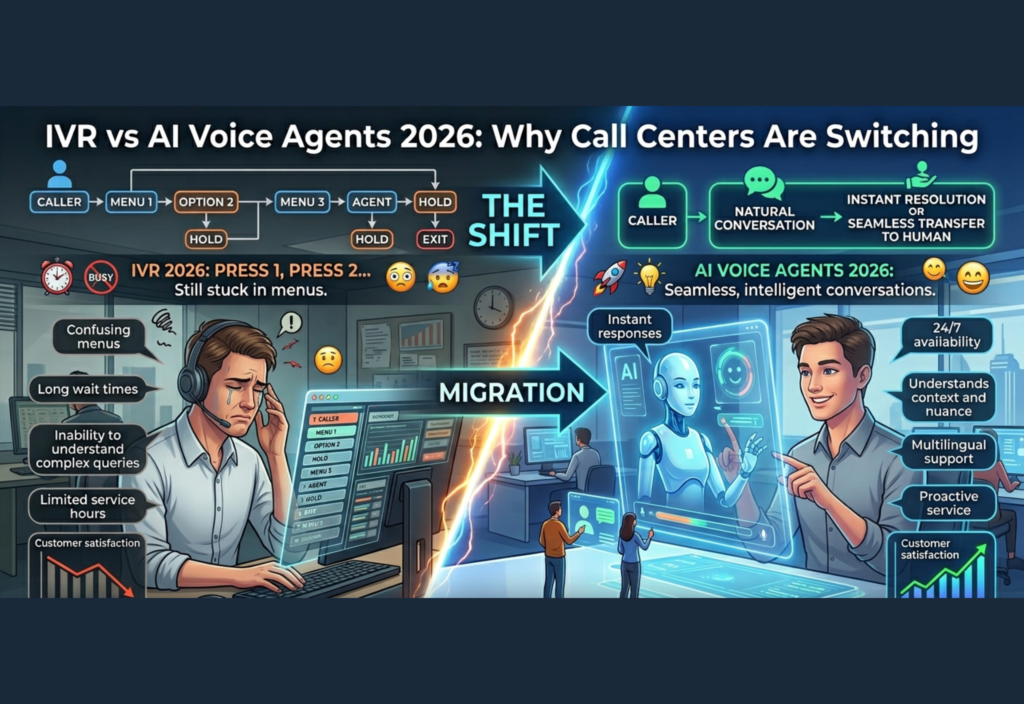
Customer service technology is evolving rapidly, and in 2026 one of the most important comparisons in the industry is IVR vs AI Voice Agents 2026. Traditional IVR (Interactive Voice Response) systems have been used by call centers for decades to automate basic customer interactions. However, modern AI voice agents are now replacing or upgrading these systems by offering more natural, intelligent, and human-like conversations.
Businesses are increasingly switching from IVR to AI voice agents because customers now expect faster, smarter, and more personalized support. While IVR systems rely on fixed menus and keypad inputs, AI voice agents understand natural language, respond dynamically, and solve complex customer problems without forcing users through long menu options.
This article explains why call centers are moving away from IVR systems, how AI voice agents work, and what this shift means for the future of customer support in 2026.
What Is IVR (Interactive Voice Response)?
IVR is an automated phone system that interacts with callers using pre-recorded voice menus. Customers listen to options and respond using keypad inputs or simple voice commands.
Typical IVR features include:
- Press 1 for sales
- Press 2 for support
- Basic call routing
- Pre-recorded responses
- Limited automation
IVR systems have been widely used because they reduce the need for human agents to handle basic queries. However, they often create frustration due to long menus and lack of flexibility.
What Are AI Voice Agents?
AI voice agents are advanced conversational systems powered by artificial intelligence, natural language processing, and machine learning. Unlike IVR, they understand real human speech and respond in a conversational way.
AI voice agents can:
- Understand natural language queries
- Hold human-like conversations
- Solve customer issues in real time
- Access databases instantly
- Handle multiple languages
- Transfer complex cases to human agents
These systems are designed to feel like speaking to a real person rather than navigating a menu.
IVR vs AI Voice Agents 2026: Key Differences
User Experience
IVR systems force users to navigate menus, which often leads to frustration and long call times. Customers may need to listen to multiple options before reaching the right department.
AI voice agents provide a smoother experience by allowing users to simply speak their problem. The system understands intent and responds immediately without forcing menu navigation.
Speed and Efficiency
IVR systems can slow down the customer journey due to rigid menu structures. Every interaction depends on selecting the correct option.
AI voice agents are much faster because they:
- Respond instantly
- Skip unnecessary steps
- Understand full queries
- Provide direct answers
This significantly reduces average handling time in call centers.
Accuracy and Understanding
IVR systems are limited in understanding customer intent. They only follow predefined paths and cannot handle unexpected questions.
AI voice agents use advanced language models to:
- Understand context
- Interpret natural speech
- Learn from interactions
- Improve over time
This makes them far more accurate in resolving customer issues.
Cost Comparison
IVR systems are relatively cheap to operate but limited in capability. However, they still require maintenance and often fail to reduce human workload effectively.
AI voice agents may require higher initial investment, but they reduce long-term costs by:
- Handling more calls automatically
- Reducing human agent workload
- Improving first-call resolution rates
- Operating 24/7 without breaks
Why Call Centers Are Switching from IVR to AI Voice Agents in 2026
Rising Customer Expectations
Customers in 2026 expect instant, conversational, and efficient support. Traditional IVR systems feel outdated compared to modern AI interactions.
Demand for Personalization
AI voice agents can personalize responses based on customer history, preferences, and behavior, something IVR systems cannot do.
Reduced Operational Pressure
Call centers face increasing pressure to handle large volumes of calls. AI voice agents help reduce workload by automating repetitive tasks.
Multilingual Support
AI systems can communicate in multiple languages automatically, making them ideal for global businesses compared to traditional IVR systems.
Faster Problem Resolution
AI voice agents reduce the need for multiple transfers and long waiting times, leading to faster issue resolution.
Limitations of IVR Systems in 2026
Despite being widely used, IVR systems now face several limitations:
- Poor user experience
- Limited flexibility
- High customer frustration rates
- Lack of natural conversation
- Slow navigation through menus
These limitations make IVR less effective in modern customer service environments.
Challenges of AI Voice Agents
Although AI voice agents are more advanced, they also come with challenges:
- Higher setup cost
- Data privacy concerns
- Need for continuous training
- Occasional misunderstanding of complex queries
However, most businesses consider these challenges manageable compared to the benefits.
Industries Adopting AI Voice Agents
Banking and Finance
Used for fraud alerts, account queries, and transaction support.
Healthcare
Used for appointment booking, patient reminders, and basic medical support.
E-commerce
Used for order tracking, returns, and customer inquiries.
Telecom
Used for billing support, troubleshooting, and service activation.
Future of Call Centers in 2026 and Beyond
The future of call centers is shifting toward hybrid systems where AI voice agents handle most routine tasks while human agents focus on complex and emotional cases.
Future trends include:
- Fully conversational AI systems
- Real-time emotion detection
- Hyper-personalized support
- Automated end-to-end customer service
Final Thoughts
The comparison of IVR vs AI Voice Agents 2026 clearly shows a major shift in customer service technology. While IVR systems were once the standard for automation, they are now being replaced by smarter and more flexible AI voice agents.
Businesses are switching because AI offers better speed, accuracy, scalability, and customer experience. Although IVR systems are still in use, the future clearly belongs to AI-powered conversational systems that can understand and respond like humans.
Companies that adopt AI voice agents early will have a strong advantage in delivering faster, more efficient, and more satisfying customer support in the digital era.