
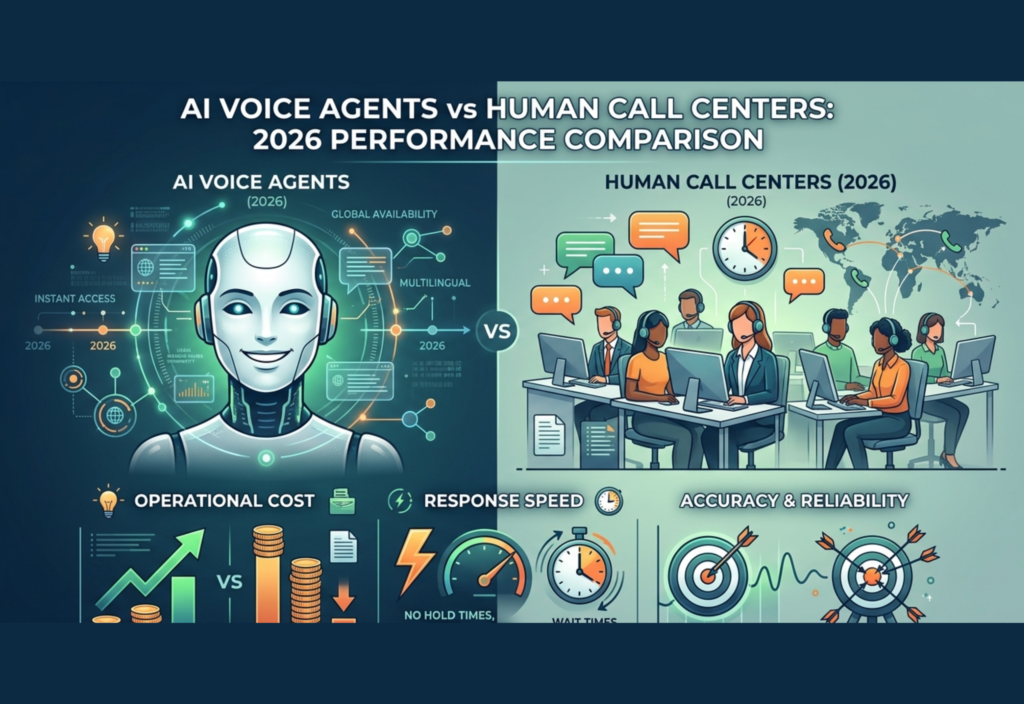
Customer service is changing rapidly in 2026 as businesses adopt artificial intelligence to improve communication, reduce operational costs, and provide faster support. One of the biggest shifts in the customer service industry is the rise of AI voice agents. Companies across healthcare, banking, retail, travel, and e-commerce are replacing or supporting traditional call centers with AI-powered voice systems capable of handling customer conversations automatically.
The debate around AI Voice Agents vs Call Centers 2026 has become one of the most important business discussions of the year. Organizations want to know whether AI voice technology can truly match the speed, accuracy, and human interaction provided by traditional customer support teams.
AI voice agents now answer customer questions, schedule appointments, process orders, resolve complaints, and even conduct sales conversations without human involvement. At the same time, traditional call centers continue to offer emotional understanding, complex problem-solving, and personalized communication that many businesses still value.
This article explores the differences between AI voice agents and traditional call centers in 2026, comparing costs, speed, accuracy, customer experience, scalability, and long-term business impact.
What Are AI Voice Agents?
AI voice agents are advanced conversational systems powered by artificial intelligence, natural language processing, speech recognition, and machine learning. These systems understand spoken language, process requests, and respond naturally during phone conversations.
Modern AI voice agents can:
- Answer customer calls automatically
- Understand multiple languages
- Detect customer intent
- Handle appointment scheduling
- Provide order updates
- Process payments
- Route complex issues to human agents
- Operate 24/7 without breaks
Unlike older automated phone systems, AI voice technology in 2026 sounds more human-like and conversational.
What Are Traditional Call Centers?
Traditional call centers rely on human agents to handle customer communication through phone calls, live chat, and email support. Businesses often use large customer service teams to manage incoming and outgoing communication.
Call center agents are responsible for:
- Solving customer issues
- Handling complaints
- Processing transactions
- Providing technical support
- Managing customer relationships
- Offering emotional understanding
Human agents remain valuable for complex conversations that require empathy, negotiation, or critical decision-making.
AI Voice Agents vs Call Centers 2026: Cost Comparison
Lower Operational Costs with AI Voice Agents
One of the biggest advantages of AI voice systems is cost reduction. Businesses using AI voice agents can significantly lower customer service expenses because AI systems do not require salaries, bonuses, office space, or employee benefits.
AI voice platforms reduce costs related to:
- Employee hiring
- Training programs
- Overtime payments
- Infrastructure management
- Workforce scheduling
Many companies report major savings after automating routine customer support tasks.
High Expenses of Traditional Call Centers
Traditional call centers remain expensive to operate, especially for large businesses handling thousands of daily customer interactions.
Major call center expenses include:
- Employee salaries
- Recruitment costs
- Staff turnover
- Training programs
- Equipment and office space
- Management teams
In 2026, rising labor costs continue increasing operational pressure on customer service businesses worldwide.
Long-Term Financial Impact
Although AI voice systems require initial investment and software integration, long-term operational costs are usually lower than maintaining large human support teams.
For businesses focused on scalability and cost efficiency, AI voice technology offers strong financial advantages.
Speed Comparison in AI Voice Agents vs Call Centers 2026
Instant Response Times
AI voice agents can answer calls immediately without requiring customers to wait in long queues. This dramatically improves customer response times.
Benefits include:
- Faster issue resolution
- Reduced hold times
- Immediate call handling
- Simultaneous conversations
- 24/7 availability
Customers increasingly expect instant service, making response speed a major competitive advantage.
Human Agent Delays
Traditional call centers often experience delays during busy hours. Customers may wait several minutes or longer before reaching a live representative.
Common causes of delays include:
- High call volumes
- Limited staffing
- Shift scheduling issues
- Peak business hours
Long waiting times often reduce customer satisfaction.
Handling Large Volumes
AI systems can manage thousands of conversations at the same time without performance drops. Human call centers require larger teams to scale operations.
This makes AI voice agents highly effective during:
- Holiday sales periods
- Emergency service spikes
- Product launches
- Marketing campaigns
Accuracy Comparison Between AI Voice Agents and Call Centers
Improved AI Accuracy in 2026
Artificial intelligence has improved significantly in speech recognition and language understanding. Modern AI voice agents can understand accents, slang, and natural conversation patterns more accurately than earlier systems.
AI systems excel at:
- Following scripts consistently
- Accessing customer data instantly
- Providing standardized information
- Avoiding human calculation errors
- Recording conversations automatically
Machine learning continuously improves performance over time.
Human Error in Call Centers
Human agents can make mistakes because of fatigue, stress, or lack of training. Errors may include:
- Incorrect information
- Missed customer details
- Miscommunication
- Inconsistent service quality
Large support teams also create variations in customer experience.
Complex Problem Solving
Despite AI improvements, human agents still outperform AI in highly emotional or unpredictable situations. Complex technical issues, sensitive complaints, and negotiations often require human judgment.
Businesses often combine AI automation with human escalation systems for better results.
Customer Experience in AI Voice Agents vs Call Centers 2026
Advantages of AI Voice Customer Service
AI voice agents provide:
- Instant support
- Consistent responses
- 24/7 availability
- Multilingual communication
- Faster transactions
Customers appreciate quick and efficient service for simple tasks like checking order status or booking appointments.
Emotional Intelligence of Human Agents
Human customer service representatives remain stronger in emotional communication.
Human agents can:
- Show empathy
- Build trust
- Handle emotional customers
- Understand frustration
- Adapt conversation tone naturally
Many customers still prefer human interaction for sensitive issues.
Changing Customer Expectations
Younger consumers are becoming more comfortable speaking with AI systems, especially when interactions are fast and accurate.
In 2026, many businesses use hybrid support systems that combine AI speed with human empathy.
Scalability and Business Growth
AI Voice Systems Scale Faster
AI voice platforms allow businesses to expand customer support operations quickly without hiring large teams.
This is especially useful for:
- Startups
- E-commerce companies
- Global businesses
- Seasonal operations
AI systems can support global customers across different time zones simultaneously.
Scaling Traditional Call Centers
Expanding traditional call centers requires:
- Hiring additional staff
- Training new employees
- Increasing office infrastructure
- Managing workforce operations
Scaling human support teams takes more time and resources.
Security and Privacy Concerns
AI Voice Security Risks
AI voice systems collect large amounts of customer data, raising privacy and cybersecurity concerns.
Potential risks include:
- Data breaches
- Voice cloning attacks
- AI manipulation
- Unauthorized recordings
Businesses must implement strong security measures to protect customer information.
Human-Related Security Risks
Traditional call centers also face security challenges, including:
- Insider threats
- Human error
- Data leaks
- Social engineering attacks
Proper employee training remains essential.
Industries Using AI Voice Agents in 2026
Healthcare
Hospitals and clinics use AI voice systems for:
- Appointment scheduling
- Patient reminders
- Prescription updates
- Insurance verification
Banking and Finance
Financial institutions use AI agents for:
- Fraud alerts
- Balance inquiries
- Customer verification
- Loan support
E-Commerce
Online retailers automate:
- Order tracking
- Returns processing
- Customer support
- Product recommendations
Travel and Hospitality
Travel companies use AI voice systems for:
- Booking confirmations
- Flight updates
- Hotel reservations
- Customer inquiries
The Future of AI Voice Agents vs Call Centers 2026
Experts believe AI voice technology will continue improving rapidly over the next few years.
Future developments may include:
- More natural conversations
- Advanced emotional detection
- Real-time language translation
- Smarter customer personalization
- Fully autonomous customer service systems
However, human agents are unlikely to disappear completely. Businesses will still need human expertise for complex communication and relationship management.
Which Option Is Better for Businesses?
The answer depends on business goals, customer expectations, and operational needs.
AI voice agents are ideal for:
- Reducing operational costs
- Handling repetitive tasks
- Scaling customer support
- Providing 24/7 service
Traditional call centers remain valuable for:
- Emotional customer interactions
- Complex support issues
- High-value sales conversations
- Personalized relationship building
Many successful companies in 2026 combine both approaches to create balanced customer support systems.
Final Thoughts
The comparison between AI Voice Agents vs Call Centers 2026 highlights how artificial intelligence is transforming customer service worldwide. AI voice technology delivers faster response times, lower operational costs, and scalable support solutions that many businesses now depend on.
At the same time, traditional call centers continue providing emotional intelligence, human understanding, and complex problem-solving abilities that AI systems still struggle to replicate fully.
The future of customer service will likely involve hybrid systems where AI handles routine interactions while human agents focus on advanced communication and relationship management. Businesses that successfully combine both technologies will be better positioned to improve customer satisfaction, reduce costs, and compete in the rapidly evolving digital economy.