
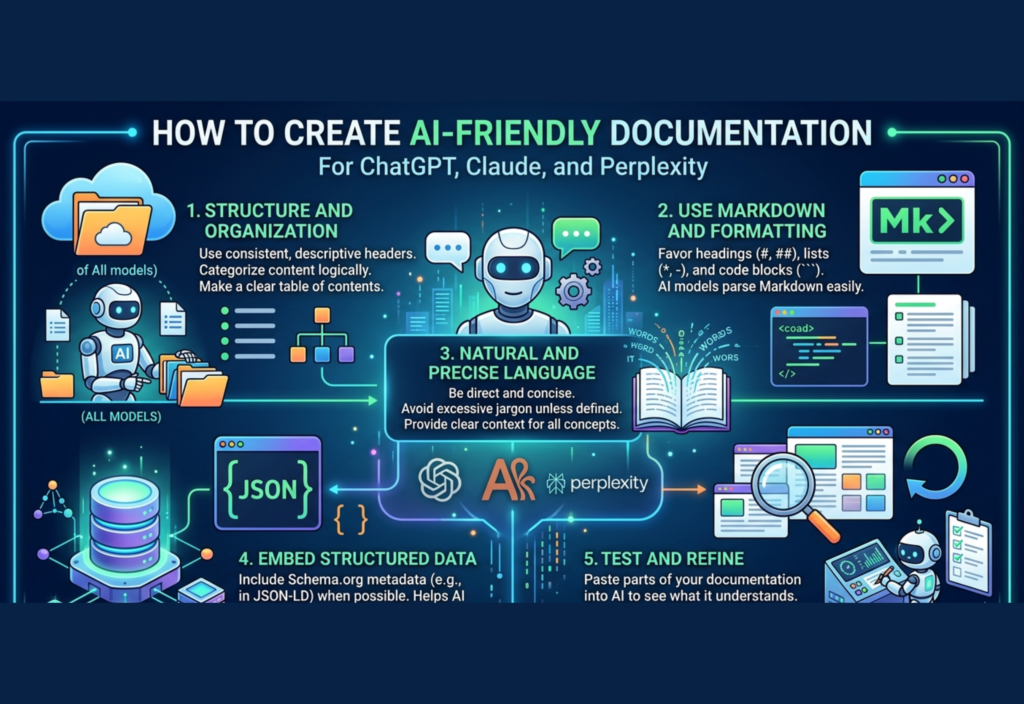
Artificial Intelligence tools such as ChatGPT, Claude, and Perplexity AI are now widely used in education, business, programming, marketing, and research. These tools perform best when the input they receive is clear, structured, and easy to interpret.
This is where AI-friendly documentation becomes important. It is a method of writing content in a way that both humans and AI systems can understand without confusion. In this guide, you will learn how to create professional, plagiarism-free, and highly effective AI-friendly documentation.
Understanding AI-Friendly Documentation
AI-friendly documentation refers to content that is designed with clarity, structure, and simplicity so that AI systems can easily process it.
Unlike traditional writing, AI-friendly content focuses on:
- Logical structure
- Clear instructions
- Simple wording
- Consistent terminology
- Well-defined context
The goal is to reduce ambiguity so that AI models can generate accurate and relevant responses.
Why AI-Friendly Documentation is Important
Modern AI systems rely heavily on patterns, structure, and context. If your documentation is unclear, AI may struggle to interpret it correctly.
Poorly written content can lead to:
- Misinterpretation of instructions
- Incomplete or incorrect responses
- Loss of important context
- Reduced performance of AI tools
On the other hand, well-structured documentation improves:
- Accuracy of AI responses
- Speed of understanding
- Quality of generated output
- User satisfaction
Core Principles of AI-Friendly Documentation
1. Use Simple and Clear Language
One of the most important rules is to avoid unnecessary complexity. Write in a way that is easy to understand for both humans and machines.
Example:
Bad: The application executes advanced computational procedures for data transformation.
Good: The application processes data.
Simple language ensures that AI models correctly interpret meaning without confusion.
2. Maintain Proper Structure
A well-organized structure helps AI understand the hierarchy of information. Always divide your content into clear sections such as:
- Introduction
- Overview
- Features
- Steps or Instructions
- Examples
- Conclusion
This structure helps AI identify relationships between different parts of the content.
3. Keep Paragraphs Short and Focused
Long paragraphs make it difficult for AI to extract key information. Each paragraph should focus on one idea only.
Best practice:
- 2 to 4 lines per paragraph
- One main idea per paragraph
- Avoid unnecessary repetition
This improves readability and processing efficiency.
4. Provide Clear Context
AI systems rely heavily on context. If context is missing, responses may become inaccurate.
Each section should clearly explain:
- What the topic is about
- Why it is important
- How it works
- What the expected outcome is
Clear context reduces misunderstanding and improves response quality.
5. Use Consistent Terminology
Consistency is very important in AI-friendly writing. If you use different words for the same concept, AI may treat them as separate meanings.
Example:
If you choose the word “user”, do not switch between:
- user
- client
- person
- visitor
Stick to one term throughout the document.
6. Include Practical Examples
Examples help both humans and AI systems understand concepts more effectively. They provide real-world context and improve clarity.
Example format:
Input: How to reset a password
Output: Go to settings, select account, and click reset password option
Examples make documentation more actionable and understandable.
7. Use Structured Formatting Techniques
Structured formatting improves readability and AI comprehension.
Recommended formats include:
- Bullet points for listing information
- Numbered steps for instructions
- Tables for comparisons
- Headings for organization
- Subheadings for breakdown of topics
This structure helps AI quickly identify important data points.
Optimizing Documentation for AI Tools
Different AI tools respond better to different writing styles. Understanding these differences can improve your results.
ChatGPT Optimization
ChatGPT works best with:
- Clear instructions
- Step-by-step prompts
- Well-defined context
- Direct questions or commands
The more structured your input, the more accurate the output.
Claude Optimization
Claude is strong in handling long-form content. To optimize for Claude:
- Provide detailed explanations
- Maintain logical flow
- Use structured sections
- Include full context rather than short prompts
It performs well with in-depth documentation.
Perplexity AI Optimization
Perplexity focuses on factual and search-based responses. For better results:
- Use clear and direct questions
- Include factual information
- Avoid unnecessary storytelling
- Keep content concise and informative
It works best with research-oriented content.
SEO Best Practices for AI-Friendly Documentation
To make your documentation effective for both AI systems and search engines, follow these SEO practices:
- Naturally include your main keyword throughout the content
- Use keywords in headings and subheadings
- Avoid keyword stuffing
- Write a clear and informative meta description
- Ensure balance between readability and optimization
Good SEO improves visibility and ranking while maintaining clarity.
Common Mistakes to Avoid
Many people make mistakes that reduce the effectiveness of AI-friendly documentation. Avoid the following:
- Overly complex sentences
- Lack of structure
- Inconsistent terminology
- Missing examples
- Repetitive content
- Unclear instructions
These mistakes can confuse both AI models and human readers.
Best Practices Summary
To create high-quality AI-friendly documentation, always follow these principles:
- Use simple and clear language
- Maintain a structured format
- Keep paragraphs short
- Provide clear context
- Use consistent terminology
- Include practical examples
- Focus on readability and logic
Conclusion
Creating AI-friendly documentation for tools like ChatGPT, Claude, and Perplexity is essential in today’s AI-driven world. Well-structured and clear content improves understanding, enhances AI response accuracy, and increases overall efficiency.
When your documentation is simple, logical, and well-organized, both AI systems and human readers benefit equally. By applying these principles consistently, you can create professional, high-quality, and plagiarism-free documentation that performs effectively across all AI platforms.