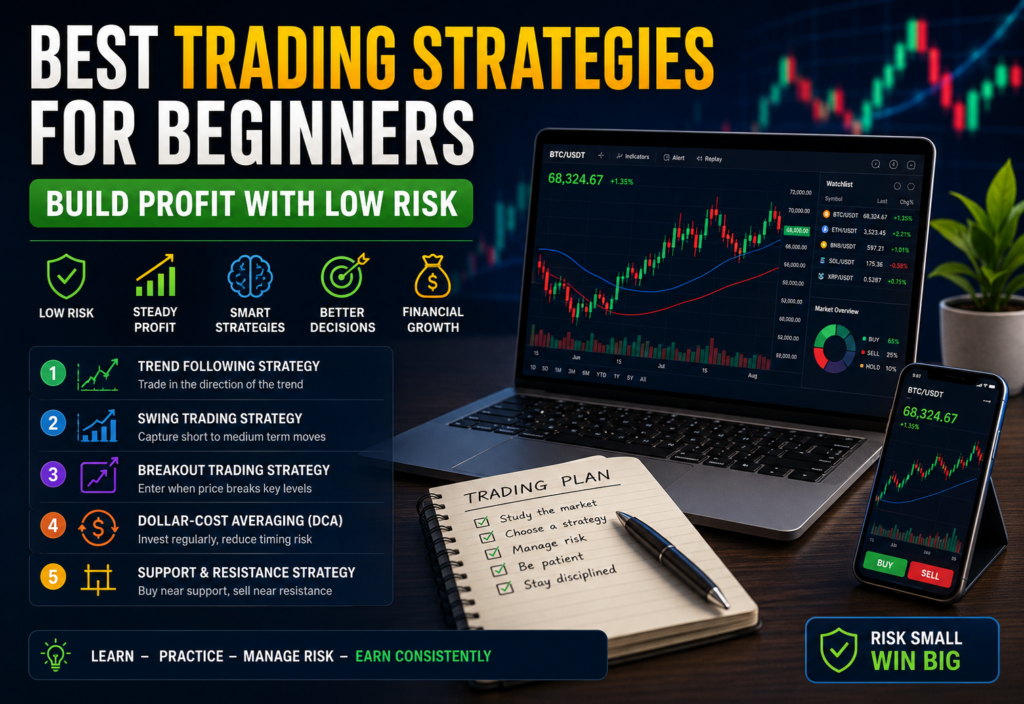
Trading has become one of the most popular ways to earn money online, but it is also one of the most risky if done without proper knowledge. Many new traders enter the market expecting quick profits and end up losing money because they lack planning and discipline. That is why learning best trading strategies for beginners is extremely important before starting real trading.
The main purpose of trading is not to get rich overnight, but to build consistent profits over time while protecting your capital. When beginners understand how the market works and follow a structured approach, they can reduce risk and improve their chances of success.
In this detailed guide, we will explore practical and low-risk trading methods that help beginners trade with confidence and control.
Why Trading Strategy is Important for Beginners
A trading strategy is a clear plan that tells you when to enter, when to exit, and how much risk to take. Without a strategy, trading becomes emotional and unpredictable.
Beginners who follow a proper approach can:
- Reduce unnecessary losses
- Avoid emotional trading decisions
- Improve consistency
- Build long-term discipline
- Protect trading capital
In simple words, a strategy turns trading from guessing into a structured skill.
Top Trading Strategies for Beginners
1. Trend Following Strategy
One of the most reliable approaches for new traders is trend following. This method focuses on trading in the direction of the market trend instead of trying to predict reversals.
How it works:
- If the market is moving upward → look for buying opportunities
- If the market is moving downward → look for selling opportunities
The idea is simple: “The trend is your friend.”
Why beginners prefer it:
- Easy to understand
- Works in all markets (stocks, forex, crypto)
- Reduces emotional pressure
- Helps build confidence
Key advantage:
You are not guessing the market—you are simply following it.
2. Swing Trading Strategy
Swing trading is a popular method where traders hold positions for a few days or weeks to capture price swings.
How it works:
- Buy when price is near a support zone
- Sell when price reaches resistance
What you need:
- Basic chart reading
- Support and resistance knowledge
- Patience
Benefits:
- No need to watch charts all day
- Suitable for part-time traders
- Balanced risk and reward
- Good for beginners who want steady learning
Swing trading is ideal for those who want flexibility and less stress.
3. Breakout Trading Strategy
Breakout trading focuses on entering the market when the price moves outside a strong level of support or resistance.
How it works:
When price breaks a strong level with momentum, it often continues in that direction.
Example:
If a stock stays between $50 and $55 for days and suddenly moves above $55 with volume, it may continue rising.
Benefits:
- Clear entry signals
- Strong profit potential
- Works well in volatile markets
Important tip:
Always wait for confirmation to avoid false breakouts.
4. Dollar-Cost Averaging (DCA)
Dollar-cost averaging is one of the safest methods for beginners because it reduces timing risk.
How it works:
Instead of investing a large amount at once, you invest small fixed amounts regularly.
Example:
Investing $50 or $100 every week regardless of market conditions.
Benefits:
- Reduces impact of market volatility
- Lowers emotional pressure
- Encourages long-term investing
- Very beginner-friendly
This method is widely used in stocks and cryptocurrency investing.
5. Support and Resistance Strategy
Support and resistance are key price levels where markets tend to react repeatedly.
How it works:
- Support = price level where buying pressure increases
- Resistance = price level where selling pressure increases
Strategy:
- Buy near support levels
- Sell near resistance levels
Why it works:
Markets often respect historical price zones because traders react at the same levels.
Benefits:
- Easy to learn
- Highly effective in all markets
- Helps understand market structure
Risk Management for Beginners
No trading method works without proper risk control. Risk management is the most important part of successful trading.
Essential rules:
- Risk only 1%–2% per trade
- Always use stop-loss orders
- Avoid overtrading
- Never use high leverage as a beginner
- Stick to your trading plan
Even the best strategy will fail without proper risk control.
Common Mistakes Beginners Should Avoid
Most beginners lose money due to avoidable mistakes.
Mistakes include:
- Trading without a plan
- Emotional decision-making
- Overtrading the market
- Ignoring stop-loss
- Chasing quick profits
- Using high leverage
Avoiding these mistakes can significantly improve trading results.
Trading Psychology for Beginners
Trading is not just about charts and numbers—it is also about mindset.
Important psychology tips:
- Stay patient during losses
- Do not panic in market fluctuations
- Avoid revenge trading
- Stick to your strategy
- Focus on long-term growth
A calm mind is one of the strongest tools in trading.
Best Markets for Beginners
Beginners can start trading in different financial markets depending on their interest.
Stock Market
- More stable
- Easier to understand
- Good for long-term learning
Forex Market
- High liquidity
- 24-hour market
- Suitable for active trading
Cryptocurrency Market
- High volatility
- High risk and high reward
- Requires careful risk management
Start small in any market and focus on learning first.
Building a Simple Trading Plan
A trading plan helps you stay disciplined and consistent.
A good plan includes:
- Entry rules
- Exit rules
- Risk per trade
- Profit targets
- Trading schedule
- Maximum daily loss limit
Without a plan, trading becomes random and emotional.
Final Thoughts
Trading can be a powerful skill if learned properly. Beginners should focus on learning step by step instead of rushing for profits. The real success in trading comes from patience, discipline, and consistent practice.
By using simple strategies, managing risk carefully, and controlling emotions, anyone can improve their trading performance over time.
The key is to start small, stay consistent, and focus on learning rather than chasing fast money.