AI Agent Testing Framework tools have become extremely important in modern artificial intelligence development. In 2026, AI agents are no longer experimental—they are actively used in real-world applications such as automation, customer support, coding assistance, and data analysis.
However, as these systems grow more powerful, they also become less predictable. For this reason, testing has become a critical step before deploying any AI system into production.
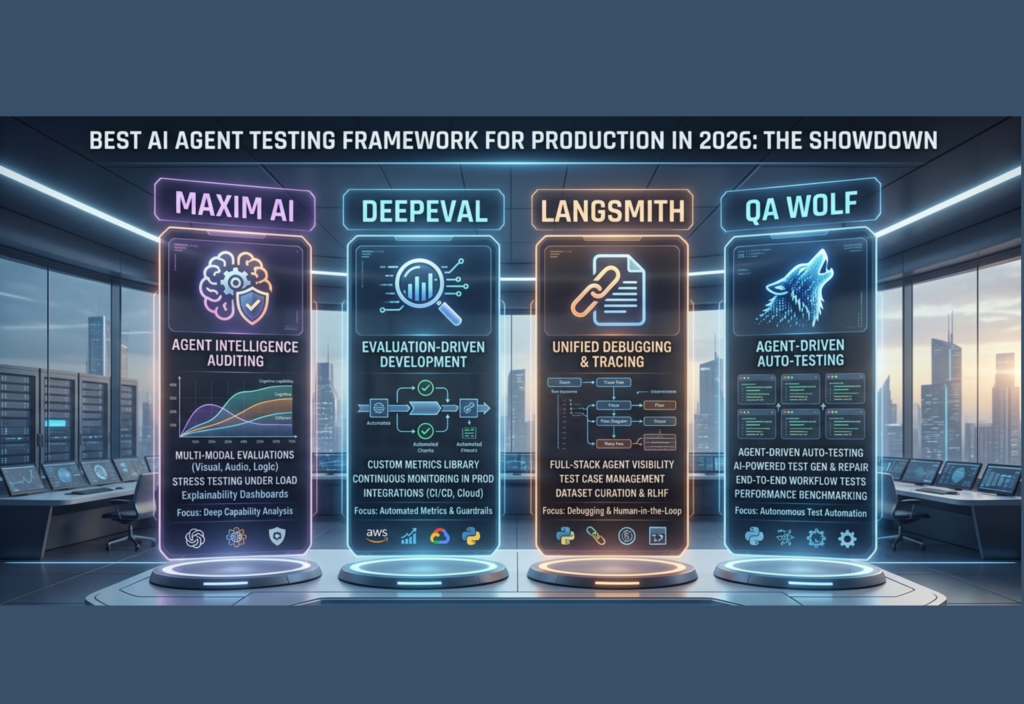
Without proper evaluation, AI agents may generate incorrect answers, behave inconsistently, or even create security risks. Therefore, developers now rely on specialized testing frameworks like Maxim AI, DeepEval, LangSmith, and QA Wolf.
In this article, we will compare these tools and understand which AI Agent Testing Framework works best for production environments in 2026.
Why AI Agent Testing is Becoming Essential
Unlike traditional software, AI systems do not always produce fixed outputs. Instead, they generate responses based on patterns, context, and training data.
Because of this behavior, several challenges can appear in production environments. For example, AI may sometimes give incorrect information or behave differently for the same input. In addition, edge cases can produce unexpected results.
Moreover, security risks such as prompt injection and hallucinations make testing even more important. As a result, companies now invest heavily in AI testing tools to ensure system reliability.
What an AI Agent Testing Framework Actually Does
An AI Agent Testing Framework helps developers evaluate and monitor AI systems in a structured way. Rather than manually checking outputs, these tools automate the testing process.
In most cases, they are used to:
- Evaluate AI-generated responses
- Detect hallucinations and inconsistencies
- Track performance over time
- Run automated test cases
- Compare multiple AI models
Furthermore, these frameworks help teams improve AI quality continuously instead of fixing issues after deployment.
Top AI Agent Testing Tools in 2026
Today, several tools are widely used for AI evaluation and production testing. The most popular ones include:
- Maxim AI
- DeepEval
- LangSmith
- QA Wolf
Each tool focuses on a different part of the AI testing lifecycle.
Maxim AI Overview
Maxim AI is a production-focused AI evaluation and observability platform.
It is designed to help teams continuously monitor AI behavior and improve prompt performance over time.
Key Features:
- Real-time monitoring of AI systems
- Prompt testing and version tracking
- Human feedback collection
- Model comparison tools
- Production analytics dashboard
Because of these features, Maxim AI is often used in live production environments where reliability is a priority.
DeepEval Overview
DeepEval is an open-source framework that gives developers full control over AI testing.
It is especially useful for engineering teams that want to build automated testing pipelines.
Key Features:
- Automated evaluation tests for AI outputs
- Hallucination detection system
- Custom metric creation
- CI/CD integration support
- Code-first testing approach
In addition, DeepEval is highly flexible, which makes it suitable for advanced development workflows.
LangSmith Overview
LangSmith by LangChain is a powerful tool for tracing and debugging AI applications.
It provides deep visibility into how AI agents execute tasks step by step.
Key Features:
- Detailed workflow tracing
- Prompt and model evaluation
- Dataset-based testing
- Debugging complex AI chains
- Strong integration with LangChain
As a result, LangSmith is widely used for complex multi-step AI systems.
QA Wolf Overview
QA Wolf focuses on end-to-end testing for web applications.
Although it is not a pure AI testing framework, it still plays an important role in overall application quality assurance.
Key Features:
- Automated browser testing
- End-to-end workflow validation
- Cloud-based testing infrastructure
- Reduced manual QA workload
Therefore, QA Wolf is more suitable for full application testing rather than AI-specific evaluation.
Comparison of AI Agent Testing Frameworks
| Tool | Best For | Strength |
|---|---|---|
| Maxim AI | Production AI systems | Monitoring and evaluation |
| DeepEval | Developers | Flexible open-source testing |
| LangSmith | AI workflows | Debugging and tracing |
| QA Wolf | Web applications | End-to-end testing |
Each of these tools solves a different problem in the AI development process.
How to Choose the Right Framework
Choosing the right solution depends on your project requirements.
If you need production monitoring and real-time insights, Maxim AI is a strong option.
On the other hand, if you want full control over testing logic, DeepEval works better.
Meanwhile, LangSmith is ideal for developers building complex AI agent workflows.
Similarly, QA Wolf is useful when you need full application-level testing.
In many cases, teams actually combine more than one tool to achieve better coverage.
Final Thoughts
To conclude, AI systems in 2026 are becoming more advanced, but they also require more careful testing. Because of this, AI Agent Testing Framework tools are now essential in modern development workflows.
They help teams improve reliability, reduce risks, and ensure consistent performance in production environments.
Ultimately, selecting the right tool depends on your use case. However, investing in proper AI testing infrastructure is one of the most important decisions for any AI-driven product today.